



Hotel AI assistants are not just chatbots: they need data, context, and workflows
For an AI assistant to be genuinely useful in hotels, homestays, and serviced apartments, teams need PMS data, property context, a knowledge base, and clear operational workflows.

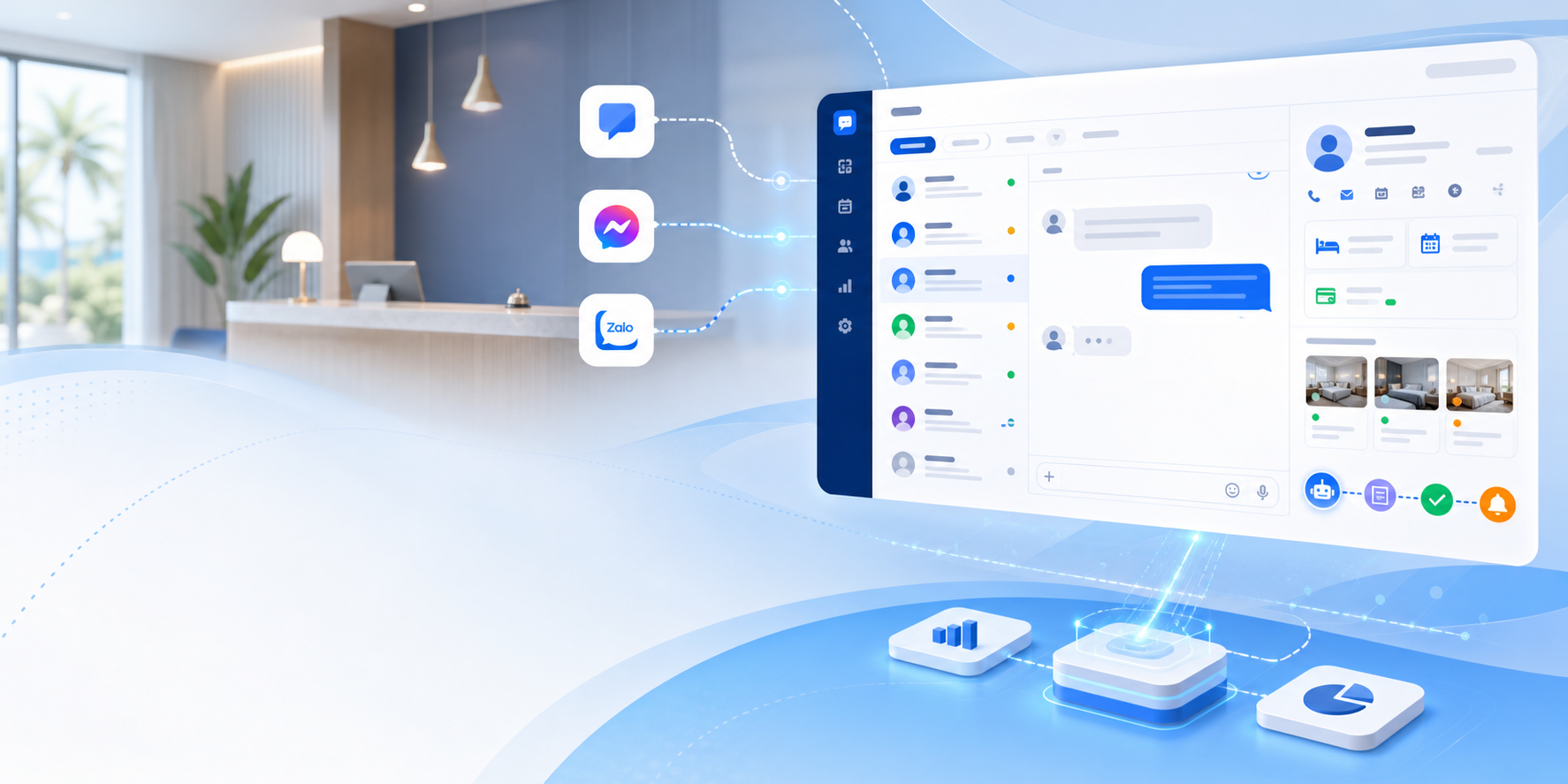
Many hospitality businesses are exploring AI assistants to answer guests automatically, reduce reception workload, and respond faster across websites, Facebook, or Zalo.
But if an AI assistant is treated only as a chatbot for common questions, the business will likely be disappointed. AI can sound more natural than a traditional chatbot, but to answer accurately, safely, and usefully, it needs more than a good prompt.
For hotels, homestays, and serviced apartments, an effective AI assistant needs three foundations: data, context, and workflows.
Required foundation
Why traditional chatbots are often not enough
Guests do not always follow fixed flows. They may ask several things in one message, change their needs mid-conversation, or ask for advice based on a specific context.
Accurate data
Property details, room types, pricing, surcharges, bookings, check-in/check-out, services, and FAQs need structure in the PMS or knowledge base.
Property context
AI must know which branch the guest is asking about because parking, VIP rooms, weekend pricing, and check-in policies may differ.
Conversation workflow
AI needs enough information without annoying the guest, guessing when data is missing, or repeating calls to action too early.
From advisory to operations
AI assistants need PMS and knowledge base connectivity
Controlled PMS connectivity
AI can check availability, today’s bookings, upcoming check-ins, unpaid bookings, room status, revenue, or occupancy.
Easy-to-update knowledge base
Room rates, surcharges, offers, services, branch information, FAQs, and check-in/check-out rules should change without code edits.
Conversation testing
Teams should test pricing, rooms, branches, missing information, multi-intent questions, sensitive data, and out-of-scope cases.
Observability
Operators need visibility into latency, conversation volume, common questions, API/provider errors, token usage, and responses needing review.
Not just a chatbot
When AI connects to the PMS correctly, it is no longer just an advisory chatbot. It becomes an operations assistant that helps reception look up data, lets managers check revenue or occupancy quickly, and creates a path toward automation.
StayLedger AI Assistant
How StayLedger AI Assistant approaches this problem
FlowNexa builds StayLedger AI Assistant as more than a chatbot: it is an AI assistant platform for hospitality operations.
Multichannel
Natural-language guest advisory across websites, Facebook, Zalo, and webhooks.
Property-aware
Knowledge bases, tenant/property context, and data permissions are designed explicitly.
Copilot path
Can connect to PMS data to support staff and managers while tracking quality, latency, and token usage.
If you want to deploy an AI assistant for a hotel or homestay, do not start with “which AI model should we use?”. Better questions are: are room, pricing, and booking data standardized; is there a PMS or central data source; how many properties are involved; what do guests ask most often; what may AI answer; when should it hand off to staff; who reviews and updates the knowledge base.
Hotel AI assistants are not just chatbots. To create real value, AI needs accurate PMS data, clear property context, an editable knowledge base, thoughtful conversation workflows, security controls, and production observability.
FlowNexa can help assess your current data, design AI use cases, build a knowledge base, integrate PMS data, and deploy AI assistants across websites, Facebook, Zalo, or internal channels.


