


Skip to content
FlowNexa
  • AI Services
  • Solutions
  • About
  • Blog
VIEN
Book a consultation
Back to Blog
Business Automation4 min readFlowNexa Editorial Team

After-Hours Missed Calls: How Can You Respond Automatically Without Losing Leads?

Design a flow that captures missed calls, verifies intent, creates leads, prioritizes callbacks, and uses bounded voice AI without frustrating callers.

Aug 16, 2026
After-Hours Missed Calls: How Can You Respond Automatically Without Losing Leads?

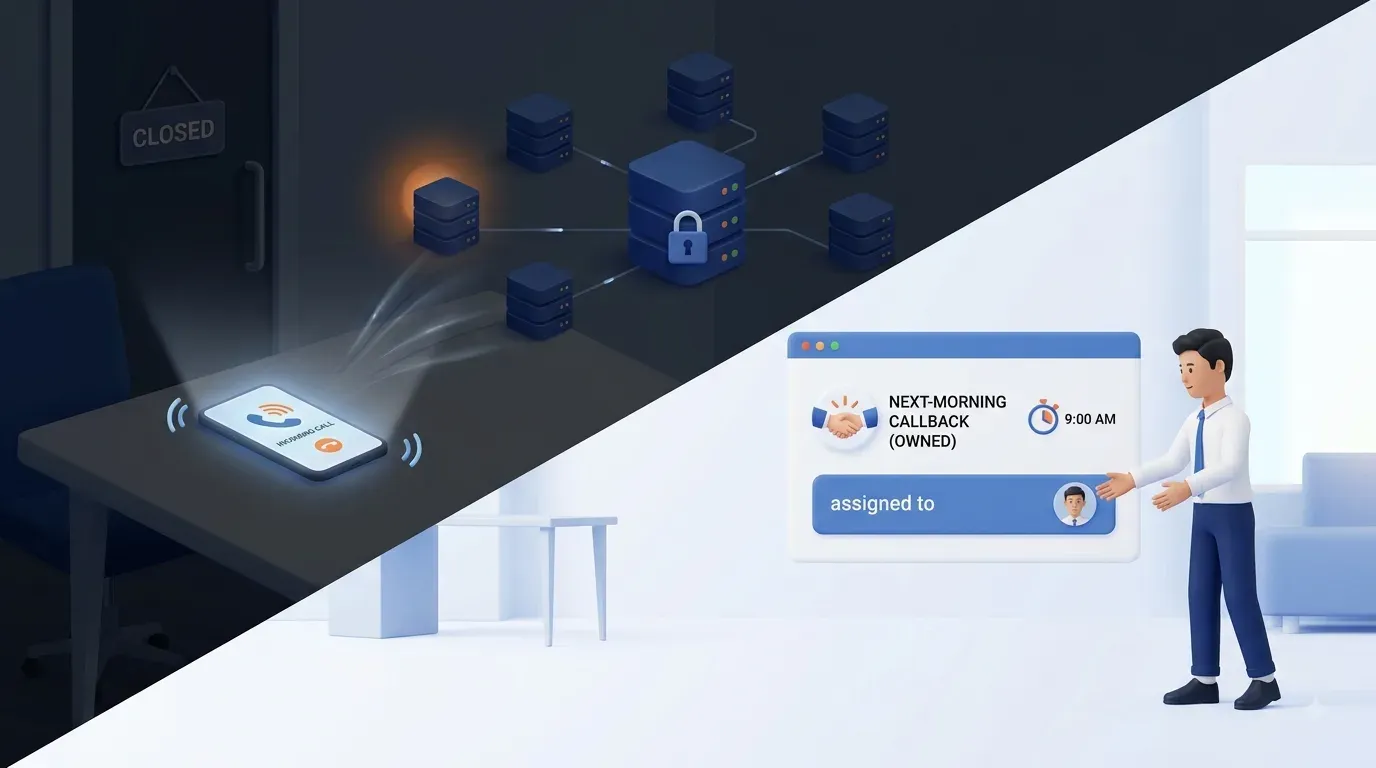
An after-hours missed call should not automatically become a sales campaign. A safe process captures call status from the voice provider, prevents duplicate leads, sends a short acknowledgment when there is an appropriate basis, collects minimal intent, and creates an owned callback task with an SLA. Voice AI should handle a bounded scope—such as intake or scheduling—and transfer to a person when requested, uncertain, or sensitive.

The goal is faster response without pretending that the caller consented to marketing, calling indefinitely, or allowing AI to make unapproved commitments about price, policy, or outcomes.

The gap

Why do missed calls disappear from the pipeline?

A call log does not automatically create a lead, owner, and next action.

Many businesses review phone or contact-center history the next morning. Some staff call back from memory; several may call the same number; spam and existing customers mix with new prospects. When the call sits outside the CRM, Sales cannot see campaign source, appropriate branch, or the last interaction.

Voice platforms can send webhooks for calls and provide states such as answered, busy, no-answer, and completed. Twilio documents HTTP webhooks for incoming calls and status tracking through the Call resource.

The webhook supplies a technical event. The business still defines what qualifies as a lead, duplicate logic, consent, priority, ownership, and closure.

Signals

The missed-call process lacks control

Trace the path from call log to CRM and the actual callback.

No owner

A phone number exists in the log but nobody owns the callback.

Duplicate callback

Multiple representatives create separate activities for one call.

Existing customers look like leads

A customer with an active support case enters a new-sales pipeline.

No final outcome

Connected, rescheduled, invalid, and closed states are not recorded.

Workflow

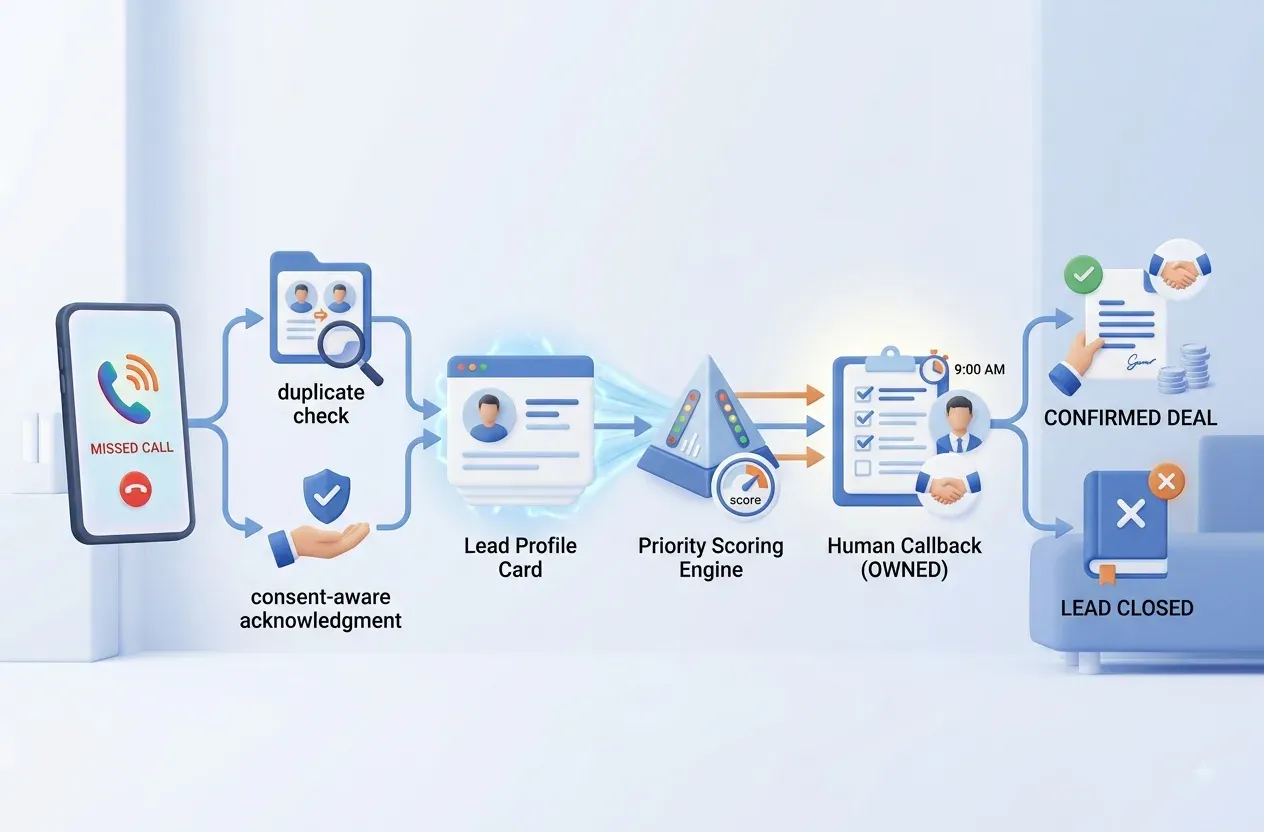
Turn a call event into an accountable callback

Every step needs an identifier, state, and stop condition.

When a status callback arrives, verify the provider signature and record call_id, normalized source number, destination number, time, status, and campaign or branch when available. Use call_id as the idempotency key so repeated callbacks do not create new leads. Look for an existing customer or lead using verified identifiers and a bounded time window, but do not merge identities by name alone.

Route existing customers to their owner or support queue. For a qualifying new number, create a callback_required lead with branch, priority, and callback_due_at. A short acknowledgment may let the caller select intent or a preferred time; do not place them directly into a marketing sequence. If voicemail is available, a transcript may support classification but should link to permitted evidence.

Close the task with an explicit outcome: connected, appointment booked, rescheduled, unreachable after the limit, invalid or spam, or opted out. Retrieve provider logs to reconcile missed events; see Twilio call logs.

Voice AI

AI can answer after hours, but only within clear boundaries

Begin with intake and scheduling, not unrestricted selling.

Voice AI is appropriate when the question scope is narrow, source data is controlled, and the caller can always reach a person. The agent should identify itself as automated, request recording consent where applicable, verify identity before disclosing private information, and never request secrets such as passwords or one-time codes.

Define an action allowlist: capture name and intent, answer business hours, create a callback request, or book an available slot. Block or require approval for special pricing, refunds, contract changes, health information, disputes, and legal commitments. Limit duration, confirmation attempts, and callback attempts.

Retain transcripts for the minimum necessary period, redact sensitive data, and support deletion according to policy. Measure false transfers, incorrect intent, abandoned calls, and complaints—not only the number of calls handled by AI.

KPIs

Measure recovered opportunities without frustrating callers

Track speed, outcomes, and negative signals together.

Capture rate

Valid no-answer calls converted into owned records.

Callback SLA

Callbacks completed within the promised time.

Connection rate

Successful callback connections by time window and source.

Opt-out and complaints

Rejections or complaints caused by inappropriate contact.

FAQ

Frequently asked questions about missed-call automation

Automate the response, not assumptions about caller intent.

Should every missed call receive an immediate message?

No. Exclude spam, extremely short calls, blocked numbers, and cases without an appropriate contact basis. Apply frequency limits.

How many leads should repeated calls from one number create?

Usually one open lead or case, with individual calls recorded as activities. Deduplicate by customer, intent, and time window.

May a voice agent provide prices?

Only approved list prices governed by explicit rules. Custom quotations and special terms should transfer to Sales.

What if the voice provider misses a callback event?

Periodically reconcile provider call logs with internal records to detect missing events.

FlowNexa

Turn a missed call into an owned callback

FlowNexa can help connect call events to CRM and design practical SLAs, deduplication, routing, and voice-AI boundaries.

Pilot after hours

Start with one hotline, one branch, and one intent category.

Preserve human handoff

Every caller has a path to a person and a way to stop contact.

Read next

Related insights

Operations Automation

Multichannel Orders and Inventory: How Do You Prevent Overselling?

Design a central inventory authority, reservation ledger, idempotency, event synchronization, and reconciliation to prevent overselling.

AI Automation

AI Misreads an Invoice: What Controls Are Needed Before Accounting?

Design invoice processing with field-level confidence, business validation, reconciliation, risk-based review, and posting gates.

Data Governance

Duplicate Customers in CRM: How Do You Merge Without Combining the Wrong People?

Design duplicate detection with identity keys, confidence, review queues, merge policy, and recovery controls.

FlowNexa

FlowNexa helps small and mid-sized businesses bring AI into customer service, workflow automation, and efficient data operations. Cloud-native and DevSecOps provide the foundation that keeps these solutions secure, reliable, and easy to scale.

FLOWNEXA COMPANY LIMITED

Tax ID: 0319612776

Address: 228/6 Au Duong Lan, Chanh Hung Ward, Ho Chi Minh City, Vietnam

Website: flownexa.ai

Services

AI chatbots & supportAI assistantsAutomationCloud & infrastructure

Company

AboutBlogPrivacyTerms

Contact

hello@flownexa.ai
0948 279 029
Chat on Zalo
Chat on Messenger
Replies within one business day

© 2026 FlowNexa. All rights reserved.

Microsoft, Azure, Microsoft 365, AWS, Kubernetes, and Cloudflare are trademarks of their respective owners. FlowNexa is not claiming partnership unless expressly stated.

B2B service website — no online ordering or online payment.

Practical AI · Automation · Secure CloudPrivacyTermsCookiesLegal
Share:
FacebookZaloLinkedIn
Share:
FacebookZaloLinkedIn