


Multichannel Orders and Inventory: How Do You Prevent Overselling?
Design a central inventory authority, reservation ledger, idempotency, event synchronization, and reconciliation to prevent overselling.

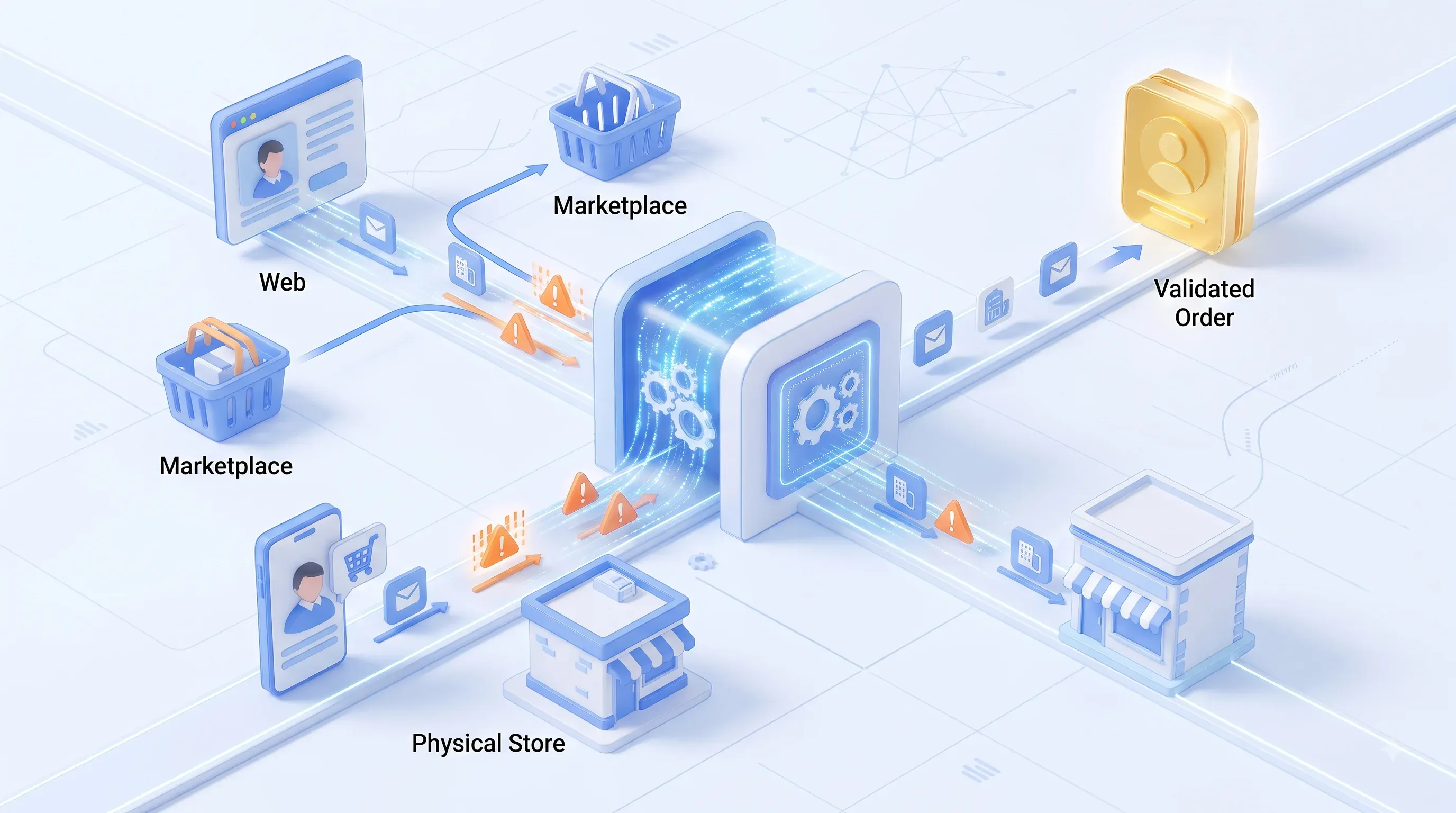
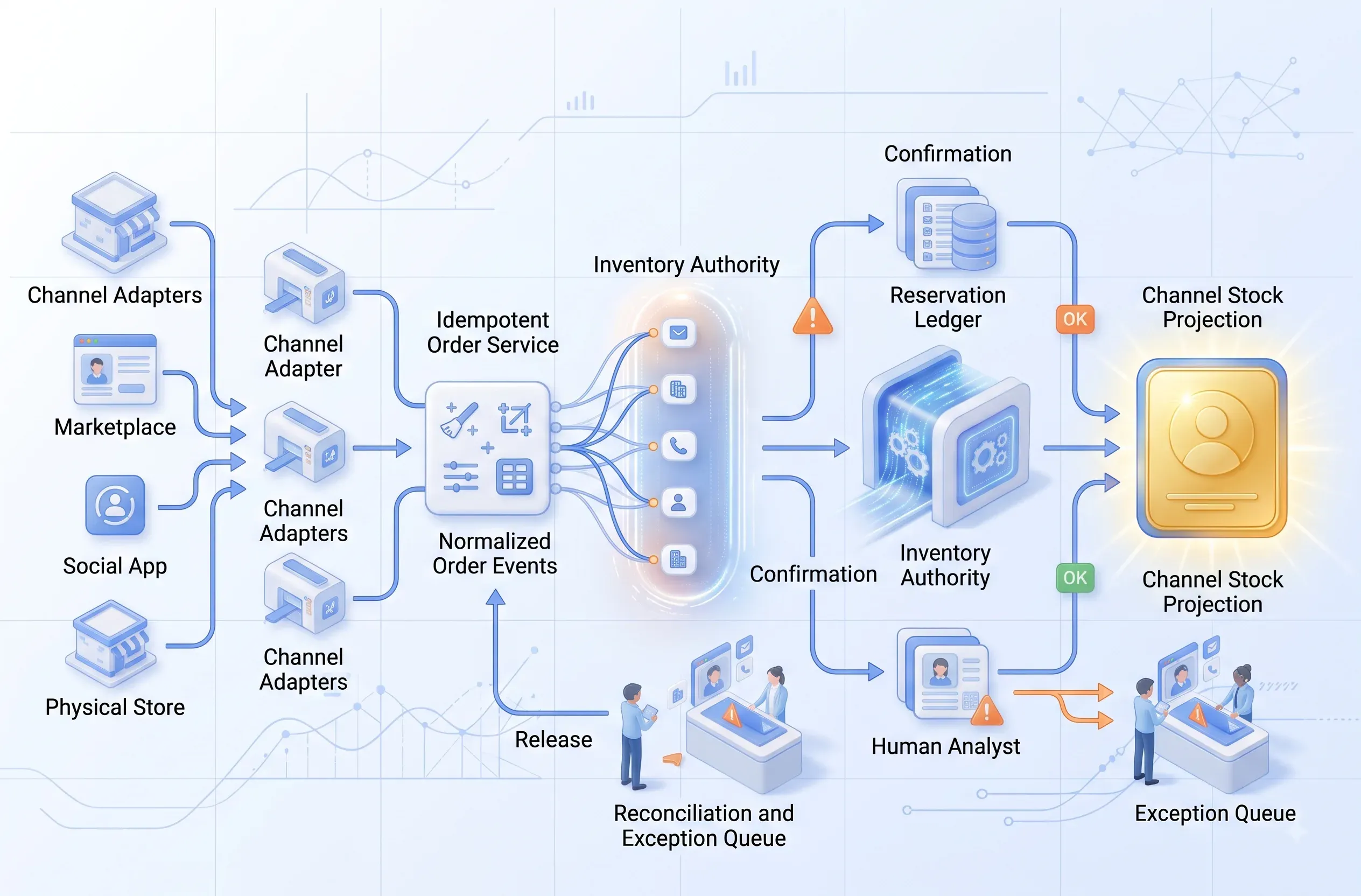
To prevent overselling across web, marketplaces, social commerce, and stores, the business needs one authoritative inventory source and a reservation mechanism. Every order reserves stock through an atomic or concurrency-controlled operation before customer confirmation. Channels receive projected availability; none treats its local copy as final truth.
Webhooks and near-real-time synchronization still have delay, duplication, and ordering problems. The architecture therefore needs idempotency, pending, confirmed, and released states, safety stock, and reconciliation. Updating quantities faster without a reservation ledger only makes overselling less frequent; it does not remove the race condition.
Race condition
How can two channels sell the last item?
Reading inventory and decrementing inventory are two different moments.
The website and marketplace both read available = 1. Each displays stock, accepts checkout, and sends an event later. Without concurrency control around read–modify–write, both orders succeed. Similar divergence occurs when cancellation does not release a reservation, returns are counted before inspection, or stores sell offline during an outage.
Inventory has multiple states: on-hand, available, committed, incoming, damaged, and safety stock. Shopify InventoryLevel models item quantities per location with states including available, on-hand, incoming, and committed; see InventoryLevel.
The organization must define each state and the sellable-quantity formula. If channels calculate availability differently, synchronizing the same raw number is still incorrect.
Signals
The system synchronizes numbers but does not govern inventory
Inspect both transactions and reconciliation.
Negative inventory
An order confirms after available stock reached zero.
Cancellation does not return stock
Reservation or committed quantity remains locked.
One event applied twice
Webhook retry decrements stock or creates another order.
Location divergence
Total stock exists, but the fulfillment location is empty.
Architecture
Use an inventory authority and reservation ledger
Confirm an order only after reservation succeeds.
Each channel adapter maps orders into a common schema containing channel, external_order_id, items, quantities, preferred location, and event version. The order service uses (channel, external_order_id) as an idempotency key. The inventory service is the only authority that changes committed and available stock, reserving through an atomic conditional update or compare-and-set.
A reservation has ID, order ID, SKU, location, quantity, expiry, and state. When payment or another confirmation condition succeeds, it becomes committed or allocated. Timeout, payment failure, or cancellation releases it idempotently. Channel and location safety stock may differ but remains centrally governed.
Inventory adjustments need reasons and references for audit. Shopify inventoryAdjustQuantities applies deltas by location, returns an adjustment group, and supports idempotency in current API versions; see inventory adjustment. The design principle applies beyond Shopify.

Reliability
Assume webhooks can repeat, arrive late, or become temporarily unavailable
Event delivery is not a perfect distributed transaction.
Verify webhook authenticity, retain event IDs and raw payloads according to policy, acknowledge quickly, and process through a queue. Consumers must be idempotent and compare event version or source time before applying a change. Receipt order is not necessarily business order. An incomplete event should trigger an API fetch or dependency wait, not an invented state.
Use an outbox for events emitted after internal transactions so database commit cannot succeed while message publication disappears. During channel outages, limit sales through projected availability and a safety buffer. After recovery, replay events and reconcile. Shopify exposes resource webhooks, while the consumer remains responsible for lifecycle and errors; see Shopify webhooks.
Reconciliation compares orders, reservations, inventory state, and fulfillment using a watermark. Mismatches enter a repair queue; auto-repair only deterministic, idempotent cases with a post-repair assertion.
KPIs
Measure inventory correctness and customer outcomes
Low latency with high overselling is still failure.
Oversell rate
Confirmed orders that cannot be fulfilled because stock is unavailable.
Reservation expiry
Expired reservations not released at the expected time.
Inventory divergence
SKU-location differences between authority and channel beyond tolerance.
Reconciliation lag
Time from mismatch to detection and repair.
FAQ
Frequently asked questions about multichannel inventory
Choose appropriate consistency while preserving one source of truth.
Must synchronization be perfectly real time?
Not always. The authority needs atomic reservation, while channels need sufficiently fresh projections and safety buffers.
Can database locks solve the problem?
Within one database, yes. Distributed systems usually require conditional writes, versioning, or a dedicated inventory service.
When should a reservation be released?
On payment timeout, abandoned checkout, cancellation, or another defined rule. Release must be idempotent and audited.
Should each channel receive separate inventory?
Allocation quotas are possible, but they still need central governance, controlled reallocation, and reconciliation.
FlowNexa
Synchronize orders around one inventory authority
FlowNexa can help design the common order schema, reservation ledger, idempotent workflows, and reconciliation dashboards for existing channels.
Pilot high-risk SKUs
Start with fast-moving or low-stock products.
Measure before expansion
Track overselling, divergence, and repair backlog by channel.