



AI workflow failure: how do you know whether the model, prompt, data, or API is at fault?
A production diagnostic playbook using traces, replay, and one-variable tests to separate model, prompt, data, API, and orchestration failures.

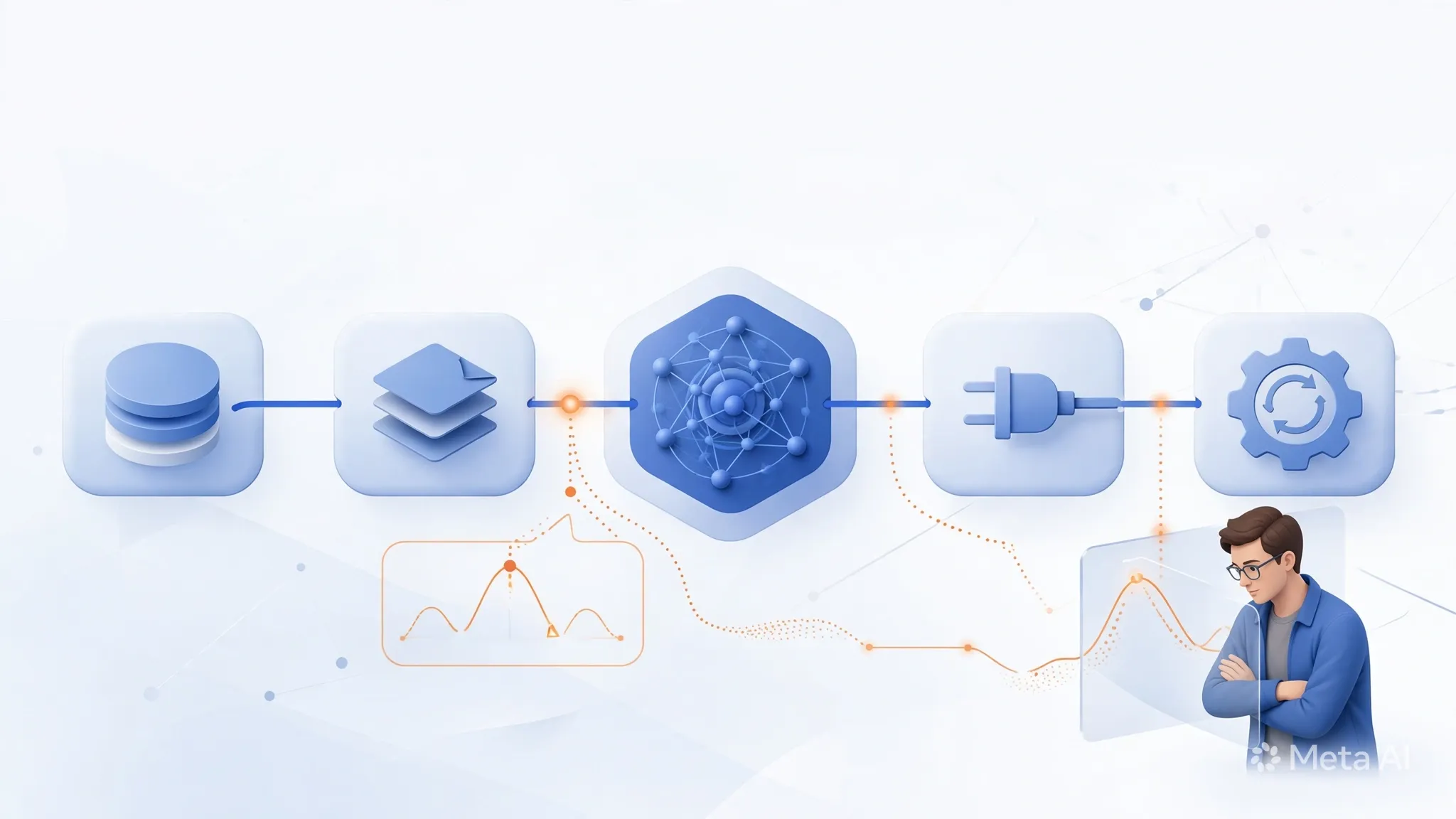
To determine whether an AI workflow failed because of the model, prompt, data, or API, do not begin by switching models or rewriting the prompt. Preserve one reproducible execution, split its trace into layers, and change exactly one variable per replay. If the request never reached the model, the model is not the cause. If the model returned the right result but parsing or the destination API failed, prompt work will not solve the incident.
A reliable diagnostic process has four steps: locate the first failure → distinguish technical failure from quality failure → replay a frozen input → run controlled tests for each hypothesis. Production also needs a fifth category beyond the four in the question: workflow orchestration and state. Mapping, branching, queues, timeouts, retries, parsers, and state persistence can break a run even when both the model and APIs behave correctly.
Error taxonomy
Define failure by layer before investigating
An HTTP 500, schema-invalid JSON, and a low-quality answer are different incidents.
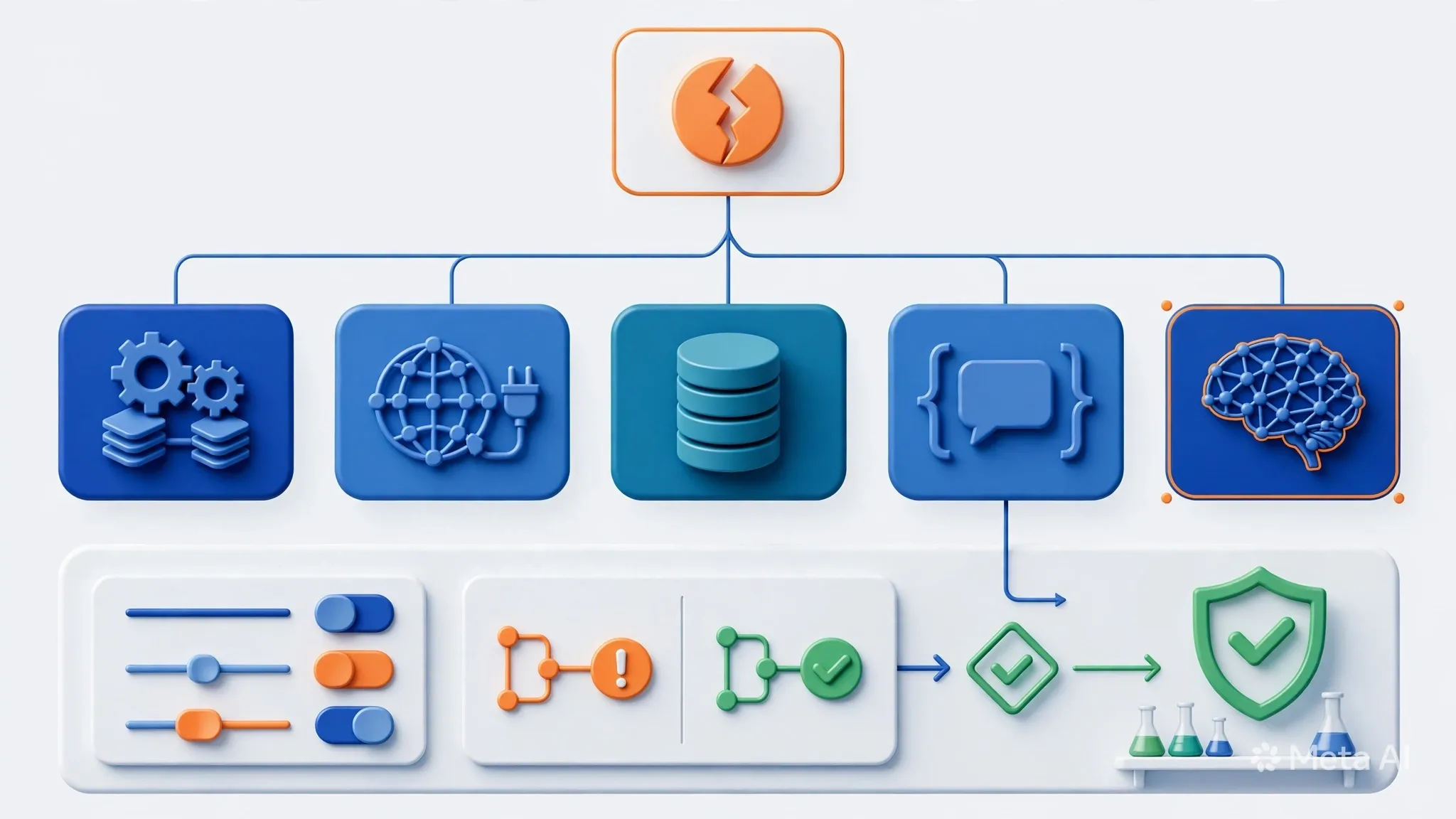
An operational taxonomy should include at least five groups:
- Orchestration: the workflow takes the wrong path; an expression fails, items disappear during a merge, a parser throws, queue time grows, state transitions incorrectly, or retries duplicate an outcome.
- API/provider: DNS, TLS, authentication, quota, rate limits, timeouts, 4xx/5xx responses, empty bodies, or a changed provider contract. This includes the model API and external tool APIs.
- Data/context: missing fields, wrong types or encoding, oversized input, irrelevant retrieval, stale data, OCR defects, an incorrect tenant filter, or truncated context.
- Prompt/contract: ambiguous or conflicting instructions, missing examples, an unclear output schema, overlapping tool descriptions, or a prompt version that no longer matches downstream processing.
- Model: insufficient capability for the task, unstable format compliance, incorrect tool selection despite a clear candidate set, or quality regression after a model/version change.
One run can contain several cascading failures. The root cause is the first incorrect event that created the chain, not necessarily the final red node.
Triage signals
Which signals point to each cause?
Use evidence at every boundary rather than inferring from the final error message.
| Observed signal | First suspicion | What to inspect |
|---|---|---|
| Request never leaves the workflow or takes the wrong branch | Orchestration | Per-node input/output, expressions, state transitions, queue, timeout |
| 401/403 | Credentials, scope, or policy | Secret version, audience, token expiry, resource permissions |
| 429 or traffic-correlated latency | Provider/API capacity | Rate-limit headers, retry-after, concurrency, quota, backoff |
| 400/422 | Request contract | Endpoint, model name, schema, field types, payload size |
Model returns 200, but output cannot be parsed | Prompt/schema or parser | Raw response, finish reason, structured-output contract, truncation |
| Failure affects one customer or document segment | Data/context | Tenant, locale, encoding, missing fields, retrieval result |
| Same input and prompt consistently perform better on a control model | Model capability/version | Evaluation set, model/deployment ID, repeated control runs |
| Model output is correct, but the final action is wrong | Mapping, business rule, or API/tool | Arguments before/after transforms, authorization, API response |
These signals start an investigation; they do not prove causality. A model API 400 may originate from orchestration that built an invalid payload. Invalid output may result from truncated context rather than a weak prompt.
Diagnostic flow
Locate the first failure in a deterministic order
Check transport and contracts before investigating probabilistic quality.
Use this order for each incident:
- Did the execution start and take the expected branch? If not, investigate the trigger, filters, expressions, queue, and state.
- Did every external call complete technically? Capture status and error codes, latency, attempt, timeout, and provider request ID.
- Did the payload satisfy its contract? Validate schemas before and after each transformation; retain an input hash/version instead of relying on the UI.
- Did the model receive the intended prompt and context? Check prompt version, model/deployment, system instructions, tool definitions, token usage, finish reason, and the retrieval documents actually inserted.
- Did the raw model output satisfy the contract? Separate parsing/schema validation from content evaluation.
- Did downstream processing use the output correctly? Compare model output with the tool/API payload and read back the destination postcondition.
- If technical checks pass, does quality meet the rubric? Evaluate correctness, relevance, groundedness, or a business-specific rule.
Preserve raw evidence under controlled access. A screenshot of one node rarely proves that data remained unchanged across transformations.

Observability contract
A trace must answer which version, which data, and where the failure began
Without provenance, teams cannot replay an incident or attribute it accurately.
Every execution needs an end-to-end trace_id and spans for the trigger, transforms, retrieval, model call, tool/API calls, validation, and persistence. AWS recommends structured logs with correlation identifiers and layer-specific metrics. OpenTelemetry defines GenAI attributes for provider, requested and returned model, token usage, finish reasons, tool calls, and retrieval documents.
At minimum, record workflow_version, node_version, prompt_version, model_requested, model_returned, provider/deployment/region, input schema version, input hash, retrieval document IDs and scores, tool schema version, attempt, timeout, status/error code, latency, token usage, output schema result, and business postcondition. Retain the provider request ID and relevant rate-limit headers for external calls.
Do not log complete prompts, outputs, tool arguments, or documents by default. OpenTelemetry warns that these fields can contain PII or sensitive data. Apply allowlisting, redaction/tokenization, encryption, RBAC, short retention, and access auditing. For replay, use sanitized snapshots or a protected evidence store rather than casually copying production data into test environments.
Controlled replay
Change one variable to distinguish model, prompt, and data failures
A diagnostic A/B test is meaningful only when all other variables stay fixed.
Turn the failed execution into an immutable test case containing normalized input, a context/retrieval snapshot, prompt version, tool definitions, expected schema, and expected business outcome. Then run this matrix:
- Baseline replay: same model, prompt, data snapshot, and mocked APIs. If the failure does not recur, inspect nondeterminism, provider versions, caching, and external state.
- Prompt test: hold the model and data constant; use only the candidate prompt. The prompt hypothesis strengthens when many cases improve without regressions.
- Model test: hold prompt and data constant; switch to a control model. One better response is insufficient—compare an evaluation set against a rubric.
- Data test: hold model and prompt constant; replace the defective input with a golden input or repair exactly one defect. If output recovers, focus on ingestion, validation, or retrieval.
- API isolation: replace the real API/tool with a stub that has a known response; then send the recorded payload to the API sandbox. This separates payload construction from destination-system behavior.
Never replay side-effect actions directly in production. Use read-only mode, dry-run, sandbox, stubs, or idempotency keys. If verification is unavoidable, isolate the resource scope and define postconditions first.
Root-cause playbook
Fix the proven layer, not the most visible symptom
Each cause requires different controls and ownership.
For orchestration: add schema gates between nodes, explicit state machines, timeout budgets, idempotency, bounded retries, a DLQ, and reconciliation. Avoid continue on fail patterns that suppress an error while forwarding corrupt state.
For APIs/providers: classify retryable versus permanent errors by code; respect Retry-After; use exponential backoff with jitter, circuit breakers, quota alerts, and fallback only when semantic contracts are equivalent. Authentication and schema errors should not be retried blindly.
For data/context: validate required fields, types, encoding, size, tenant, and freshness at ingestion; preserve lineage; measure retrieval hit rate, relevance, and empty-context rate; quarantine abnormal input.
For prompts/contracts: version prompts like code; separate instructions from untrusted data; use structured outputs/schema; add examples and negative cases; run regression evaluations before rollout. Do not patch every incident into an ever-growing list of prompt exceptions.
For models: prove the hypothesis with representative evaluations; inspect model/version drift, context limits, modalities, latency, and cost. Switch only when the candidate passes quality and operational gates. Canary model changes and retain deployment rollback.
Prevention
Turn each incident into a regression test and layer-specific SLO
A fix matters only when the same failure cannot return silently.
Every confirmed incident should create at least one regression case with sanitized input, expected branch, expected tool/API call, output schema, and business outcome. n8n can load execution data from a previous run for debugging, while data pinning and mocking freeze development inputs. For AI workflows, n8n recommends evaluations instead of relying on a few manually inspected examples.
Dashboards should separate technical reliability from AI quality. Technical metrics include workflow success, node errors, API 4xx/5xx/429, timeouts, queue wait, retries, and p95 latency. AI metrics include schema-valid rate, task success, rubric-based correctness or groundedness, no-answer/clarification rate, tool selection, and postcondition success. Segment by workflow, prompt, model, data source, tenant/use case, and deployment version so averages do not hide regressions.
Establish a change gate: new prompts, models, tools, and schemas proceed to canary only after evaluations pass; automatically roll back or stop expansion when error budgets or quality thresholds are breached. A single “workflow success” SLO is insufficient: API 200 does not prove the answer is correct, and a correct answer does not prove the side effect completed.
A practical n8n implementation
- Attach
trace_id,workflow_version, andinput_hashimmediately after the trigger and propagate them through every sub-workflow. - Before the AI node, record prompt/model/tool/schema versions and validate normalized input.
- After the AI node, retain technical metadata and raw responses according to policy; run parsing and schema validation in a separate node.
- Wrap each HTTP/tool call in a normalized error envelope:
layer,code,retryable,attempt,provider_request_id, andsafe_message. - Use an Error Workflow to send the incident envelope to the tracking system; never forward credentials, raw PII, or entire prompts through Slack or email.
- For a failed execution, copy data into a test workflow, pin and mask the input, stub side-effect APIs, and replay with the one-variable matrix.
- Split dashboards by stage: ingestion, retrieval, model, validation, action, and verification.
- After a fix, add the case to the evaluation dataset and CI gate before activating the new version.
An incident envelope should answer: which run; where the first failure occurred; which input, prompt, model, and tool versions were involved; whether it reproduced; which hypotheses were eliminated; what changed; and which regression test now protects the workflow. This reduces diagnosis time without turning logs into a sensitive-data warehouse.
Frequently asked questions
FAQ about diagnosing AI workflows
Practical questions when a workflow is intermittent or only reports an error at its final node.
Does one incorrect response prove that the model is weak?
No. Keep prompt and data constant, run a representative evaluation set, and compare a control model. Context, truncation, sampling, or external state may explain one failure.
Can an HTTP 200 response rule out an API failure?
No. The body may violate the contract, be empty, or represent an unfinished asynchronous operation. Validate the response and verify the destination postcondition.
Should we log every prompt and output for debugging?
Not by default. Apply policy, redaction, encryption, RBAC, and suitable retention; prefer hashes, versions, metadata, and sanitized snapshots.
When should an AI node be retried?
Retry transient failures such as timeouts, 429s, or selected 5xx responses under policy. Do not blindly retry authentication, invalid-request, schema, or content-quality failures.
How do you debug a failure that will not reproduce?
Inspect model/provider versions, retrieval snapshots, cache, timestamps, tenant state, and external API responses. Improve provenance so the next incident can freeze every decision input.
FlowNexa perspective
Build AI workflows that can be observed, replayed, and verified
FlowNexa can help standardize telemetry, error taxonomies, evaluation datasets, and runbooks so operations teams identify the correct failure layer before changing production.
Expected deliverables
Trace schema, incident envelope, replay harness, test matrix, layer-specific dashboards, SLOs, regression suite, and rollback gates.
Closing principle
Do not fix the final red node; locate the first incorrect event and prove root cause with a controlled experiment.


