


AWS, Azure, VPS or On-Premises: What Should Vietnamese SMEs Choose?
A practical comparison of AWS, Azure, VPS and on-premises infrastructure across total cost, security, scalability and operations—so Vietnamese SMEs choose for fit, not headline price.


An SME runs its accounting tool, website, sales application and customer data on a USD 40-per-month VPS. Everything looks fine until the disk fails, nobody has ever tested a restore, and the only person who knows the server credentials is unavailable. Another company moves every workload to public cloud, only to watch its bill grow because resources sit idle, logs are retained indefinitely and nobody owns FinOps.
The short answer: there is no universally best option for SMEs. A VPS often fits small, straightforward workloads and constrained budgets. AWS fits businesses that need a broad service ecosystem, deep automation and global scale. Azure is often attractive when the business already relies on Microsoft 365, Windows Server, SQL Server or centralized identity. On-premises infrastructure makes sense when systems depend on local equipment, require very low LAN latency, face specific data constraints or are supported by a capable operations team. For many SMEs, the practical answer is a staged combination: start simple, isolate backups from production, establish a security baseline and migrate only workloads with a clear business case.
Analysis
Do not start with a vendor name
Start with the workload, the importance of its data and the company's ability to operate it.
A sound infrastructure decision should answer at least eight questions:
- What does the business lose if the system is unavailable for two hours?
- What recovery point objective and recovery time objective are acceptable?
- Must data stay in a particular location or connect to on-site equipment?
- Is traffic steady, seasonal or campaign-driven?
- Can the team handle patching, on-call work, restore tests and incidents?
- Does the system need managed databases, object storage, queues, CDN or AI services?
- Is the priority low initial spend or three-year total cost?
- Will the company expand into more branches, markets or products?
Without these answers, AWS-versus-Azure debates are usually brand debates rather than architecture decisions.
Analysis
Understand the four operating models
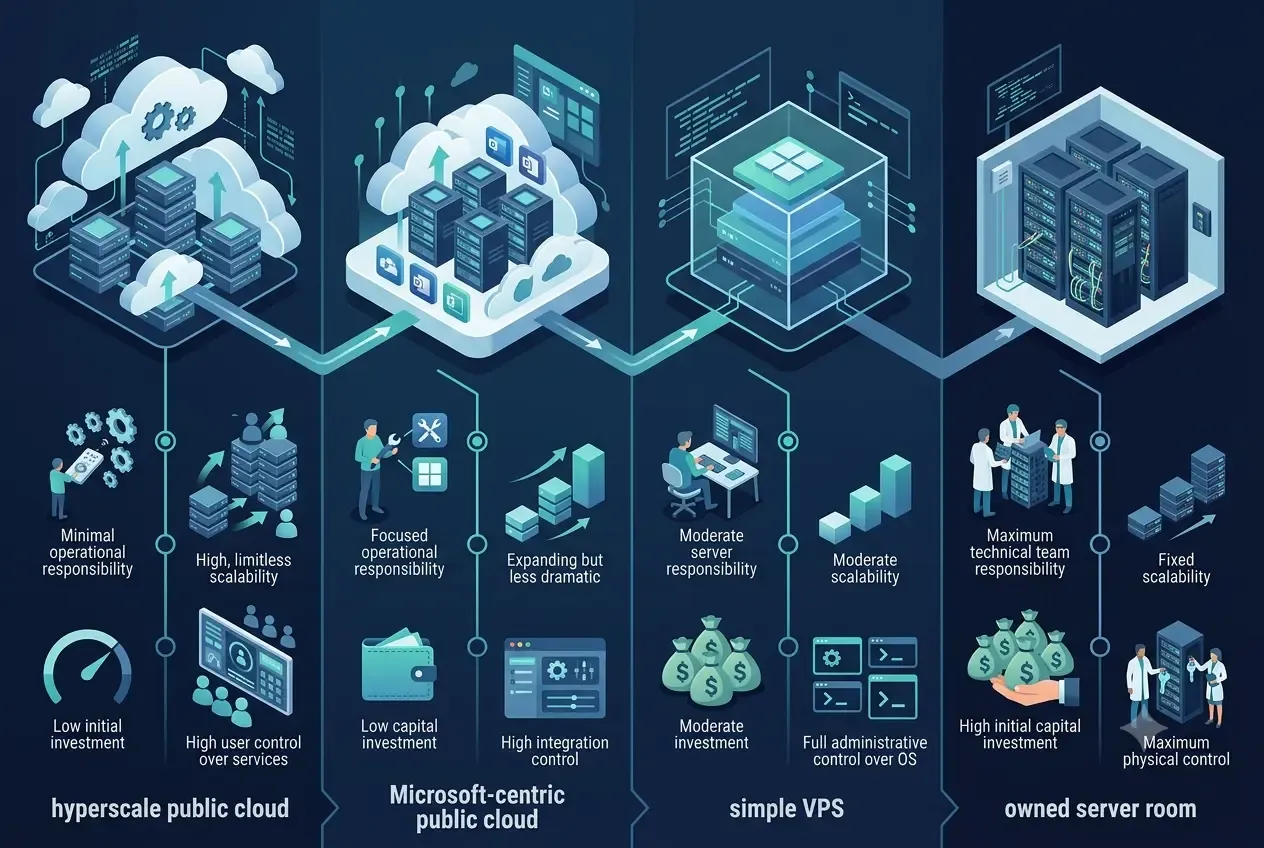
The main differences are flexibility, control and how much operational responsibility the business retains.
FlowNexa Cloud Assessment
AWS: strong when a product needs scale and deep automation
Start with operational evidence instead of choosing a platform by assumption.
Recommendation
AWS offers a broad ecosystem across compute, databases, storage, networking, security, analytics and AI. It is a strong candidate for SaaS, e-commerce, multi-region systems and workloads built around Infrastructure as Code and autoscaling. The breadth also creates complexity. SMEs still have to design IAM, networking, backup, logging, monitoring and cost controls; moving to AWS does not automatically make a system secure or highly available.
Practical guidance
Azure: strong in Microsoft-centric and hybrid environments
A key consideration when selecting and operating infrastructure.
Recommendation
Azure deserves a close look when the business depends on Microsoft Entra ID, Microsoft 365, Windows Server, SQL Server, .NET or connections between office systems and cloud services. Identity, RBAC and centralized management can reduce organizational friction. Governance is still required for subscriptions, resource groups, policies, networks and budgets; integration advantages do not eliminate architectural responsibility.
Practical guidance
VPS: strong when simplicity and predictable entry cost matter
A key consideration when selecting and operating infrastructure.
Recommendation
One or a few VPS instances can run a website, API, workers and a small database with a clear initial price. This model fits MVPs, corporate websites, internal applications and steady workloads that do not yet require many managed services. The trade-off is responsibility: operating-system patches, firewalling, databases, backups, failover and recovery often fall to the customer. Putting everything on one host turns a cheap VPS into an expensive single point of failure.
Practical guidance
On-premises: appropriate when there is a specific technical or regulatory reason
A key consideration when selecting and operating infrastructure.
Recommendation
Servers in an office, factory or private data center can fit equipment-control systems, cameras, high-volume LAN file access, difficult legacy applications or special data requirements. The business gains hardware control but takes on capital investment, power, connectivity, UPS, cooling, warranty, spares, physical security, redundancy and staffing. A server in an office is not equivalent to a data center.

Analysis
A decision matrix for Vietnamese SMEs
This is a starting point. The final answer must be based on the actual workload and business requirements.
| Criterion | AWS | Azure | VPS | On-premises |
|---|---|---|---|---|
| Fast provisioning | High | High | Very high | Low |
| Upfront cost | Low | Low | Low | High |
| Scalability | Very high | Very high | Medium | Low to medium |
| Managed services | Very broad | Very broad | Limited | Built by the business |
| Microsoft integration | Good | Very good | Configuration-dependent | System-dependent |
| Hardware control | Low | Low | Low | Very high |
| Operational burden | Medium | Medium | Medium to high | Very high |
| Bill predictability | Medium | Medium | High | Medium after investment |
| Multi-region and DR | Strong, but must be designed | Strong, but must be designed | More difficult | Expensive |
| Best fit | SaaS, scale, cloud-native | Microsoft, hybrid, enterprise identity | Small apps, websites, MVPs | Local equipment, legacy, special constraints |
How to read the table: managed does not mean operations-free. Cloud providers secure and operate the underlying cloud infrastructure, while customers remain responsible for their data, identities, service configuration and many security controls depending on the service model.
The FlowNexa principle
Do not choose the platform with the most features. Choose the simplest operating model that still meets the business's RTO, RPO, security and growth requirements.
Analysis
Compare true cost, not server price
A VM or VPS price is only one line in total cost of ownership.
A monthly cost model should include:
- Compute, storage, snapshots and data transfer.
- Databases, cache, load balancers, CDN and public IP addresses.
- Off-system backups, copies in another account or location and restore costs.
- Monitoring, log ingestion, retention and alerting.
- WAF, secret management, vulnerability scanning and endpoint protection.
- Operating-system, database and commercial software licenses.
- Engineering time for patching, deployment, incidents, audits and optimization.
- Downtime and key-person dependency risk.
- For on-premises: hardware, racks, UPS, electricity, cooling, redundant connectivity, warranty and refresh cycles.
A USD 40 VPS may be enough for a small application, but that amount does not include on-call engineering, independent backup, monitoring or standby capacity. Conversely, a cloud architecture that adopts managed services before the workload needs them can produce disproportionate cost. Regions, exchange rates, taxes, traffic and commitments change, so SMEs should model normal, peak and recovery scenarios in the official calculators, then add internal operating costs.
Analysis
Cloud is not automatically more secure
A capable platform provides controls; configuration and operating discipline determine the actual security outcome.
Every production model should have a minimum baseline: MFA, least privilege, separate administrative identities, secret management, appropriate encryption, audit logs, vulnerability management, immutable or deletion-resistant backups, restore drills and an incident runbook.
On AWS or Azure, the customer does not secure the physical facility or hypervisor, but data can still be exposed through a public bucket, an overly broad security rule, secrets committed to source code or an administrator account without MFA. A VPS widens the self-managed scope because the team usually patches the operating system and middleware. On-premises expands responsibility further to hardware, networking, power and physical security.
Analysis
Recommendations for five common situations
Choose by workload characteristics, not merely by company size.
1. Corporate website or low-traffic API: start with a reputable VPS or managed application platform; separate DNS, backup and monitoring from the host.
2. Growing SaaS product: shortlist AWS or Azure when managed databases, object storage, queues, CDN, autoscaling, IaC and isolated staging/production environments become valuable. Kubernetes is not mandatory unless its complexity is justified.
3. A business deeply invested in Microsoft 365 and Windows: Azure is often a logical shortlist because of identity and Microsoft integration, but total cost and partner capability still need validation.
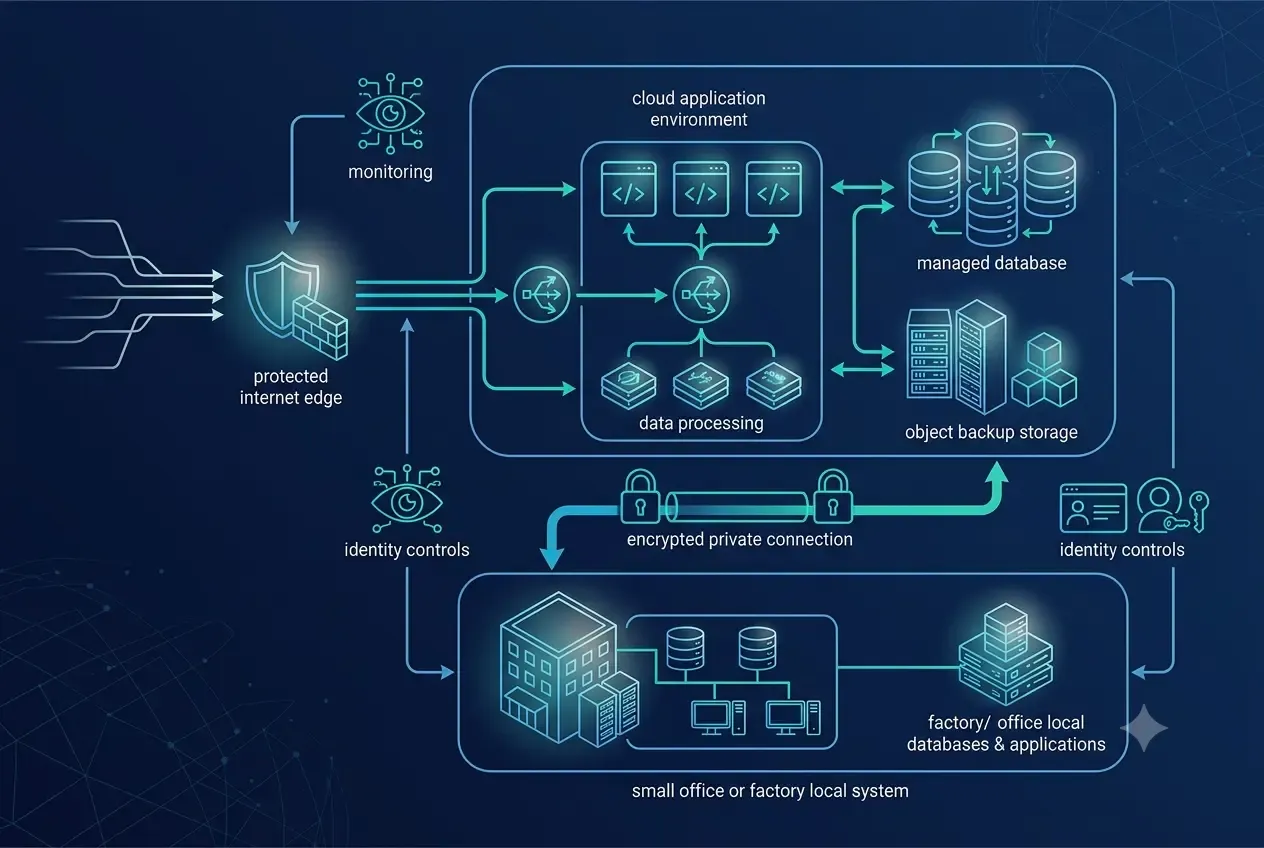
4. A factory, retail chain or hotel with on-site systems: consider hybrid. Keep workloads that depend on LAN or local equipment on site; place customer-facing portals, backup, analytics or internet services in cloud.
5. Critical data with a small IT team: reduce the self-managed surface through managed services or a managed provider. A simple architecture with verified backups is usually safer than an unattended enterprise-style stack.

Analysis
Seven common mistakes
The platform is rarely the only cause of failure; most risk comes from architectural and operational decisions.
- Choosing the lowest VM price while ignoring backup, traffic and labor.
- Keeping the application, database and backup on one VPS.
- Migrating everything before measuring dependencies and performance baselines.
- Adopting Kubernetes to run only a few simple containers.
- Treating snapshots as a disaster-recovery strategy.
- Failing to assign budget alerts, tagging and ownership to cloud resources.
- Buying on-premises hardware without redundant connectivity, power, spares and personnel.

Analysis
A 30-day decision checklist
A short evidence-based assessment is better than a large decision built on assumptions.
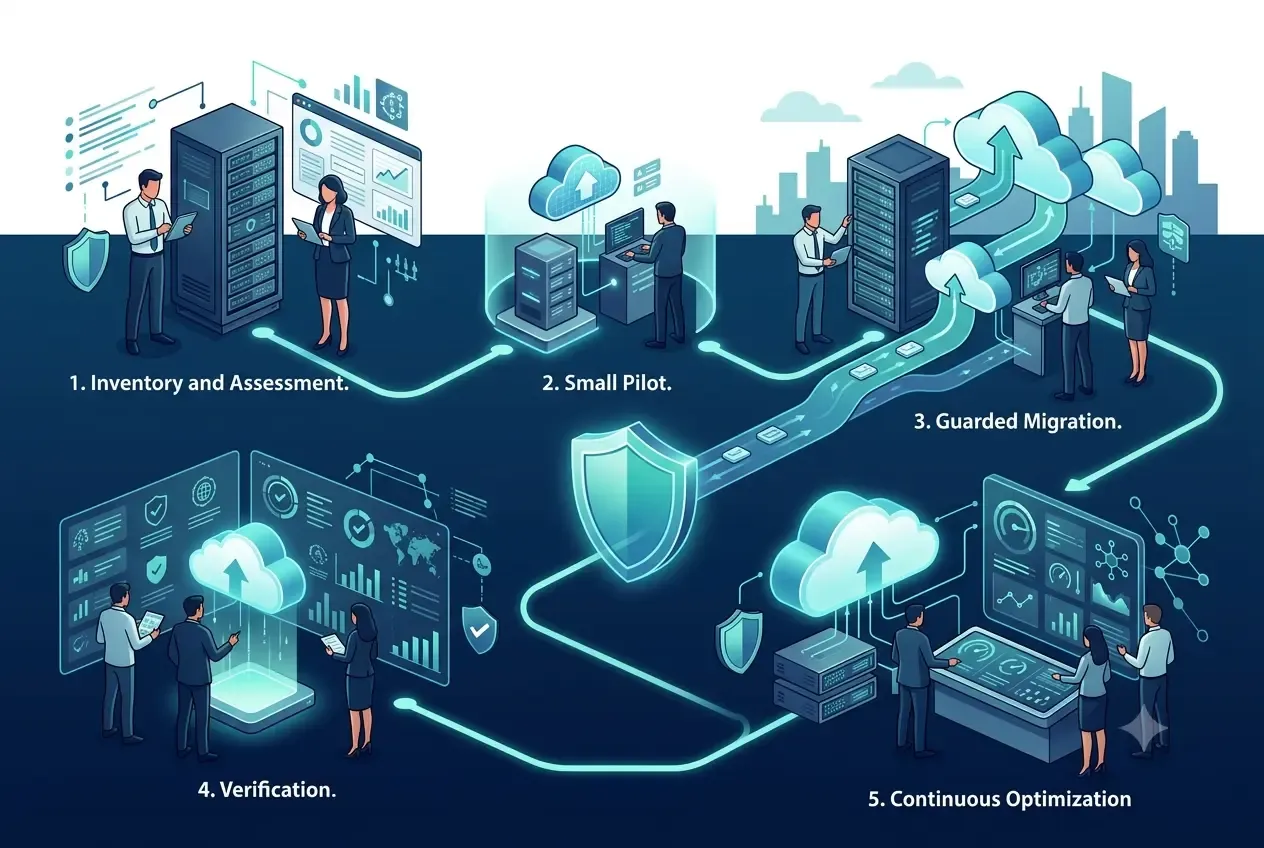
- Inventory applications, databases, storage, integrations and owners.
- Classify criticality and define RTO and RPO for each workload.
- Measure CPU, RAM, storage IOPS, bandwidth, peak traffic and data growth.
- Identify dependencies on fixed IPs, devices, licenses and legacy systems.
- Model 12- and 36-month TCO for at least two options.
- Design IAM, networking, logging, backup and restore before migration.
- Select one low-risk workload for a pilot.
- Run performance tests, security tests and a restore drill.
- Configure budget alerts, tagging, dashboards and accountable owners.
- Expand only after the pilot meets technical and business criteria.
Analysis
Frequently asked questions
Questions FlowNexa commonly hears when SMEs evaluate infrastructure.
Is AWS or Azure cheaper?
There is no vendor-level answer. Region, compute type, licensing, storage, egress, support, discounts and architecture determine the result. Compare the same workload and availability target in each official calculator.
Can a VPS run production?
Yes, when the workload fits and backup, restore, security, monitoring, capacity and single points of failure are controlled. Production readiness is a risk-control standard, not a platform name.
Is on-premises always cheaper after three years?
No. Capital, electricity, redundant connectivity, warranty, refresh, licensing, staffing and downtime all count. It can fit steady workloads or local constraints without being universally cheaper.
Should an SME use multi-cloud?
Most SMEs should not begin with multi-cloud. It multiplies skills, governance, observability and operational procedures. Adopt it only when a business, regulatory or resilience requirement clearly outweighs the complexity.
Should everything be migrated at once?
Usually not. Inventory first, define success criteria, pilot one workload, test rollback and migrate in controlled waves.
Analysis
Conclusion: choose for operability, not fashion
The best option is the one the business can consistently secure, observe, back up, restore and optimize.
For Vietnamese SMEs, a VPS is a reasonable starting point for small systems; AWS and Azure add leverage when products need managed services, automation and scale; on-premises remains relevant for workloads tied to local equipment, data or latency. Hybrid can combine strengths, but only with clear boundaries and ownership.
The right decision does not have to be permanent. A good architecture lets the business start with enough capability, collect operational evidence and evolve with growth without exposing data to unnecessary risk.
Practical guidance
Request an infrastructure assessment and cost estimate
A key consideration when selecting and operating infrastructure.
Request an infrastructure assessment
FlowNexa helps inventory workloads, define RTO/RPO, compare TCO across AWS, Azure, VPS and on-premises, and design a pilot with a tested rollback approach.