



Skip to content
FlowNexa
  • AI Services
  • Solutions
  • About
  • Blog
VIEN
Book a consultation
Back to Blog
Workflow Automation4 min readFlowNexa Editorial Team

Automation Says Success but the Business Process Failed: Verify the Outcome

Separate technical success from business success and design workflows with outcome assertions, reconciliation, audit trails, and recovery.


Aug 15, 2026
Automation Says Success but the Business Process Failed: Verify the Outcome

A workflow is successful only when the intended business outcome has occurred and evidence confirms it. An HTTP 200 response, a green execution, or a row written to an intermediate table proves that a technical step completed. It does not prove that the customer received the email, the correct order was created, the invoice was approved, or the CRM reflects the final state.

To prevent false success, define the business outcome before building the workflow, add an outcome assertion at the end, reconcile the source with the destination, and route exceptions into retry, repair, or human review. This is the difference between automation that runs and a process that remains dependable in production.

The gap

How is technical success different from business success?

API success is not always customer success.

Consider a workflow that receives an order, calls an invoice API, and sends an email. The invoice API returns 200 but creates a draft; the email service accepts the request but the address later bounces; the last node still completes. The dashboard is green while the customer has no valid invoice.

This happens when the success criterion is placed at a system boundary rather than the final outcome. Other causes include eventual consistency, asynchronous processing, late webhooks, semantically wrong mappings that still pass schema validation, and APIs that return “accepted” rather than “completed.” Ordinary retries do not detect these cases because no exception is raised.
n8n documents exception handling and error workflows, but the business must also define business failure: a technically valid execution whose result fails acceptance criteria. See n8n guidance on graceful error handling.

False success

Four common failure patterns

Every node is green, but the outcome is wrong or incomplete.

Accepted, not completed

The API queued the request for later asynchronous processing.

Valid schema, wrong mapping

The payload passes validation but is attached to the wrong customer or order.

Partial success

The CRM updates while email, inventory, or accounting remains incomplete.

No final confirmation

The workflow never reads the destination state to prove completion.

Design

Add an outcome assertion to the end of the workflow

Every process needs a machine-verifiable definition of done.

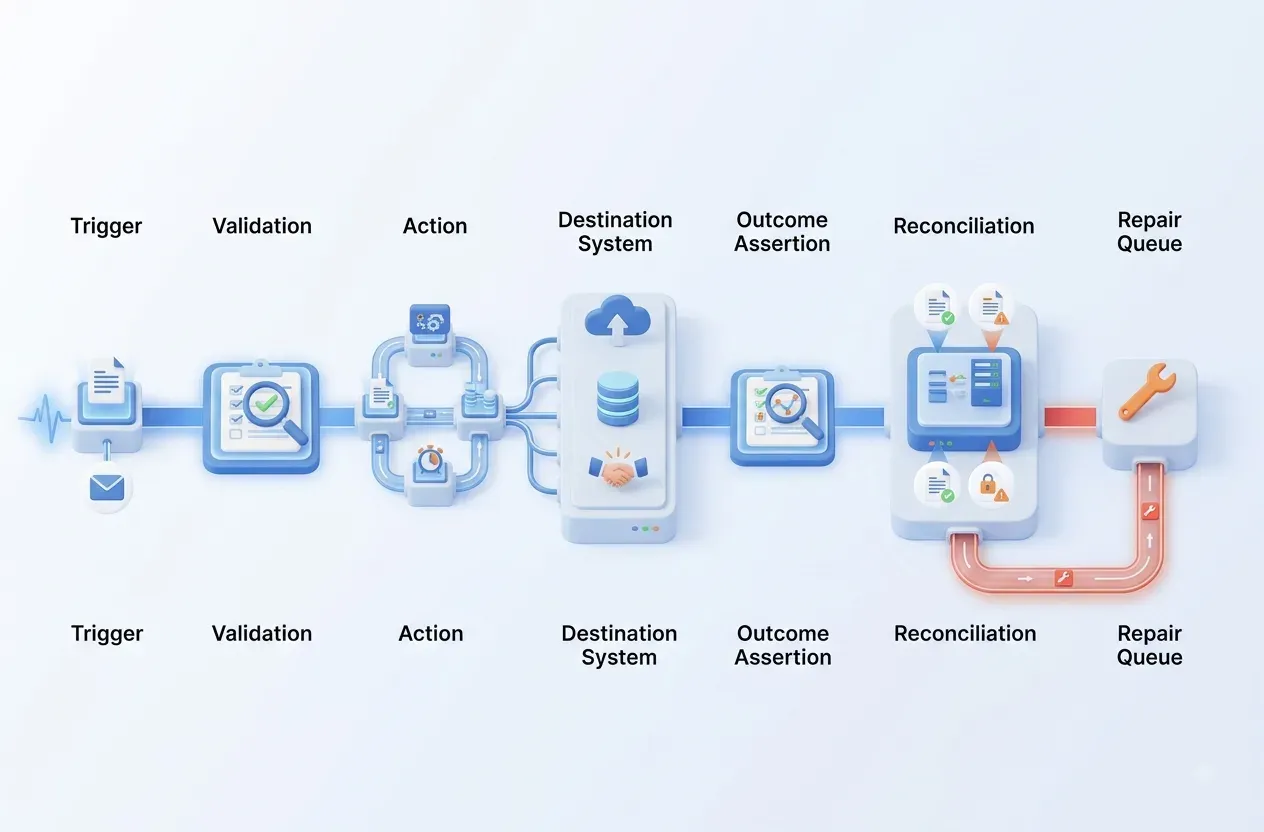
Start with an outcome contract. For example, an order is complete only when it has a unique order_id, the total matches the source, status is confirmed, inventory is reserved, and notification delivery has reached an acceptable state. The contract identifies the source of truth for every condition.

After taking action, the workflow does not finish immediately. It waits for a callback or reads the destination state and executes the assertion. If processing remains within its allowed window, status is pending. Temporary failure enters retry with backoff. A mismatch creates a repair task containing the correlation ID and evidence from both systems. If the next action is irreversible, stop and require approval.

Use one correlation ID across the trigger, sub-workflows, APIs, and queues. OpenTelemetry describes context propagation as the mechanism that correlates traces, metrics, and logs across services; the same principle supports end-to-end transaction investigation. See OpenTelemetry context propagation.

Operations

Reconciliation is the safety net for automation

Not every mismatch appears immediately in an execution log.

Run an independent reconciliation job that compares source and destination within a bounded time window. Every captured payment should have an invoice; every qualified lead should have an owner; every confirmed booking should have a reservation ID in the PMS. The job should not silently repair everything on day one. Classify mismatches, collect evidence, and auto-repair only cases governed by deterministic, idempotent, and verifiable rules.

Separate execution_success_rate from business_completion_rate on dashboards. Add pending age, mismatch count, repair backlog, and time to reconcile. Alert by business impact: an email may be retried, while an incorrect total or wrong-customer update should fail closed.

Collect only the observability data you need and redact sensitive fields. OpenTelemetry provides a vendor-neutral framework for traces, metrics, and logs, while business outcomes still require carefully governed custom attributes. See the OpenTelemetry documentation.

Acceptance

Checklist before calling a workflow production-ready

Every “no” reveals an operational control gap.

Outcome contract

Completion criteria and sources of truth are explicit.

Read after write

A callback or destination-state check confirms the result.

Recovery path

Retry, repair, rollback, and manual review are distinct.

Reconciliation

An independent job detects missing or inconsistent transactions.

FAQ

Frequently asked questions about false success

Do not use a green execution as the final KPI.

Does HTTP 200 mean success?

Only for that request. Read the API semantics to determine whether the operation is completed or merely accepted.

Must every write be read back?

Not always. Apply stronger verification to financial transactions and bookings; lower-risk internal notifications may rely on retries.

Will reconciliation create excessive load?

Control it with watermarks, pagination, bounded windows, and comparisons of only essential fields. Avoid a full scan on every run.

When is automatic repair safe?

When the cause is deterministic, the operation is idempotent, no data is destroyed, and a post-repair assertion confirms the result.

FlowNexa

Measure automation by the business result

FlowNexa can help add outcome contracts, correlation IDs, reconciliation, and dashboards so workflow status reflects operational reality.

Choose one critical flow

Start with orders, leads, reports, or tickets where failure cost is visible.

Establish a baseline

Measure false success and repair backlog before scaling automation.

Read next

Related insights

Operations Automation

Multichannel Orders and Inventory: How Do You Prevent Overselling?

Design a central inventory authority, reservation ledger, idempotency, event synchronization, and reconciliation to prevent overselling.

AI Automation

AI Misreads an Invoice: What Controls Are Needed Before Accounting?

Design invoice processing with field-level confidence, business validation, reconciliation, risk-based review, and posting gates.

Data Governance

Duplicate Customers in CRM: How Do You Merge Without Combining the Wrong People?

Design duplicate detection with identity keys, confidence, review queues, merge policy, and recovery controls.

FlowNexa

FlowNexa helps small and mid-sized businesses bring AI into customer service, workflow automation, and efficient data operations. Cloud-native and DevSecOps provide the foundation that keeps these solutions secure, reliable, and easy to scale.

FLOWNEXA COMPANY LIMITED

Tax ID: 0319612776

Address: 228/6 Au Duong Lan, Chanh Hung Ward, Ho Chi Minh City, Vietnam

Website: flownexa.ai

Services

AI chatbots & supportAI assistantsAutomationCloud & infrastructure

Company

AboutBlogPrivacyTerms

Contact

hello@flownexa.ai
0948 279 029
Chat on Zalo
Chat on Messenger
Replies within one business day

© 2026 FlowNexa. All rights reserved.

Microsoft, Azure, Microsoft 365, AWS, Kubernetes, and Cloudflare are trademarks of their respective owners. FlowNexa is not claiming partnership unless expressly stated.

B2B service website — no online ordering or online payment.

Practical AI · Automation · Secure CloudPrivacyTermsCookiesLegal
Share:
FacebookZaloLinkedIn
Share:
FacebookZaloLinkedIn