
Practical DevSecOps for Business Websites: CI/CD, GitOps, Kubernetes, and Monitoring
How FlowNexa deploys a Next.js website and Strapi CMS on Kubernetes with CI/CD, security scanning, a GitOps deployment branch, monitoring, backup, and restore drills.

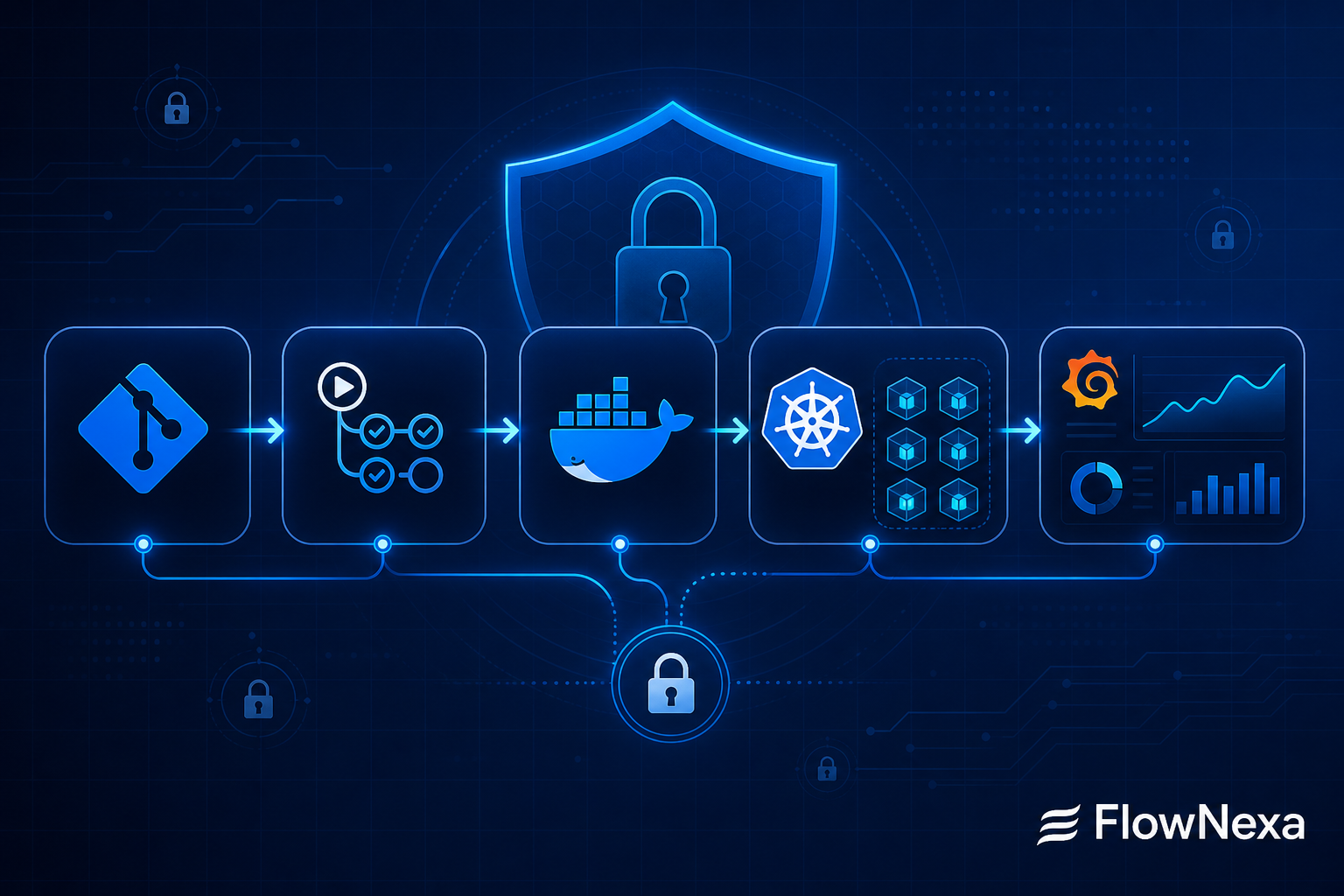
When a business website moves into production, the question is no longer simply “how do we deploy?”. The more important question is: how do we deploy safely, with control, rollback capability, testing, security gates, and long-term operational stability?
That is why FlowNexa built its website around DevSecOps and GitOps from the start. Instead of manual deploys from a laptop or direct edits on a server, every change flows through testing pipelines, image builds, security scans, manifest updates, and controlled Kubernetes rollouts.
FlowNexa currently runs its public website on Next.js, its CMS on Strapi, and deploys both to Kubernetes for staging and production. Beyond CI/CD, the platform includes monitoring, backup, restore drills, and production resource dashboards.
Production readiness
Why production websites need more than one deploy command
Once a website has a CMS, multiple environments, SEO, backups, monitoring, and real production traffic, risk grows quickly if deployment stays manual.
Common problems
Risks when deployment is just one command
Unknown running version
Production no longer has a precise trace of which image or commit is live.
No security scan
Releases go straight to production without a quality gate or vulnerability scan.
Staging/production drift
Environments diverge over time, so rehearsal loses meaning.
Hard rollback
Images or manifests are not versioned clearly when you need to return to a stable build.
Operator dependency
Deployment depends on individual experience instead of a controlled process.
No post-deploy verify
There is no routine for backup, restore, and monitoring checks after release.
FlowNexa addresses this with a DevSecOps process that is automation-first, secure-by-default, and GitOps-ready.
Architecture
High-level architecture
Public Next.js website, Strapi CMS, PostgreSQL, persistent volumes for media uploads, and separate staging and production Kubernetes environments.
Developer ↓ Pull Request / Merge to main ↓ GitHub Actions CI ↓ Verify web + Verify CMS ↓ SonarQube quality gate + security scan ↓ Build Docker images ↓ Trivy image vulnerability scan ↓ Push image with immutable tag ↓ Update Kubernetes manifests ↓ GitOps deployment branch ↓ Staging / Production Kubernetes ↓ Prometheus + Grafana monitoring ↓ Backup / Restore drill / Alerting
CI pipeline
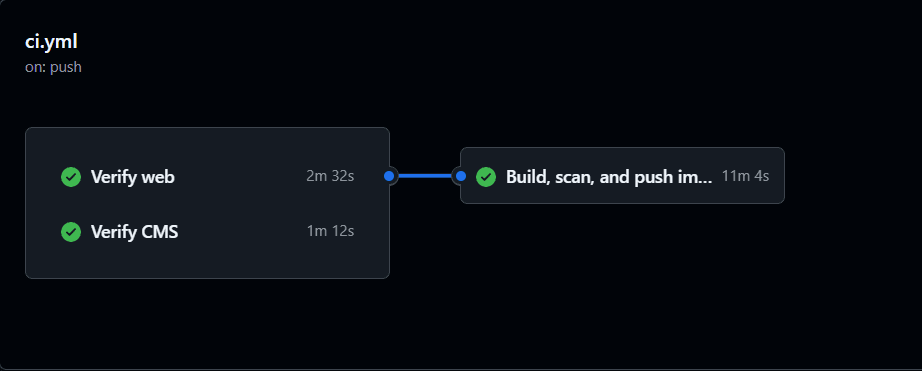
CI on main: verify before building images
Images are built and published only after both web and CMS verify jobs pass.
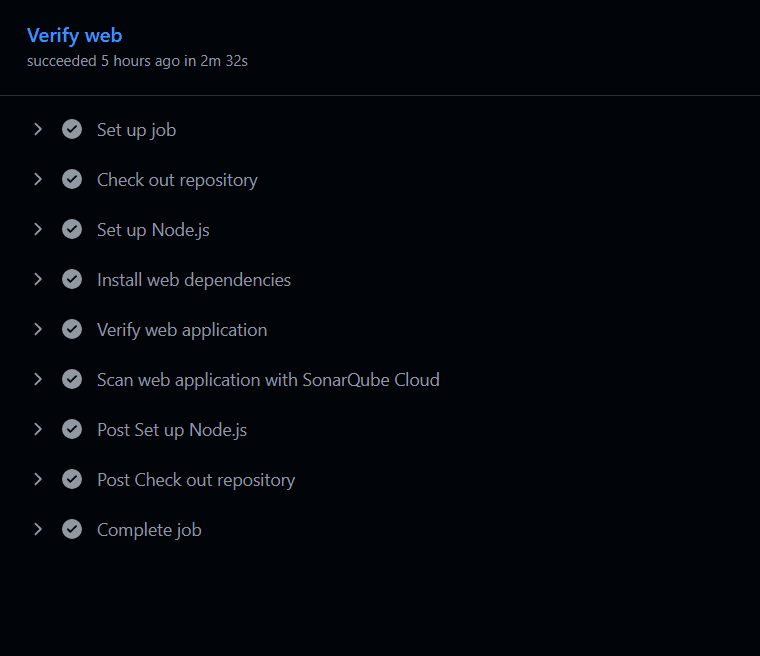
Verify web
Next.js application verification pipeline
Checkout repository
Pull source code from the main branch.
Setup Node.js
Standardize the runtime for verification.
Install dependencies
Install dependencies before running checks.
Verify web application
Run lint, typecheck, test, and build for the web app.
SonarQube Cloud scan
Run the quality gate and security scan before image build.

The CMS pipeline runs a separate verify job for Strapi. The key point is that images are built and published only after both web and CMS verification succeed. This reduces the chance of pushing a broken image to the registry and makes the pipeline the first control layer before release.
DevSecOps gate
Security and quality belong in the pipeline
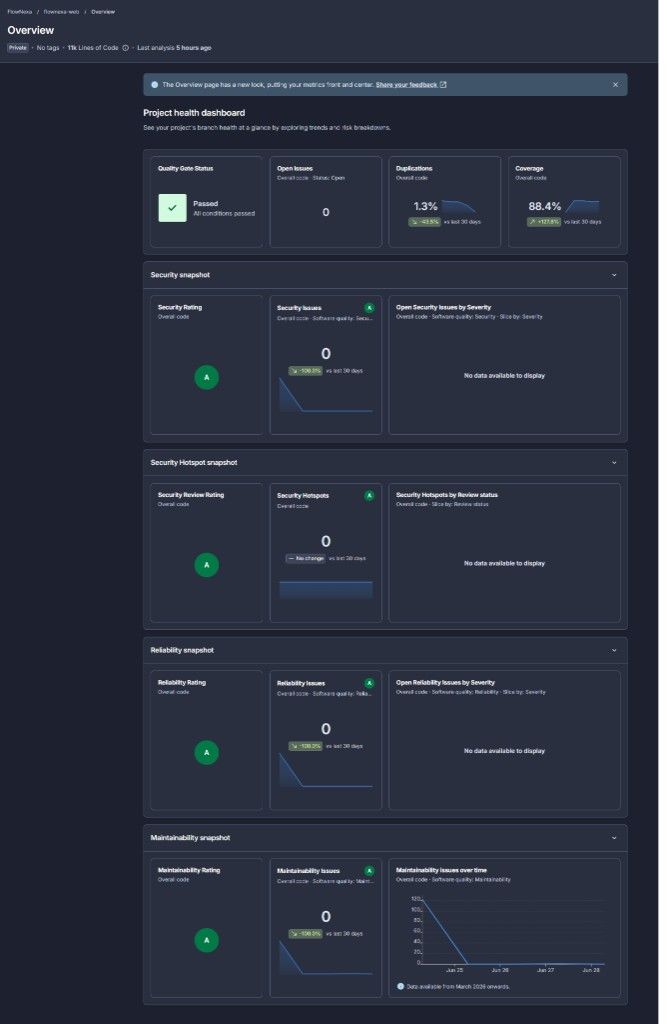
SonarQube Cloud checks the quality gate, coverage, security, reliability, maintainability, duplications, and security hotspots.

Operating principle
If the quality gate or security scan fails, the pipeline must stop. After source verification, Docker images are scanned with Trivy. HIGH or CRITICAL vulnerabilities must be addressed before the image is used in production.
Immutable tags
Build images with immutable tags
FlowNexa uses image tags based on the commit short SHA, for example flownexa-web:<short-sha> and flownexa-cms:<short-sha>.
Benefits
Why production should not rely on the latest tag
Exact traceability
Know exactly which version is running in staging or production.
Commit linkage
Trace a production image back to its source commit quickly.
Fast rollback
Return to a previous image tag when production incidents happen.
Less confusion
Avoid ambiguity when a moving latest tag is overwritten.
Release transparency
Make deployment history clearer for the whole team.
GitOps
GitOps deployment branch: separate source code from deployment state
The main branch owns source code and CI; the deployment branch owns Kubernetes manifests and the image tag in use.
main branch ↓ CI verify + security scan ↓ Build and push image ↓ Update deployment branch ↓ GitOps controller sync ↓ Kubernetes rollout GitOps is not only about Argo CD or Flux. Its biggest value is that every production change has history, review, versioning, and a clear rollback path.
Staging
Staging is production rehearsal
Staging is not just for previewing UI. It is where the full release flow is validated before go-live.
Staging checklist
Important staging steps
Deploy the new image
Roll out an image that already passed verify and scan steps.
Verify web and CMS
Check rendering, APIs, and content behavior.
Validate CMS media
Upload and delete media in the CMS, then confirm website rendering.
Backup and restore drill
Run drills for database and uploads before production.
Capture UI/UX
Capture multiple viewports, themes, and languages to catch layout issues.
Check runtime errors
Look for console errors, network failures, missing assets, and layout overflow.
Kubernetes
Production readiness on Kubernetes
A production-ready system needs more than a successful deployment.
Operations
Important operational factors at FlowNexa
Web HPA
The web app runs multiple replicas and scales with HPA.
Single CMS replica
CMS stays at one replica while media uploads use an RWO persistent volume.
PostgreSQL PVC
Database metadata has its own persistent volume.
Uploads PVC
CMS uploads use a separate persistent volume from the database.
Dual backup
Back up both database and uploads with a dedicated backup volume.
Verify and monitoring
Run production verify scripts after deploy, plus monitoring and alerting.
Operable architecture
Scaling to many replicas is not always correct if the storage backend is not ready. While media uploads remain on a local PVC, scaling CMS replicas can create file consistency risk.
Monitoring
Post-deploy monitoring: the part CI/CD often forgets
After deployment, the more important question is: is the system actually healthy?

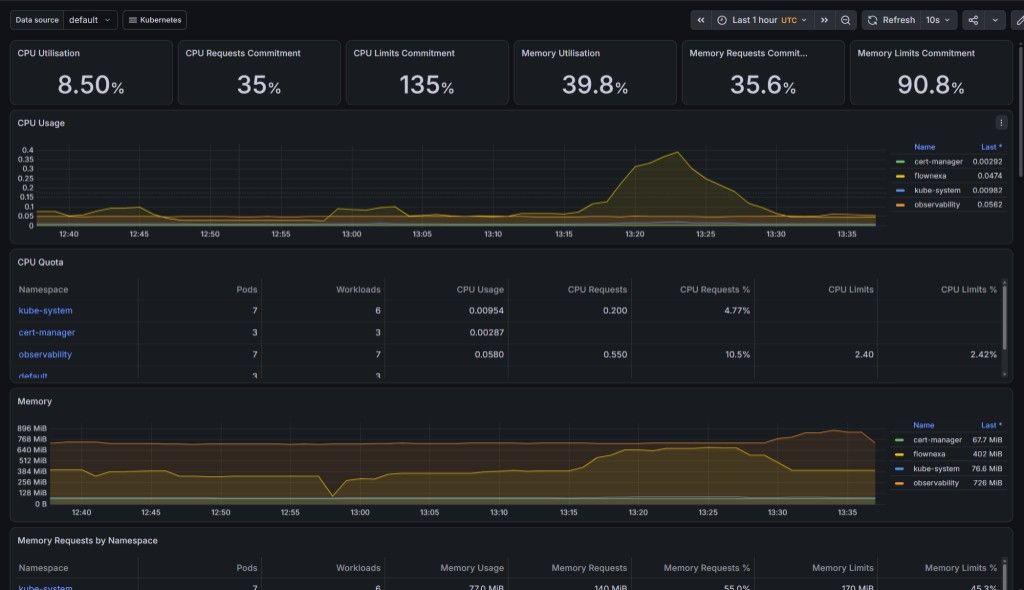
Runtime metrics
Metric groups worth tracking
CPU and memory
Utilization, requests, and limits by namespace.
Workloads and pods
Running pods and workloads with abnormal resource usage.
Post-deploy trends
Detect CPU or memory spikes after a new release.
Resource configuration
Evaluate whether requests and limits are configured sensibly.
Storage monitoring
Monitoring storage: database, uploads, and backups
For CMS-backed websites, CPU and RAM monitoring alone is not enough.

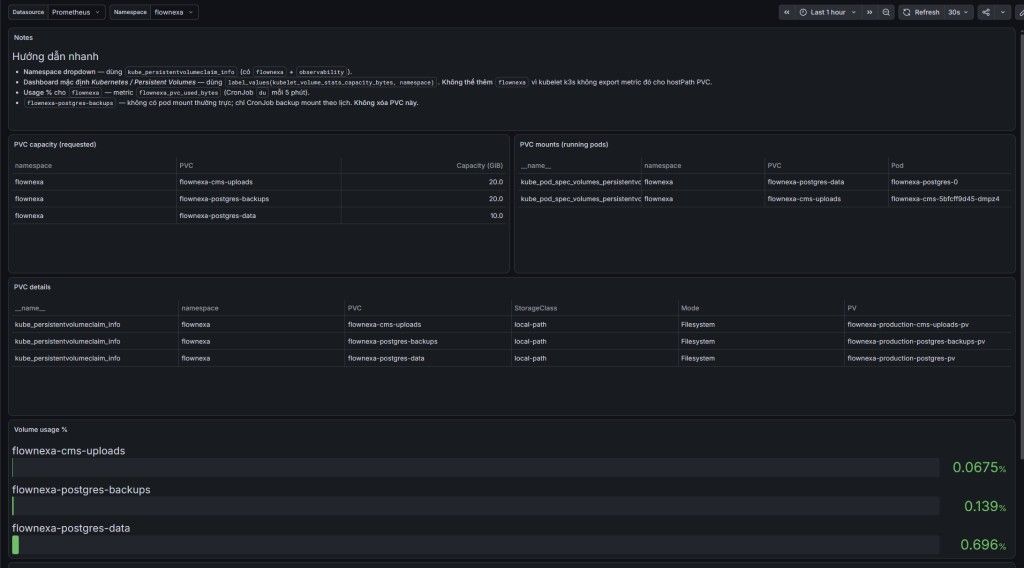
PVC dashboard
What the PVC dashboard tells operators
Mount mapping
Which PVC is mounted by which pod.
Requested capacity
Requested storage for each PVC.
StorageClass
StorageClass and access mode in use.
Usage percentage
Volume usage percentage to catch disk pressure early.
Backup volume
Whether the backup volume exists and is used as intended.
Backup principle
A backup that has never been restored is not yet a trustworthy backup. Restore drills surface incomplete backup files, permission issues, bad volume mounts, broken restore scripts, or missing media uploads early.
From FlowNexa delivery
Practical lessons
DevSecOps is a lifecycle
It is not just adding a scanner. Security, quality, and automation belong across the SDLC.
GitOps manages state
Every production change has history, review, and a rollback path.
Monitoring answers operations
Is the system healthy, is storage filling up, and are backups running?
Production readiness is continuous
Test, deploy, observe, back up, restore, and improve in a loop.
Conclusion
Business websites need production readiness, not just deployability
CI verify, SonarQube, Trivy scanning, immutable tags, a GitOps branch, Kubernetes staging/production, Grafana monitoring, PVC tracking, backup, and restore drills.
FlowNexa helps businesses design and deliver web, CMS, and SaaS platforms with a cloud-native, automation-first, and secure-by-default approach. We can help with CI/CD pipeline design, application containerization, Kubernetes deployment, GitOps workflows, security scanning in CI, monitoring/logging/alerting, backup/restore strategy, and standardized release/rollback processes.
If your team wants to move from manual deployment to a more production-ready release process, DevSecOps and GitOps are a strong investment.