
Skip to content
FlowNexa
  • AI Services
  • Solutions
  • About
  • Blog
VIEN
Book a consultation
Back to Blog
Cloud14 min readFlowNexa Editorial Team

Does multi-cloud reduce risk—or just make systems more complex?

Multi-cloud does not automatically create resilience. Use this practical framework to choose among multi-region, hybrid, and multi-cloud based on risk, RTO/RPO, operating capability, and total cost.

Updated: Aug 6, 2026
Does multi-cloud reduce risk—or just make systems more complex?

The short answer

Multi-cloud reduces risk only when it addresses a defined disruption scenario, has explicit RTO and RPO targets, and is tested regularly. If a company merely deploys the same system to two providers without standardizing data, identity, networking, observability, and switching procedures, multi-cloud usually increases cost, attack surface, and incident resolution time.

For most SMEs, a better starting point is one well-architected cloud with multi-AZ availability, independent backups, cross-region recovery, and a provider exit plan. Multi-cloud should be an evidence-based decision, not an architecture slogan.

FlowNexa point of view

Two providers do not equal two independent systems. Resilience exists only when the business can detect failure, switch over, operate in the recovery environment, and return to normal within its committed limits.

The real problem

Which risk is multi-cloud supposed to reduce?

Architecture cannot be assessed until the disruption it must withstand is defined.
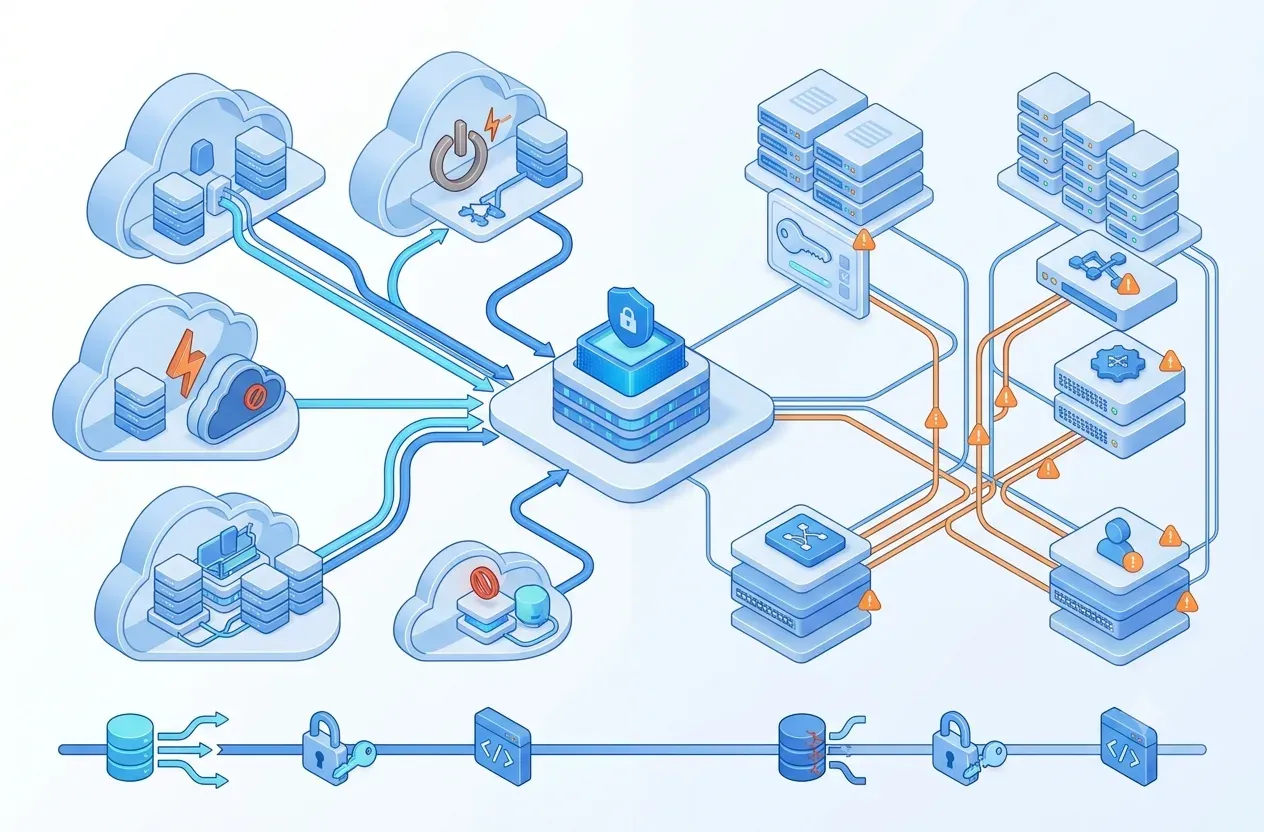
Valid drivers include regulatory or data-residency requirements; missing regions or capabilities in a target market; inherited platforms after a merger; a specialist service available from a second cloud; or business-continuity requirements for a provider-level outage.

Separate four failure scopes: resource, availability zone, region, and provider. Multi-cloud can help with the last one, but it does not fix application defects, accidental deletion, compromised credentials, faulty IaC, or one delivery pipeline propagating the same error to both clouds. Those risks require isolation, immutable backup, change controls, and tested recovery.

Trade-off map

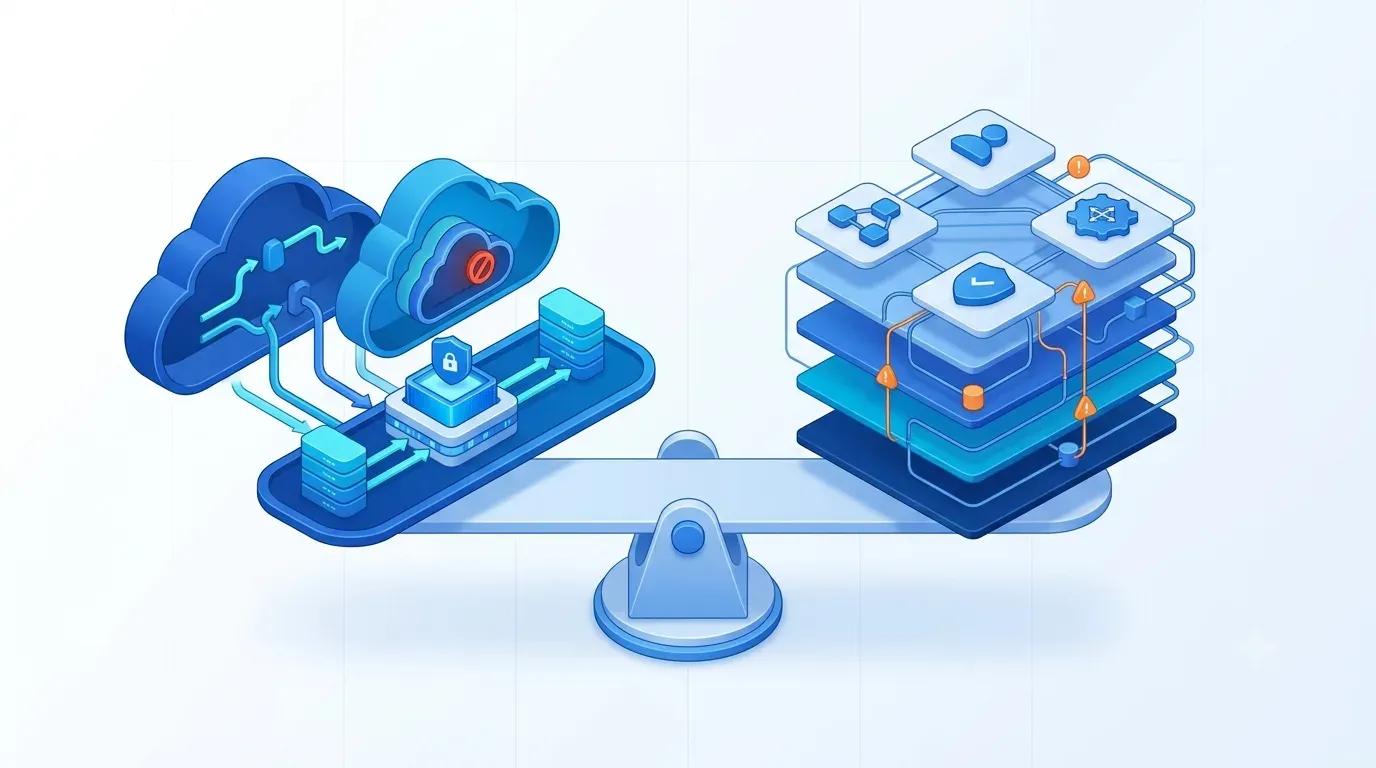
Multi-cloud reduces some risks while creating new ones

The benefit matters only when it exceeds the added complexity and the team can control that complexity.

May reduce

Dependency on one provider, geographic gaps, failure of a specialized service, and limited commercial options.

May increase

IAM inconsistency, policy drift, cross-cloud connectivity, egress, fragmented logs, key management, and skills burden.

Does not automatically solve

Application defects, corrupt data, ransomware, human error, shared SaaS dependencies, and untested recovery.

Correct framing

Multi-cloud is not the same as disaster recovery

DR is a measurable capability; multi-cloud is only one deployment option.

A DR architecture starts with business impact analysis and two objectives: RTO—the maximum acceptable interruption; and RPO—the maximum acceptable amount of data loss measured in time. Only then should the team select backup and restore, pilot light, warm standby, or active-active.

Active-active across two clouds sounds attractive but is the hardest option. Global routing, data consistency, split-brain prevention, secret synchronization, capacity, observability, and rollback all require explicit designs. If failover still depends on many unpractised manual steps, a two-cloud diagram is not evidence of resilience.

Options

When is single-cloud multi-region enough?

Choose the simplest model that still meets the business objective.

ModelBest fitPrimary controls
Single-cloud, multi-AZHA against localized infrastructure failureSame-region dependencies, backups, quotas
Single-cloud, multi-regionRegion-level DR with faster deliveryReplication, DNS, data, standby cost
Hybrid cloudOn-premises, edge, or data constraints remainConnectivity, identity, latency, ownership
Partitioned multi-cloudDifferent clouds serve distinct products or marketsGovernance and consistent operations
Multi-cloud DRProvider outage is in the threat model and impact justifies costPortability, data, failover and failback drills

For most SMEs, multi-region within one provider plus independent backup offers a better benefit-to-complexity ratio than multi-cloud active-active.

Decision gates

Proceed only after multi-cloud passes six questions

A “no” does not always stop the initiative, but it must become an owned risk with a closure plan.

Business case

What would a provider outage cost, and does its likelihood justify the total investment?

Recovery objectives

Does every workload tier have an RTO, RPO, and minimum service level during recovery?

Portability

Can the application, data, identity, keys, and dependencies actually move or switch?

Operating model

Are there platform owners, on-call coverage, runbooks, and skills for both clouds?

Security governance

Are there common baselines, policy-as-code, asset inventory, and centralized audit?

Evidence

Have failover and failback been drilled with measured RTO/RPO, data checks, and user journeys?

True cost

Do not compare compute bills alone

Most multi-cloud cost lives in people, integration, and operations.

A TCO model should include standby infrastructure; traffic and data egress; private connectivity; tooling licenses; logs, metrics, and traces; CI/CD and artifact replication; security scanning; backup; support plans; training; on-call operations; DR exercises; and the opportunity cost of building compatibility layers.

Do not assume Kubernetes or Terraform creates complete portability. They standardize parts of compute and provisioning, but managed databases, IAM, KMS, load balancers, queues, observability, and networking semantics remain different. Forcing everything to the lowest common denominator can also remove the value of managed services.

Design

Guardrails that prevent two clouds becoming two silos

Standardize the control plane while allowing deliberate workload optimization.

Minimum platform

Seven capabilities required before production

These capabilities must work across clouds and have test evidence.

Identity

Central federation, least privilege, separate break-glass access, and automated lifecycle management.

Landing zones

Consistent account or subscription structure, tagging, policies, quotas, and ownership.

Network

Non-overlapping IP plans, DNS, encryption, egress controls, and a backup path.

Delivery

Versioned IaC modules, GitOps or CI policy gates, signed artifacts, and rollback.

Data

Defined source of truth, replication mode, conflict handling, encryption, and restore validation.

Observability

Standard telemetry, end-to-end SLOs, correlation IDs, and owned alerts.

FinOps

Allocation, budgets, anomaly detection, and workload-level egress visibility.

For security, assume configuration will drift. Apply policy-as-code to public exposure, encryption, logging, approved regions, tags, and runtime versions. Centralize detection while retaining sufficient source logs for investigation. Do not copy secrets casually between clouds; define authority, rotation, and emergency access.

For data, select one explicit pattern: a primary writer with replicas; partitioning by tenant or region; or multi-writer with conflict resolution. Do not leave the database until last—data architecture usually determines achievable RPO, whether failback is practical, and the risk of split-brain.

Execution

Use a 90-day roadmap instead of deploying everything

Start with one important workload whose scope remains controllable.

Days 1–30—decide with evidence: inventory assets and dependencies; tier workloads; define the threat model and RTO/RPO; compare multi-region with multi-cloud; model TCO; select a pilot and stop criteria.

Days 31–60—build the minimum platform: landing zones, IAM federation, networking, IaC, artifact replication, backup, telemetry, and runbooks. Validate restore before testing failover.

Days 61–90—prove it: run a controlled game day; measure detection time, RTO, RPO, and error rate; validate data integrity; test failback; record manual steps; update TCO; and decide whether to scale, retain the pilot, or stop.

Evidence

The dashboard must show whether multi-cloud is actually better

Do not turn illustrative numbers into commitments. Set thresholds from each workload's business impact.

Reliability

SLOs, journey availability, MTTD, MTTR, successful failover rate, and failback time.

Data

Measured RPO, replication lag, reconciliation errors, restore success, and unrecoverable data.

Operations

Manual steps, policy drift, alert noise, deployment lead time, and change failure rate.

Security

Public exposure, excessive privilege, secret age, logging coverage, and remediation time.

Cost

Workload TCO, egress, idle capacity, tooling, support, and engineering hours spent on the platform.

Failure modes

Five common ways multi-cloud fails

Most failures come from operating assumptions, not from a missing tool.

  1. Selecting two clouds before defining the threat model: the architecture has no traceable risk or recovery objective.
  2. Duplicating everything: the team doubles control planes without defining a source of truth.
  3. Equating containers with portability: data, identity, networking, and managed dependencies are missed.
  4. Testing failover only: failback, reconciliation, and the post-recovery backlog remain untested.
  5. Assessing a diagram instead of evidence: there is no game day, measured RTO/RPO, restore proof, or accountable approval.

A simple, tested design is usually more reliable than a distributed architecture that looks impressive on a slide but has never switched in practice.

FAQ

Frequently asked questions about multi-cloud strategy

Short answers to common business decisions.

Does multi-cloud eliminate vendor lock-in?

Not completely. Lock-in also exists in data, managed APIs, skills, processes, and switching costs. A tested exit plan is more useful than an absolute “no lock-in” goal.

Should an SME adopt multi-cloud from day one?

Usually not. Establish HA, backup, DR, security baselines, and observability in one cloud first. Add a second provider only for a specific business case.

Is Kubernetes enough to move workloads between clouds?

No. Kubernetes improves portability for part of the compute layer; data, IAM, KMS, networking, registries, ingress, and dependent services still require design work.

How is multi-region different from multi-cloud?

Multi-region uses multiple regions from one provider; multi-cloud uses two or more providers. Multi-region is usually simpler but does not address provider-level failure in the threat model.

Is active-active always better than active-passive?

No. Active-active can reduce switching time but makes consistency, routing, and operations harder. The right model meets RTO/RPO with acceptable complexity.

How often should DR be exercised?

Base frequency on workload criticality and change velocity, and test after major architecture changes. Every exercise should measure RTO/RPO and validate failback, not merely start the recovery environment.

How can we tell whether multi-cloud creates value?

Compare residual risk, measured RTO/RPO, exercise success, and avoided impact against additional TCO, operating load, and newly introduced security risk.

FlowNexa Cloud Assessment

Do not buy another cloud before identifying the risk to reduce

FlowNexa helps businesses assess workloads, dependencies, RTO/RPO, security, TCO, and operational capability, then build the right roadmap across single-cloud optimization, multi-region, hybrid, or multi-cloud. The outcome is evidence-driven architecture with clear rollback and controlled cost.

Book a consultation

Discuss business impact, the current cloud estate, and critical failure points.

Request an assessment

Receive a risk map, dependency review, architecture options, and prioritized backlog.

Run a controlled pilot

Build one small recovery path, exercise it, and measure results before scaling.

Read next

Related insights

Customer Experience

A Customer Starts on Facebook and Continues on Zalo: How Do You Preserve Context?

Design omnichannel customer context across Facebook, Zalo, and CRM without incorrect identity merges, data exposure, or forcing customers to repeat themselves.

Workflow Automation

Automation Says Success but the Business Process Failed: Verify the Outcome

Separate technical success from business success and design workflows with outcome assertions, reconciliation, audit trails, and recovery.

Business Automation

Quotation Sent, Customer Silent: Automate Follow-Up Without Becoming Annoying

Design a quotation follow-up process with ownership, SLAs, behavioral signals, and stop conditions so Sales protects opportunities without pressuring customers.

FlowNexa

FlowNexa helps small and mid-sized businesses bring AI into customer service, workflow automation, and efficient data operations. Cloud-native and DevSecOps provide the foundation that keeps these solutions secure, reliable, and easy to scale.

FLOWNEXA COMPANY LIMITED

Tax ID: 0319612776

Address: 228/6 Au Duong Lan, Chanh Hung Ward, Ho Chi Minh City, Vietnam

Website: flownexa.ai

Services

AI chatbots & supportAI assistantsAutomationCloud & infrastructure

Company

AboutBlogPrivacyTerms

Contact

hello@flownexa.ai
0948 279 029
Chat on Zalo
Chat on Messenger
Replies within one business day

© 2026 FlowNexa. All rights reserved.

Microsoft, Azure, Microsoft 365, AWS, Kubernetes, and Cloudflare are trademarks of their respective owners. FlowNexa is not claiming partnership unless expressly stated.

B2B service website — no online ordering or online payment.

Practical AI · Automation · Secure CloudPrivacyTermsCookiesLegal
Share:
FacebookZaloLinkedIn
Share:
FacebookZaloLinkedIn