



End-to-end AI agents: which guardrails are required before production?
A practical production guardrail framework for autonomous AI agents covering scope, policy, authorization, idempotency, budgets, observability, kill switches, and progressive rollout.


An AI agent should run end to end in production only when its autonomy is bounded by code and policy, every side effect is traceable, cost and blast radius are capped at an accepted level, and operators can stop or downgrade the agent without relying on the model itself. A strong prompt, high confidence score, or a second LLM acting as a reviewer is not a sufficient production guardrail.
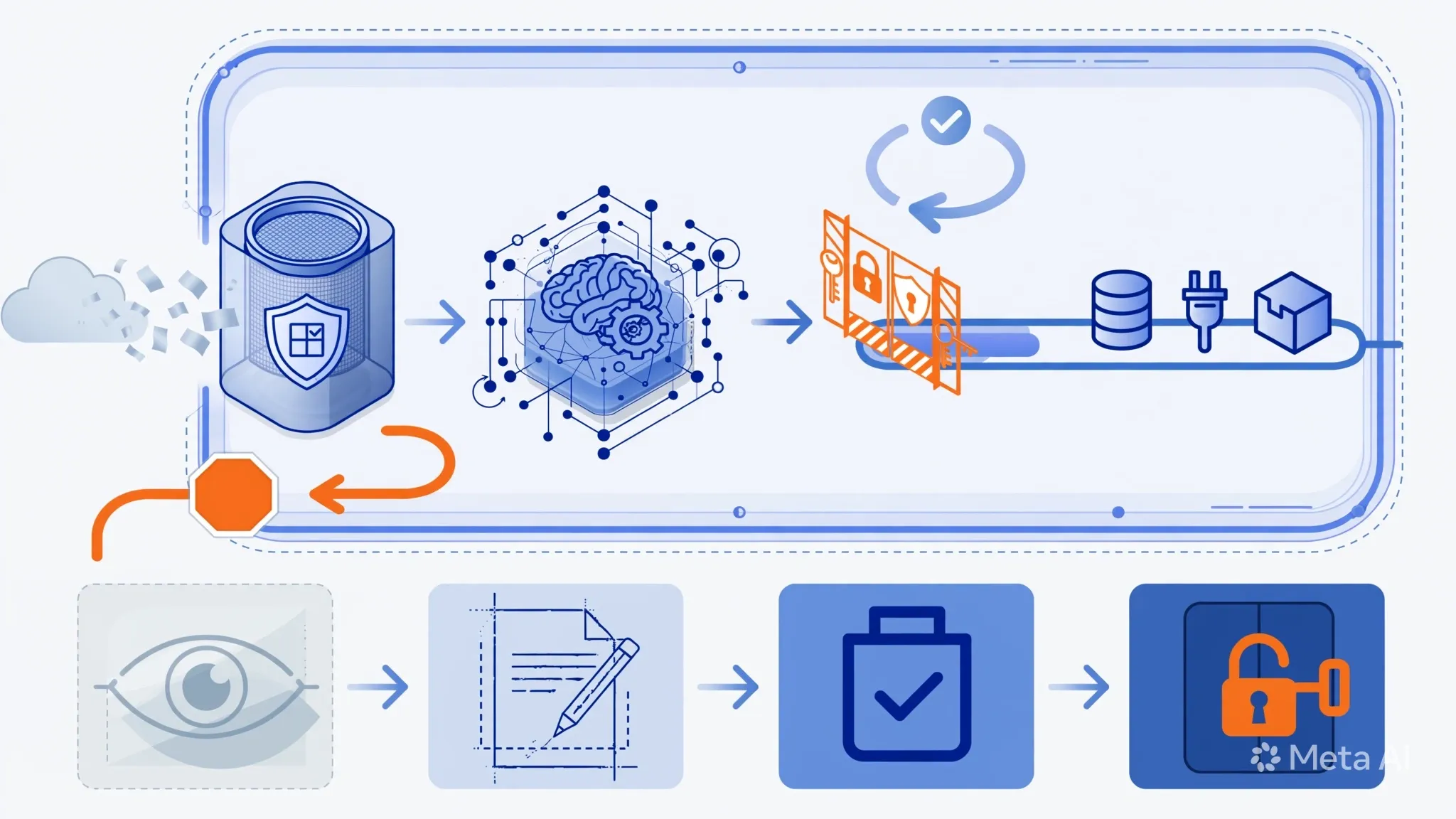
The practical control path is: untrusted input → proposed plan → independent policy decision → least-privileged execution → postcondition verification → continuous monitoring → automatic containment when a limit is breached. Read-only actions and draft creation can often be fully automated. Payments, permanent deletion, permission changes, sensitive-data disclosure, and production deployment need stricter policy, bound approval, or an explicit prohibition. The goal is not zero risk; it is residual risk that the organization has consciously accepted.
Correct framing
End to end does not mean giving the model unrestricted authority
The agent may complete a workflow autonomously, while execution authority remains outside the LLM.
An autonomous agent can receive a goal, retrieve data, create a plan, call several tools, inspect results, and retry. Every individual step may look valid while the overall sequence is wrong: correct customer data sent to the wrong channel, a non-idempotent API retried, a business state misread, or a loop that consumes the entire budget. Prompt injection, stale RAG content, hostile tool output, and model or provider changes introduce additional behavioral drift.
Separate three concepts:
- Autonomy: the agent can choose the next step inside a defined boundary.
- Authority: the resources and actions it may use, on whose behalf, and within which limits.
- Accountability: the owner responsible for outcomes, alerts, policy changes, and incidents.
Autonomy does not imply unlimited authority. Even if no person approves every run, a named owner must remain accountable for the use case, policy-as-code, and go/no-go decision. NIST AI RMF calls for a documented application scope and human oversight, testing under deployment-like conditions, production monitoring, and mechanisms to disengage or deactivate systems whose outcomes no longer match their intended use.
Scope
Define a risk envelope before building a feature list
Specify what the agent may do, must never do, and where execution stops before choosing a model or framework.
Before production, every use case needs a machine-enforceable risk envelope. It should define the permitted objective, input sources, tenants and data classes, tool and action allowlists, record and monetary limits, recipients and domains, execution window, maximum steps, retry count, token and cost budgets, and prohibited actions. It should also state the largest plausible consequence of one bad run and the recovery path.
Classify actions rather than entire connectors:
- Tier 0 — public read-only: autonomous with rate limits and basic logging.
- Tier 1 — internal read or draft: correct tenant, data filters, DLP, and complete audit required.
- Tier 2 — reversible write: preconditions, idempotency, batch caps, and preview or dry run; automatic execution only inside a small envelope.
- Tier 3 — sensitive or hard to reverse: payments, permanent deletion, access changes, external publication, and production deployment. Require bound approval by default or prevent agent execution.
Do not label an entire tool as permanently low risk. email.search differs from email.send; database.read differs from database.delete. If an action is unclassified or required context is missing, policy must fail closed.
Architecture
Separate the reasoning plane from the execution plane
The model plans; the backend authenticates, authorizes, executes, and verifies.
Do not give the model runtime a broad credential or direct access to target APIs. A production architecture needs explicit trust boundaries:
- Ingress gate: authenticate sources, scan files, enforce size limits, classify data, and reject invalid input. Email, documents, websites, and tool outputs are all untrusted data.
- Planner: the model proposes a structured plan containing intent, tool, arguments, resources, assumptions, and evidence. It has no execution authority.
- Policy Enforcement Point: checks user and agent identities, delegated scope, tenant, action, resource, data classification, risk tier, budget, and approval before every tool call.
- Executor: uses short-lived, narrow-audience credentials and an egress allowlist; secrets are never exposed to the model.
- State store: persists execution state, idempotency keys, checkpoints, and versions. Conversation memory is not the source of truth for business state.
- Verifier: checks output schemas, business invariants, and authoritative postconditions instead of merely asking another LLM whether the result looks correct.
- Control plane: owns telemetry, policy versions, feature flags, quotas, circuit breakers, kill switches, and the manual fallback path.
For MCP tools, the specification requires servers to validate inputs, enforce access controls, rate-limit calls, and sanitize outputs; clients should use timeouts, validate results, and log tool usage. These controls belong in the server and executor, not only in prompts.

Core controls
Ten guardrail layers required before production
No single filter is sufficient; controls must span data, decisions, execution, and recovery.
1. Input and context boundaries. Authenticate the source, verify real file signatures and types, enforce size and tenant limits, and quarantine risky content. Attach provenance to every RAG passage. Never promote instructions retrieved from email, web pages, PDFs, or tool results into system instructions. Filters reduce prompt-injection risk but cannot guarantee safety.
2. Structured plans and schemas. Require closed schemas with mandatory fields, enums, ranges, additionalProperties: false, and canonical identifiers resolved by the backend. Avoid tools that accept arbitrary SQL, shell commands, URLs, or free-form actions unless the use case requires them and execution is sandboxed. Persist the plan version for audit.
3. Identity and least privilege. Give each agent a distinct identity. When acting for a user, carry delegated identity or explicit scopes. Read tools cannot write. Use short-lived credentials separated by environment; do not share secrets across agents. Reauthorize tenant and resource access on every request because possession of an object ID is not proof of permission.
4. Independent policy and risk-based approval. The model cannot assess itself and grant itself permission. A policy engine returns allow, deny, require_input, or require_approval, with reason codes and obligations. Approval binds to a digest of the tool, arguments, resource, and expiry; changing a recipient, amount, or scope invalidates it.
5. Bounded execution. Set maximum steps, tool calls, wall-clock time, retries, concurrency, batch size, resources, tokens, and cost per run, tenant, and day. Circuit breakers stop loops and abnormal fan-out. Outbound tools can reach only allowlisted destinations.
6. Idempotency, transactions, and rollback. Every side effect has a durable idempotency key. Retry only classified transient failures, using exponential backoff with jitter. Use optimistic locking and preconditions to avoid overwriting newer state. Multi-step workflows need transactions or compensating actions; irreversible steps move to a higher risk tier.
7. Output validation and DLP. Validate model and tool outputs against schemas, business invariants, and data policy. Redact secrets and personal data before logging or outbound delivery, and reject invalid recipients or domains. Do not pass raw tool output back to the model when it contains instructions or out-of-scope data.
8. Observability and tamper-resistant audit. Trace each request and tool call with user and agent identity, tenant, model, prompt, tool and policy versions, redacted arguments, decision, approval, idempotency key, cost, latency, result, and side effect. The agent must not be able to modify its own audit trail.
9. Runtime detection and containment. Establish baselines by agent and tool. Detect cross-tenant attempts, deny spikes, loops, cost anomalies, new domains, unusual batch sizes, and verifier failures. Provide global, agent, tenant, and tool kill switches, plus token revocation, queue pause, and read-only or draft-only modes.
10. Change control and continuous evaluation. Treat models, prompts, tool schemas, policies, knowledge sources, and evaluators as versioned production dependencies. Run regression, adversarial, and canary tests after changes. Evaluation is meaningful only when it resembles real inputs, tools, and deployment conditions.
Safe execution
Retries and postcondition checks matter more than the agent saying “done”
Read authoritative state back from the target system and check deterministic business invariants.
A 200 OK response does not always prove that the business outcome is complete, while a timeout does not prove that no side effect occurred. The executor should distinguish rejected, failed_retryable, failed_permanent, unknown_outcome, and succeeded_verified. For an unknown outcome, query the target system by idempotency key or request ID before retrying. If the outcome remains uncertain, send the item to a reconciliation queue instead of calling the action again blindly.
After a write, the verifier should retrieve authoritative state and enforce invariants: the ticket belongs to the correct tenant and owner; email was sent only to approved recipients; a refund does not exceed the remaining amount; a deployment uses the approved artifact digest and environment. Encode these checks as deterministic rules, database constraints, policies, or API preconditions. LLM-as-judge can help assess language quality or semantic relevance, but it should not be the only evidence for authorization, monetary values, transaction state, or side-effect success.
Use checkpoints for multi-step execution. A state machine such as received → validated → planned → authorized → executing → verifying → completed/compensating/quarantined enables safe resume, prevents invalid transitions, and avoids restarting an entire workflow. Dead-letter items need reason codes and correlation IDs, but not embedded secrets.
Go or no-go
Roll out progressive autonomy instead of enabling 100% automation at once
Open each autonomy level only when evidence and a recovery path exist for that level.
A safe rollout has four stages:
- Offline evaluation: run redacted historical cases, negative tests, prompt injection, tool failures, timeouts, and concurrency scenarios without touching production.
- Shadow mode: plan against real traffic without side-effect calls; compare decisions with the existing workflow and measure false allows and false denies.
- Suggest or draft-only: let the agent read and create drafts while an authorized person executes. Validate plan quality, arguments, audit evidence, and approval UX.
- Bounded auto-execution: enable only Tier 0–2 actions for allowlisted tenants and cases, with small quotas and canaries. Expand based on evidence rather than intuition. Keep Tier 3 behind approval or denial according to risk appetite.
Production should pass only when the use case and owner are registered; data flow and threat model are reviewed; identity and least privilege are tested; deny-by-default works; idempotency and reconciliation are proven; evaluation thresholds are met; dashboards, alerts, and on-call are ready; kill-switch and rollback drills pass; audit can reconstruct who did what and why; outages have a degraded mode; and stop criteria and runbooks are approved.
There is no universal threshold such as “95% accuracy is production-ready.” Acceptance depends on false-positive and false-negative cost, blast radius, and residual risk. An internal answer assistant and an autonomous refund agent cannot share the same release gate.
Operations
Monitor AI quality, system safety, and business impact together
A dashboard with only latency and token usage cannot reveal whether the agent is causing harm.
Production telemetry should cover three groups. AI quality includes verifier-confirmed task success, grounding and citations for RAG, clarification, abstention, and policy disagreement. System reliability includes latency, timeout, retries, prevented loops, queue age, unknown outcomes, idempotency conflicts, and dependency errors. Safety and business impact includes denials by reason, approvals and overrides, DLP hits, cross-tenant attempts, unauthorized calls, records changed, outbound recipients, cost per successful task, rollback, and incident severity.
Every alert needs an action: rate-limit the agent, switch to draft-only, block a tool, pause a tenant, revoke credentials, or stop the entire system. The kill switch should not exist only inside the application that may be malfunctioning; use an independent control path with explicit permissions. The runbook must specify who can activate it, how logs are preserved, how in-flight runs are contained, how side effects are reconciled, and when service may resume. NIST AI RMF explicitly calls for mechanisms to supersede, disengage, or deactivate systems that behave outside intended use, together with post-deployment incident response, recovery, and change management.
Feed every incident and near miss back into evaluation: add the failing input to regression tests, update the threat model and policy, check other agents using the same tool or source, and roll out the fix through shadow and canary stages. Never patch a production prompt without versioning, testing, and rollback.
Frequently asked questions
Does an end-to-end AI agent always require a human in the loop? Not for every step. Low-risk actions can run inside a tested envelope. Human oversight remains necessary for ownership, deployment, exceptions, incidents, and actions with large or irreversible consequences.
Can another LLM serve as the guardrail? It can detect risky content or evaluate semantic quality, but it cannot replace authorization, schema validation, transactions, quotas, or deterministic business invariants. Both models may fail on the same hostile or incorrect context.
Is a high confidence score enough for automatic execution? No. Confidence may be uncalibrated and says nothing about permissions, data sensitivity, or blast radius. Decisions also require margin and out-of-scope checks, required entities, business risk, and policy.
Should guardrails live in n8n or the API? Orchestration can live in n8n, but critical authorization, tenant isolation, idempotency, and business invariants must be enforced by the API or executor. The workflow cannot be the only protection for the target system.
When should a team stop the use case instead of adding more controls? When the consequence cannot be bounded, the result cannot be verified, rollback or reconciliation is unavailable, permissions are inherently too broad, or control cost exceeds value. NIST also recommends considering viable non-AI alternatives during risk treatment.
Production readiness
Start with one bounded, measurable workflow
FlowNexa can help assess the use case, define its risk envelope, and design policy gates, state machines, observability, and a progressive-autonomy rollout before an AI agent creates production side effects.
Threat model and risk tiers
Classify data, tools, actions, blast radius, and residual risk.
Enforceable guardrails
Least privilege, policy-as-code, idempotency, quotas, verification, and kill switches.
Evidence-based go-live
Regression and adversarial testing, shadow mode, canaries, dashboards, and incident drills.


