



n8n workflow fails mid-run: how do you retry without duplicate data?
Design retry-safe n8n workflows with idempotency keys, unique constraints, processing states, and rules that retry only transient failures.

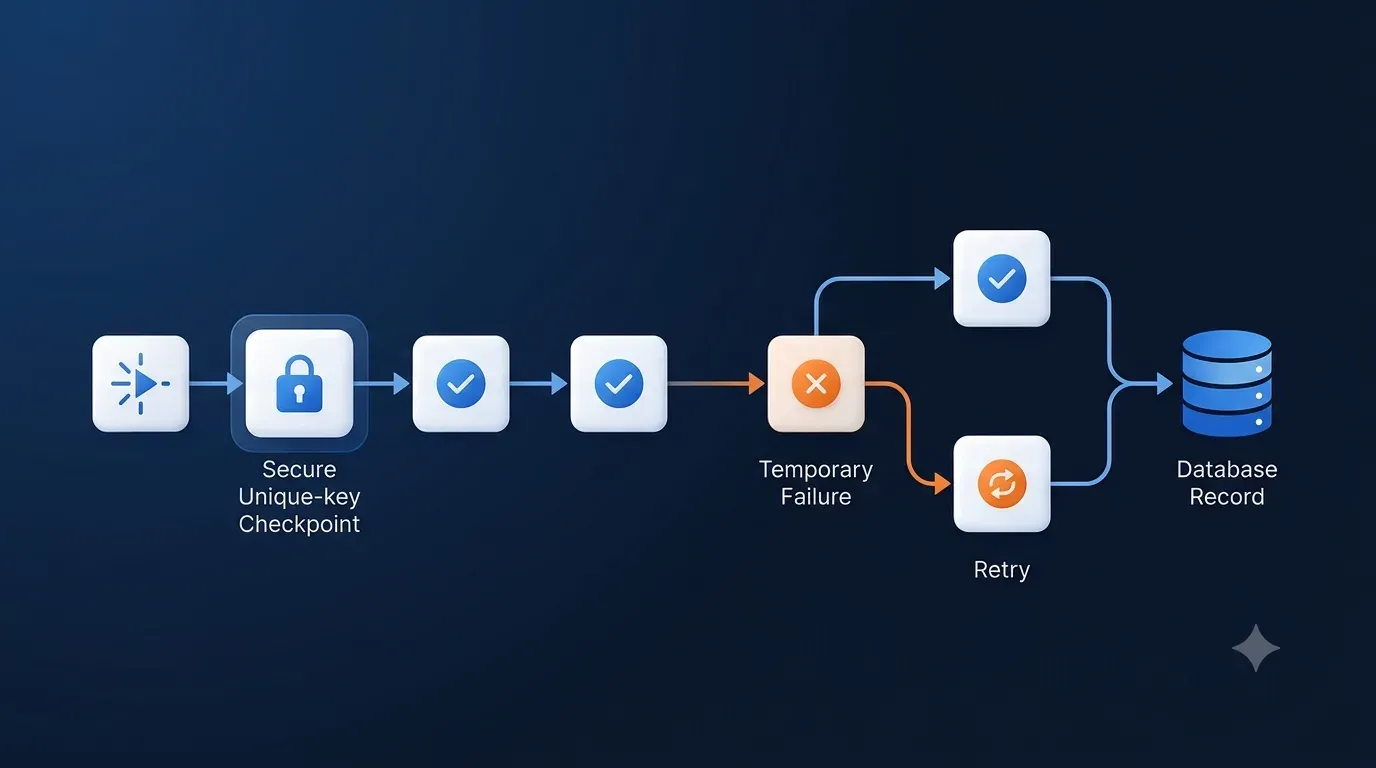
An n8n workflow may create a CRM contact successfully and then fail while sending an email or updating a spreadsheet. Re-running the entire execution can create another contact, order, or transaction. The answer is not to disable retries. It is to make every externally visible side effect idempotent: processing the same request repeatedly must produce the business effect only once.
A production-ready pattern has four layers: derive a stable idempotency_key from the original event; store processing state in a shared persistence layer; enforce atomicity with a unique constraint or conditional write; and retry only transient failures within a defined budget. When the same key returns, the workflow should return the stored result or resume from a safe state rather than create another record.
Root cause
Why can re-running an execution create duplicates?
A failed workflow does not imply that every earlier side effect was rolled back.
n8n coordinates independent systems, so there is no single transaction spanning a CRM, email provider, ERP, and spreadsheet. An API may commit a write and then time out before its response reaches n8n. The workflow sees an error but cannot tell whether the operation completed. This uncertain outcome is more dangerous than a clear failure before any write occurred.
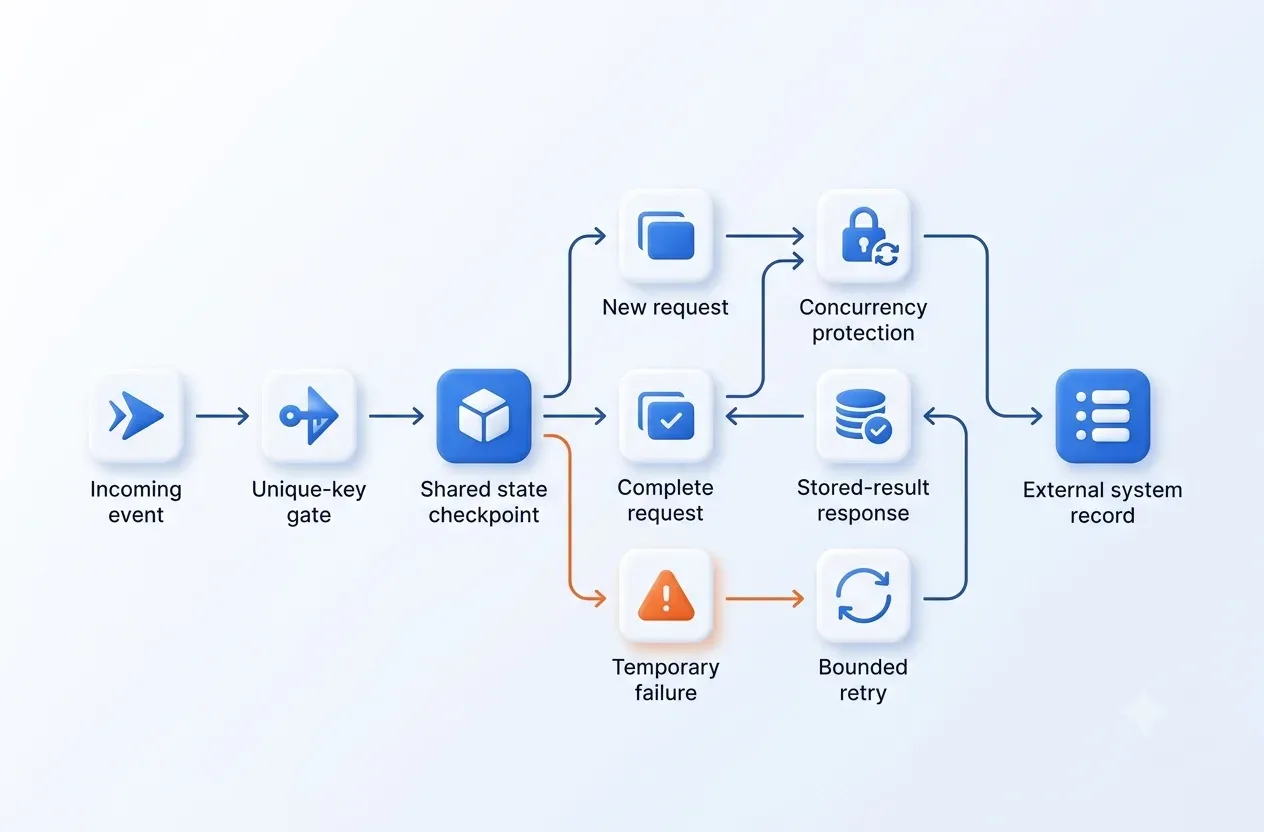
The highest-risk nodes create records, send notifications, decrement inventory, issue invoices, or trigger other workflows. Retry On Fail can help with transient errors, but it does not prevent duplication by itself. Manually re-running an execution can also repeat nodes that previously succeeded. Duplicate protection therefore belongs at the business-operation boundary or directly in front of it, not solely in n8n's retry configuration.
Core rule
Four safeguards to implement before enabling retries
Each layer covers a different failure mode; an IF node that checks for an existing record is not concurrency-safe on its own.
Stable key
Use the source event ID or a business key, and reuse the same key for every retry.
Atomic constraint
A unique index, INSERT ON CONFLICT, or conditional write prevents concurrent duplicate creation.
State machine
Track RECEIVED, PROCESSING, SUCCEEDED, RETRYABLE_FAILED, and PERMANENT_FAILED.
Selective retries
Retry timeouts, 429s, and selected 5xx errors; fail fast on bad data, authorization, and business-rule errors.

Design
Create the right idempotency key for each event
The key must represent one business intent, not one n8n execution.
Prefer an identifier supplied by the source system, such as order_id, payment_event_id, message_id, or form_submission_id. If no reliable ID exists, build a key from normalized immutable fields—for example, tenant_id + event_type + external_reference—and hash it with SHA-256. Do not use the n8n execution ID because a new run receives a new ID. A timestamp alone is also unsuitable because the same business request may arrive at different times.
Scope matters. A bare customer_id could block valid future orders from that customer, while a newly generated random UUID on every attempt cannot identify duplicates. Store a payload_hash as well. If the same key arrives with a different payload, stop with a conflict instead of silently applying new data to an old result. Set key retention according to the business replay window; payment webhooks may require a much longer window than a short synchronization task.
n8n implementation
A step-by-step retry-safe workflow pattern
Use shared state so every worker and execution observes the same source of truth.
- Receive and normalize: authenticate the webhook, normalize the fields used for the key, and preserve one correlation ID end to end.
- Register the request: atomically write the
idempotency_key,payload_hash,status=PROCESSING,locked_until, and received time. In PostgreSQL, use a unique index andINSERT ... ON CONFLICT; when the destination API supports idempotency, send the key in its designated header. - Branch on the stored state: proceed when the row was created. If it is already
SUCCEEDED, return the saved response or reference. If it isPROCESSINGwith a valid lease, finish as an in-flight duplicate. If the lease expired, allow exactly one execution to reclaim it through a conditional update. - Perform the side effect: pass the same key downstream. For systems without native support, maintain a key-to-external-ID mapping with a unique constraint in the integration layer.
- Seal the result: store
SUCCEEDED, the external ID, and the minimum response needed for replay. StoreRETRYABLE_FAILEDfor transient errors andPERMANENT_FAILEDfor invalid data or authorization failures. - Respond: a synchronous webhook should acknowledge success only after the required state is sealed. For long-running work, acknowledge acceptance and process asynchronously through a queue or outbox.
Avoid a standalone “SELECT, then INSERT” sequence without a transaction or uniqueness constraint. Two concurrent executions can both observe that no row exists and then both create one.
Retry policy
Which failures should be retried, and which should stop?
Retrying the wrong failures can amplify an outage and fill the queue.
Retry failures that are likely to clear on their own: network timeouts, brief connection loss, HTTP 429, and selected 502/503/504 responses. Set a maximum attempt count, progressively longer delays, and a small random variation so multiple executions do not retry in lockstep. Honor Retry-After when present. The total retry window must fit the business deadline and the destination's capacity.
Do not automatically retry 400/422 validation errors, 401/403 authentication or authorization failures, business-significant 404 responses, or failed business rules. Fail fast, record a clear reason, and route the item for manual review where appropriate. After a timeout on a create operation, query by idempotency key or external reference before attempting another create.
In n8n, Retry On Fail can be enabled on the appropriate node, while an Error Workflow can notify operators or coordinate error handling. Neither replaces the idempotency store. Avoid uncontrolled retries at the node, reverse proxy, queue, and parent-workflow layers simultaneously; appoint one primary retry owner and calculate the worst-case total call count.
Operations
Test and observe the design before production
Prove duplicate safety with failure injection, not only with the happy path.
Test at least six scenarios: the same payload twice in sequence; two concurrent executions; a timeout after the destination committed; a failure before the write; a worker stopping while holding a lease; and the same key with a different payload. Acceptance means there is only one side effect, retries receive the same external reference, an expired lease can be recovered, and conflicting payloads are rejected.
Monitor duplicates blocked, retries by error code, time spent in PROCESSING, reclaimed leases, permanent failures, queue depth, and the share of cases needing manual review. Logs should include the correlation ID, a masked idempotency key where sensitive, workflow/execution ID, attempt number, old and new state, and external reference. Do not log credentials, tokens, or complete payloads containing personal data.
Before release, confirm that every side-effect node is inventoried; key construction and scope are documented; unique constraints exist; states and timeouts are defined; retry budgets are bounded; dead-letter or manual review exists; dashboards and alerts are active; and the runbook explains how to replay without changing the key.
Frequently asked questions
FAQ: retries and duplicate data in n8n
Common decisions when moving a workflow from experimentation into reliable operations.
Is enabling Retry On Fail in n8n enough to prevent duplicates?
No. It only re-attempts a failed node. Protect the side effect with an idempotency key and an atomic database or destination-API operation.
Can the n8n execution ID be the idempotency key?
Not for full-workflow re-runs, because a new run gets a new execution ID. Use the source event ID or a business key that remains stable across all attempts.
Is an IF node that checks whether a record exists sufficient?
Not under concurrency. Use a unique constraint, upsert, or conditional write so the check-and-write boundary is atomic.
What if the API created the record but n8n timed out?
Do not immediately create it again. Look it up by idempotency key or external reference. If found, store that result and mark the operation SUCCEEDED; retry creation only when there is evidence that the first mutation did not occur.
How long should an idempotency key be retained?
Match the period in which the same business operation might be replayed and the severity of duplication. Define TTL by event type, but retain audit evidence longer for payments, invoices, and orders when required.
FlowNexa
Need an n8n workflow that can retry without compromising data?
FlowNexa can help review side effects and design idempotency keys, retry policies, logging, and recovery paths that fit your current systems.
Start with high-risk workflows
Prioritize orders, payments, CRM, email, and flows that write to multiple systems.
Use testable acceptance criteria
Validate with concurrent replay and injected timeouts before enabling retries in production.


