


What Does AI Assistant Operating Cost Include and How Can It Be Optimised?
A practical breakdown of AI Assistant operating cost across models, RAG, infrastructure, integrations, monitoring, support, and unit economics.
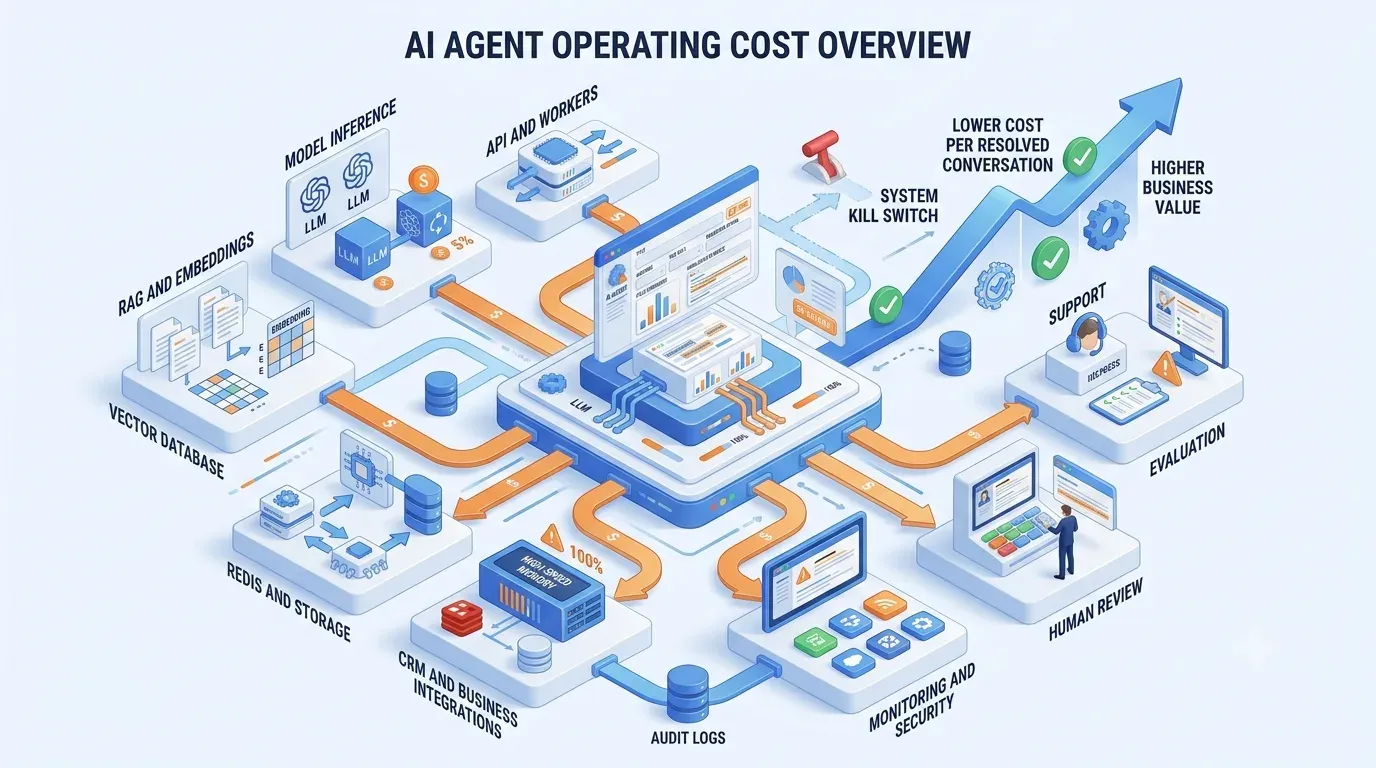
The operating cost of an AI assistant is not just what you pay for the model. The total also includes embeddings, RAG, a vector database, backend services, workers, storage, monitoring, security, integrations, support, quality evaluation, and the operations team's time.
If a business only looks at token cost, the system may look cheap while money leaks through retries, overly long context, weak retrieval, errors handled by hand, idle infrastructure, or constant support.
Core principle
The right optimisation target is total cost per correct outcome, not the smallest token bill.
Cost management
Which layers make up the cost of an AI assistant?
Look at the whole lifecycle, from request to production operations.
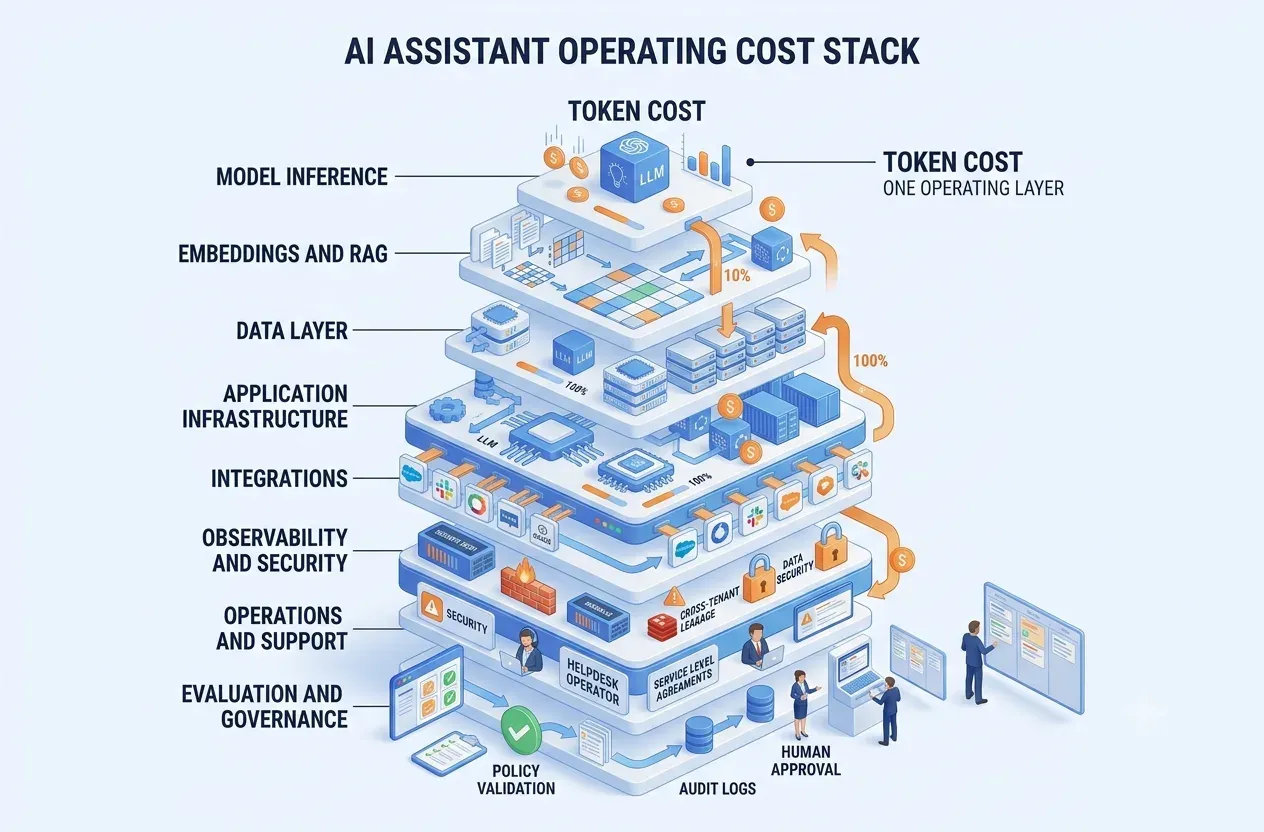
Cost stack
Eight main cost groups
Practical cost drivers, controls, and optimisation opportunities.
Model inference
Measure this item by tenant, channel, use case, quality, and outcome.
Embedding and RAG
Measure this item by tenant, channel, use case, quality, and outcome.
Data layer
Measure this item by tenant, channel, use case, quality, and outcome.
Application infrastructure
Measure this item by tenant, channel, use case, quality, and outcome.
Integration
Measure this item by tenant, channel, use case, quality, and outcome.
Observability and security
Measure this item by tenant, channel, use case, quality, and outcome.
Operations and support
Measure this item by tenant, channel, use case, quality, and outcome.
Evaluation and governance
Measure this item by tenant, channel, use case, quality, and outcome.
Cost management
Model inference is the most visible part
Cost depends on volume, context, output, and routing.
One conversation may call the model several times for intent routing, query rewriting, answer generation, tool planning, safety checks, and summarisation. Actual token use is therefore usually higher than what the user sees.
Model drivers
Factors that drive cost up
Practical cost drivers, controls, and optimisation opportunities.
Context too long
Measure this item by tenant, channel, use case, quality, and outcome.
Output too long
Measure this item by tenant, channel, use case, quality, and outcome.
Over-powered model
Measure this item by tenant, channel, use case, quality, and outcome.
Retry and fallback
Measure this item by tenant, channel, use case, quality, and outcome.
Multi-agent chain
Measure this item by tenant, channel, use case, quality, and outcome.
Tool-call loop
Measure this item by tenant, channel, use case, quality, and outcome.
Cost management
RAG improves grounding but is not free
The cost sits in ingestion, embedding, retrieval, reranking, and storage.
RAG drivers
Components to track
Practical cost drivers, controls, and optimisation opportunities.
Document ingestion
Measure this item by tenant, channel, use case, quality, and outcome.
Embedding generation
Measure this item by tenant, channel, use case, quality, and outcome.
Query embedding
Measure this item by tenant, channel, use case, quality, and outcome.
Vector search
Measure this item by tenant, channel, use case, quality, and outcome.
Reranking
Measure this item by tenant, channel, use case, quality, and outcome.
Re-indexing
Measure this item by tenant, channel, use case, quality, and outcome.
Cost management
Backend and data layers can cost more than the model
Especially when the system runs 24/7 on low traffic.
Always-on replicas, an oversized database, workers without autoscaling, or excessive logging can cost more than inference. Realtime, background, and batch workloads should run under different operating models.
Infrastructure
Main cost groups
Practical cost drivers, controls, and optimisation opportunities.
API runtime
Measure this item by tenant, channel, use case, quality, and outcome.
Workers and queues
Measure this item by tenant, channel, use case, quality, and outcome.
Database
Measure this item by tenant, channel, use case, quality, and outcome.
Redis
Measure this item by tenant, channel, use case, quality, and outcome.
Object storage
Measure this item by tenant, channel, use case, quality, and outcome.
Network
Measure this item by tenant, channel, use case, quality, and outcome.
Cost management
Connectors, review, and support are real costs
Do not treat them as invisible overhead.
Hidden costs
Easily overlooked costs
Practical cost drivers, controls, and optimisation opportunities.
API and channel fees
Measure this item by tenant, channel, use case, quality, and outcome.
Reconciliation
Measure this item by tenant, channel, use case, quality, and outcome.
Content operations
Measure this item by tenant, channel, use case, quality, and outcome.
Quality review
Measure this item by tenant, channel, use case, quality, and outcome.
Incident response
Measure this item by tenant, channel, use case, quality, and outcome.
Customer support
Measure this item by tenant, channel, use case, quality, and outcome.
Cost management
Which unit should cost be measured in?
Cost per token is not enough for business decisions.
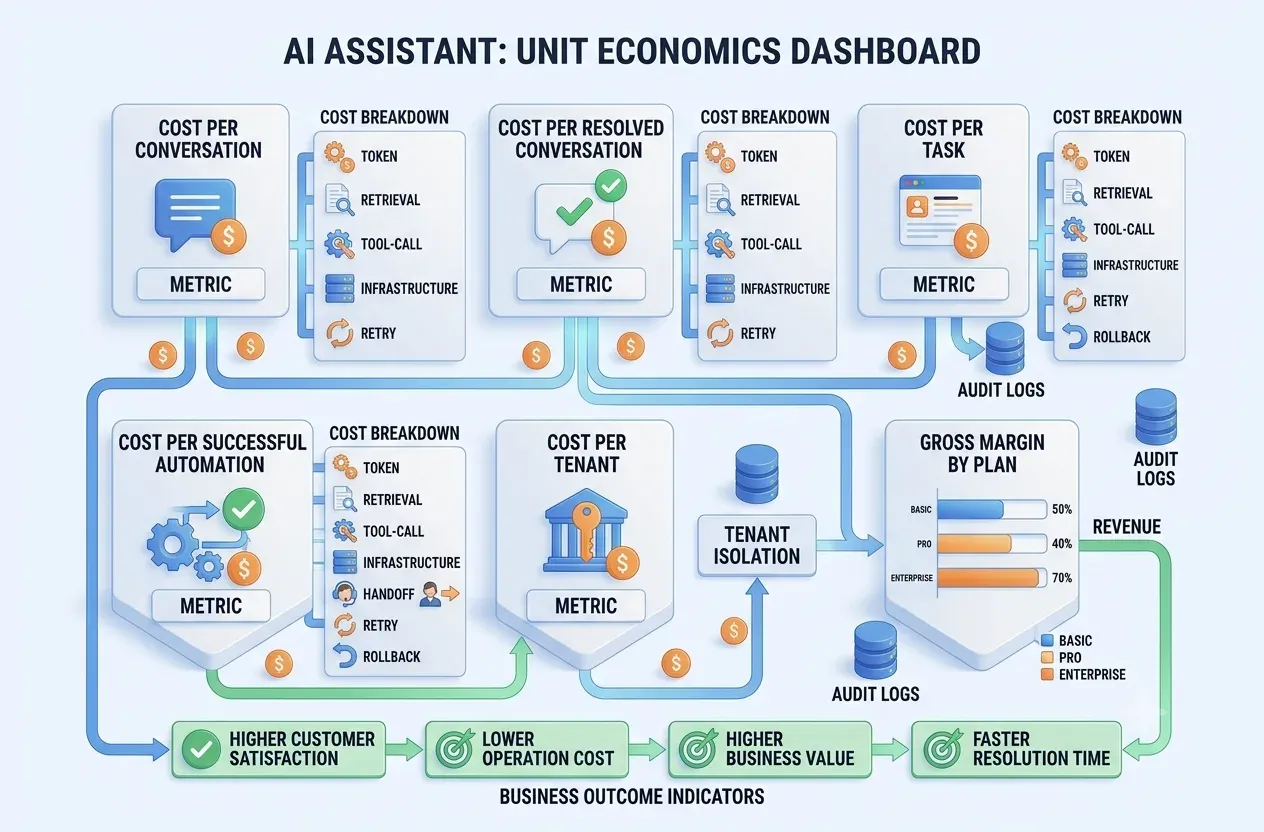
Metrics
Metrics to track
Practical cost drivers, controls, and optimisation opportunities.
Cost per conversation
Measure this item by tenant, channel, use case, quality, and outcome.
Cost per resolved conversation
Measure this item by tenant, channel, use case, quality, and outcome.
Cost per task
Measure this item by tenant, channel, use case, quality, and outcome.
Cost per successful automation
Measure this item by tenant, channel, use case, quality, and outcome.
Cost per tenant
Measure this item by tenant, channel, use case, quality, and outcome.
Gross margin per plan
Measure this item by tenant, channel, use case, quality, and outcome.
Cost management
Use model routing instead of one model for everything
Simple tasks do not need the most expensive model.
Model optimisation
Effective techniques
Practical cost drivers, controls, and optimisation opportunities.
Task-based routing
Measure this item by tenant, channel, use case, quality, and outcome.
Prompt compression
Measure this item by tenant, channel, use case, quality, and outcome.
Output limits
Measure this item by tenant, channel, use case, quality, and outcome.
Conversation summarisation
Measure this item by tenant, channel, use case, quality, and outcome.
Early exit
Measure this item by tenant, channel, use case, quality, and outcome.
Cache deterministic results
Measure this item by tenant, channel, use case, quality, and outcome.
Cost management
Good retrieval reduces both tokens and errors
Do not raise Top-K to compensate for poor chunking.
RAG optimisation
Steps to prioritise
Practical cost drivers, controls, and optimisation opportunities.
Structure-aware chunks
Measure this item by tenant, channel, use case, quality, and outcome.
Hybrid retrieval
Measure this item by tenant, channel, use case, quality, and outcome.
Metadata filter
Measure this item by tenant, channel, use case, quality, and outcome.
Adaptive Top-K
Measure this item by tenant, channel, use case, quality, and outcome.
Selective reranking
Measure this item by tenant, channel, use case, quality, and outcome.
Incremental indexing
Measure this item by tenant, channel, use case, quality, and outcome.
Cost management
Scale to real workload, not assumptions
Separate realtime, batch, and background work.
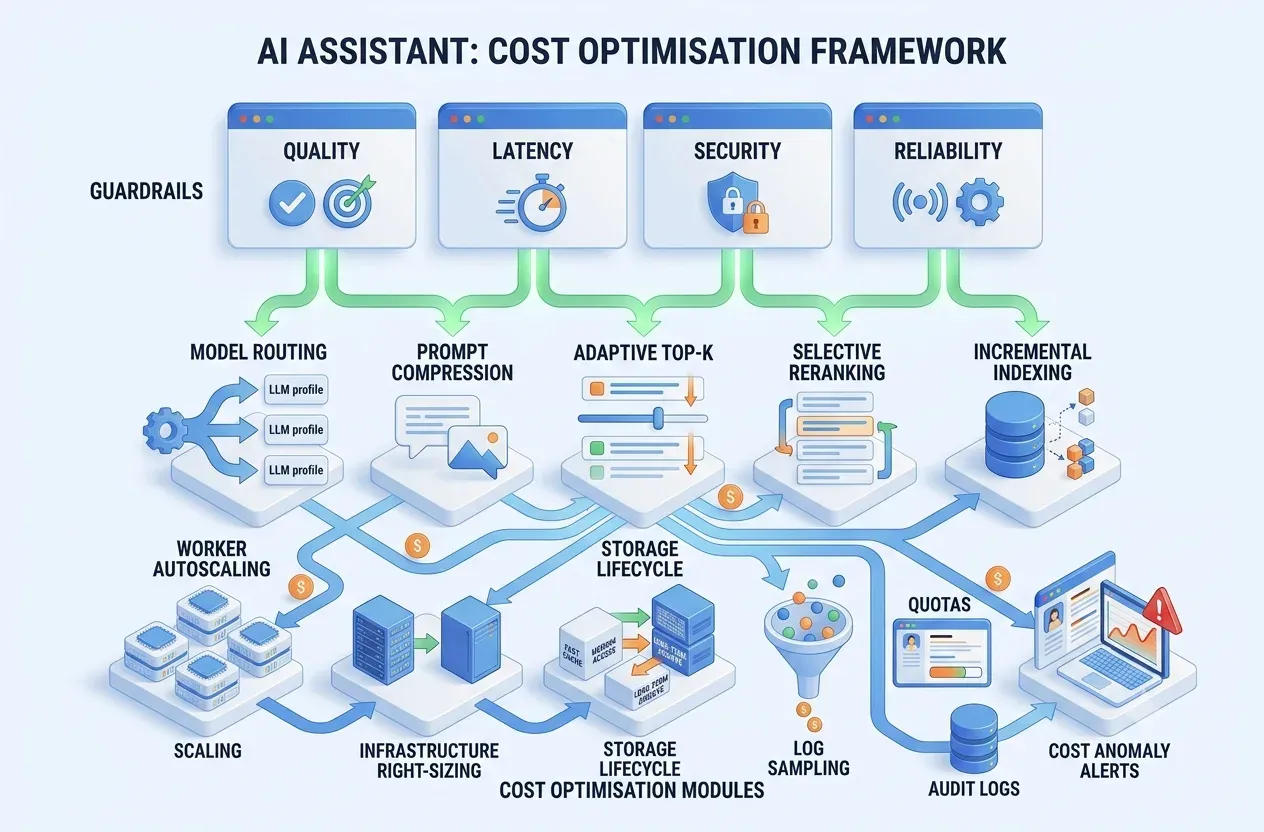
Infrastructure optimisation
Ways to reduce cost
Practical cost drivers, controls, and optimisation opportunities.
Right-size requests and limits
Measure this item by tenant, channel, use case, quality, and outcome.
Autoscale worker
Measure this item by tenant, channel, use case, quality, and outcome.
Schedule batch jobs
Measure this item by tenant, channel, use case, quality, and outcome.
Storage lifecycle
Measure this item by tenant, channel, use case, quality, and outcome.
Log sampling
Measure this item by tenant, channel, use case, quality, and outcome.
Regional design
Measure this item by tenant, channel, use case, quality, and outcome.
Cost management
Without quotas, gross margin is hard to control
Every tenant and plan needs clear limits.
Commercial controls
Controls to have
Practical cost drivers, controls, and optimisation opportunities.
Conversation quota
Measure this item by tenant, channel, use case, quality, and outcome.
Token budget
Measure this item by tenant, channel, use case, quality, and outcome.
Rate limit
Measure this item by tenant, channel, use case, quality, and outcome.
Feature tiering
Measure this item by tenant, channel, use case, quality, and outcome.
Overage policy
Measure this item by tenant, channel, use case, quality, and outcome.
Cost anomaly alert
Measure this item by tenant, channel, use case, quality, and outcome.
Cost management
In which order should you optimise?
Start with the largest cost driver.
Phase 1
Measure a baseline
Practical cost drivers, controls, and optimisation opportunities.
Tag request
Measure this item by tenant, channel, use case, quality, and outcome.
Calculate unit cost
Measure this item by tenant, channel, use case, quality, and outcome.
Find expensive flows
Measure this item by tenant, channel, use case, quality, and outcome.
Measure quality
Measure this item by tenant, channel, use case, quality, and outcome.
Set SLOs
Measure this item by tenant, channel, use case, quality, and outcome.
Phase 2
Quick wins
Practical cost drivers, controls, and optimisation opportunities.
Reduce repeated context
Measure this item by tenant, channel, use case, quality, and outcome.
Limit output
Measure this item by tenant, channel, use case, quality, and outcome.
Model routing
Measure this item by tenant, channel, use case, quality, and outcome.
Fix retry loops
Measure this item by tenant, channel, use case, quality, and outcome.
Right-size infra
Measure this item by tenant, channel, use case, quality, and outcome.
Phase 3
Optimise the system
Practical cost drivers, controls, and optimisation opportunities.
Adaptive retrieval
Measure this item by tenant, channel, use case, quality, and outcome.
Quota theo tenant
Measure this item by tenant, channel, use case, quality, and outcome.
Batch processing
Measure this item by tenant, channel, use case, quality, and outcome.
Outcome dashboard
Measure this item by tenant, channel, use case, quality, and outcome.
Continuous review
Measure this item by tenant, channel, use case, quality, and outcome.
Cost management
Cutting cost while quality drops
A cheap system that answers wrongly is not optimised.
Anti-patterns
Mistakes to avoid
Practical cost drivers, controls, and optimisation opportunities.
Only switching to a cheaper model
Measure this item by tenant, channel, use case, quality, and outcome.
Cutting context too aggressively
Measure this item by tenant, channel, use case, quality, and outcome.
Lowering Top-K arbitrarily
Measure this item by tenant, channel, use case, quality, and outcome.
Turning logging off entirely
Measure this item by tenant, channel, use case, quality, and outcome.
Scaling down too far
Measure this item by tenant, channel, use case, quality, and outcome.
Ignoring support cost
Measure this item by tenant, channel, use case, quality, and outcome.
Every optimisation change should be evaluated on cost, quality, latency, and business outcome at the same time.
Cost management
How FlowNexa helps optimise AI assistant cost
Lower unit cost while keeping quality, security, and outcomes.
Services
Support scope
Practical cost drivers, controls, and optimisation opportunities.
AI Cost Assessment
Measure this item by tenant, channel, use case, quality, and outcome.
Unit Economics Dashboard
Measure this item by tenant, channel, use case, quality, and outcome.
Model & RAG Optimisation
Measure this item by tenant, channel, use case, quality, and outcome.
Infrastructure Right-sizing
Measure this item by tenant, channel, use case, quality, and outcome.
Quota & Pricing Design
Measure this item by tenant, channel, use case, quality, and outcome.
Managed AI Operations
Measure this item by tenant, channel, use case, quality, and outcome.
FlowNexa's view
The right optimisation target is total cost per correct outcome, not the smallest token bill.
Cost management
Frequently asked questions
Answers focused on real operations.
FAQ
Quick answers
Practical cost drivers, controls, and optimisation opportunities.
Is the model always the biggest cost?
Measure this item by tenant, channel, use case, quality, and outcome.
Should small models be used for every task?
Measure this item by tenant, channel, use case, quality, and outcome.
Does RAG reduce cost?
Measure this item by tenant, channel, use case, quality, and outcome.
Charge per token or per conversation?
Measure this item by tenant, channel, use case, quality, and outcome.
How do we know the system is losing money?
Measure this item by tenant, channel, use case, quality, and outcome.
Can FlowNexa audit our current costs?
Measure this item by tenant, channel, use case, quality, and outcome.
FlowNexa AI Operations
Cut cost without cutting quality
Practical cost drivers, controls, and optimisation opportunities.
Book an AI Cost consultation
Measure this item by tenant, channel, use case, quality, and outcome.
Request an AI Cost Assessment
Measure this item by tenant, channel, use case, quality, and outcome.
