


Department-aware enterprise AI: deploying a permission-controlled knowledge assistant
A practical internal AI assistant guide for SMEs: diagnosis, rollout, security, KPIs and acceptance checklist.

Department-aware enterprise AI: deploying a permission-controlled knowledge assistant
For HR, Sales, Marketing and Finance, start by naming the process owner, permitted data and acceptance criteria. Internal ai assistant should not begin with purchasing tools and searching for a use case afterward. Assess risk, run a controlled pilot and measure outcomes before scaling. This guide gives technical and business decision-makers a practical approach.
Guide
Start with the business problem
Define scope before investing
When is this problem worth solving?
Warning signs include person-dependent workflows, fragmented data, service quality that cannot be demonstrated, and operating costs without clear accountability. Before investing, document each task, owner, frequency, risk, processing time and business impact of failure. Do not assume a new solution saves money: establish a baseline first.
Diagnose before selecting a solution
- Scope: identify pilot systems and users; exclude unapproved sensitive cases.
- Data: review completeness, authoritative sources, retention and access rights.
- Risk: describe the impact of incorrect, slow or unavailable outputs.
- Accountability: distinguish business approvers, IT operators and suppliers.
If these questions remain unanswered, prioritize discovery rather than broad rollout.
Implementation
A controlled rollout
Each step has an owner and evidence
Step-by-step implementation
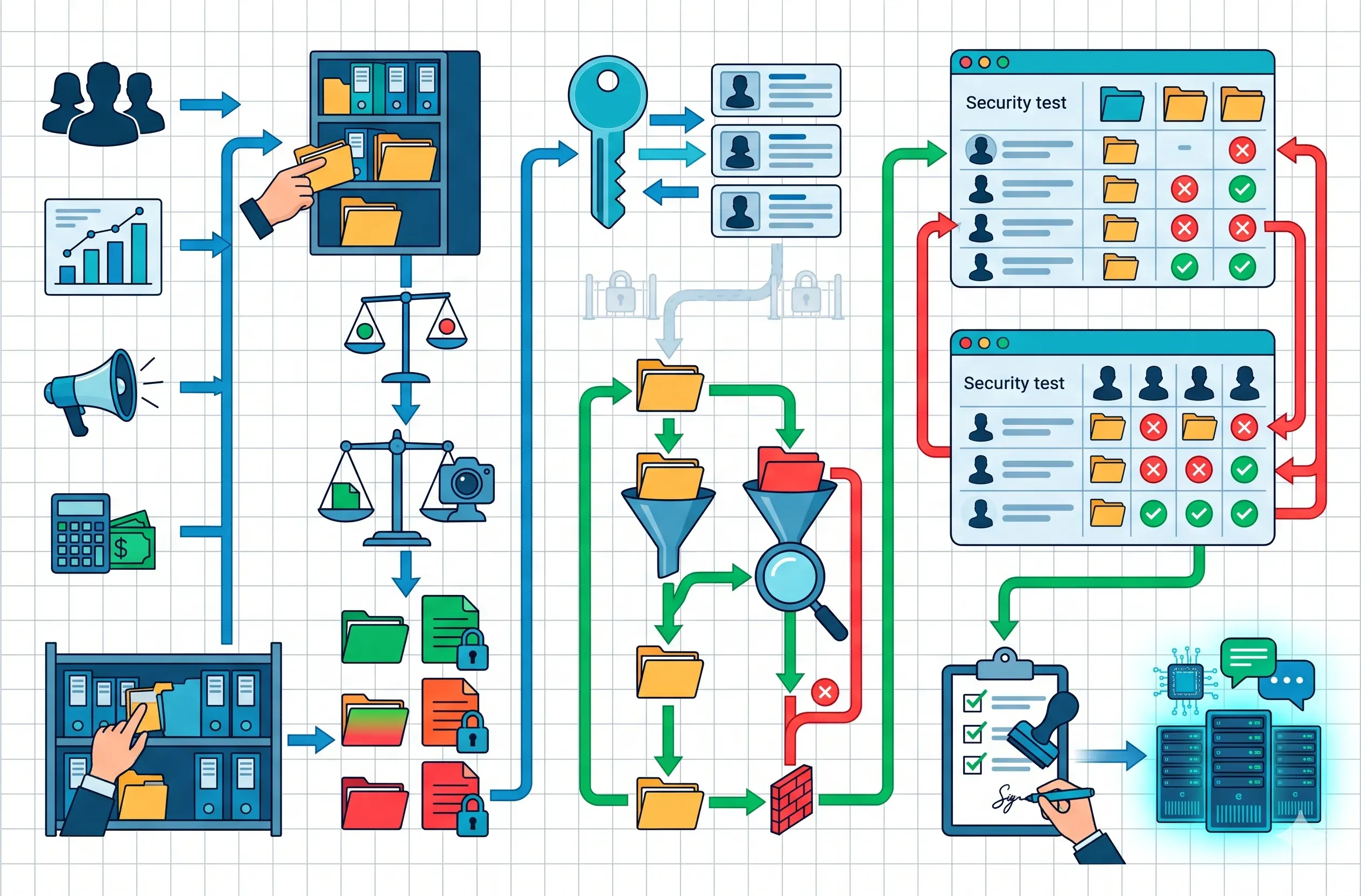
- Inventory document owners. Record execution evidence, the accountable owner and exit criteria before proceeding.
- Classify sensitivity. Record execution evidence, the accountable owner and exit criteria before proceeding.
- Synchronize SSO permissions. Record execution evidence, the accountable owner and exit criteria before proceeding.
- Filter documents before retrieval. Record execution evidence, the accountable owner and exit criteria before proceeding.
- Test cross-department access. Record execution evidence, the accountable owner and exit criteria before proceeding.
- Approve before go-live. Record execution evidence, the accountable owner and exit criteria before proceeding.
Governance
Build in safety and recovery
Manage risk from the pilot onward
Security, change control and rollback
Apply least privilege, strong administrator authentication, appropriate encryption and audit logging for critical actions. Separate testing from production; every change needs approval, a path back to a stable configuration and stop conditions. For external integrations, check secrets, token expiry, timeouts, bounded retries and duplicate handling. Review legal, contractual and data-residency requirements for the actual use case.
KPIs and acceptance checklist
Track processing time, success rate, manual interventions, availability, security incidents and cost per unit of work. Set thresholds from your own baseline; avoid unverified savings claims. Accept the solution only when ownership, runbooks, failure tests, rollback evidence, reviewed permissions and a post-launch review date are documented.
Practical guidance
Classify sources before indexing
Know which documents are sensitive and who may see them before indexing.
Attach owner, department, sensitivity, effective date, version and allowed groups to each source. Do not index documents without ownership or approval state. Separate public, internal, confidential and personal data.
When source systems have ACLs, preserve or synchronize them rather than creating an ungoverned copy. Permission changes must update or invalidate indexes and caches.

Practical guidance
Identity-aware retrieval
The assistant retrieves only documents the asker is allowed to see.
Authenticate the requester, obtain trusted groups, roles or attributes, then filter candidate documents before sending content to the model. Apply least privilege and fail closed when authorization cannot be evaluated.
Answers should cite source and version. Do not let the model decide access from question wording. Every source used in a synthesis must be authorized for the requester.
Practical guidance
Test leakage and retain audit evidence
Probe for over-permissioned answers and keep logs as evidence.
Test valid and invalid users, department changes, revoked documents, prompt injection and cross-document synthesis. Ensure logs do not over-collect sensitive content.
Audit who asked, which sources were retrieved, the policy decision and configuration version without recording private reasoning. Maintain a process to invalidate caches, investigate and notify when authorization errors occur.
Measurement
Questions before committing
Validate feasibility and expectations
Frequently asked questions (FAQ)
Should we roll this out company-wide immediately?
No. Start with one bounded workflow or user group that can be rolled back.
How should we estimate the budget?
Include implementation, licenses, infrastructure, maintenance, security and internal staff time; compare against the baseline.
Who owns the data?
The organization should appoint a data owner; implementation partners process data within agreed permissions and scope.
When is production release appropriate?
Only after functional, security, operational and recovery tests meet approved acceptance criteria.
How can we measure results?
Compare pre- and post-pilot KPIs for similar workloads while tracking quality and risk.
Can a prompt replace access control?
No. Prompts are not authorization mechanisms.
Can all departments share one store?
Only with tested document-level authorization; separation may reduce risk.
Should every answer be logged?
Balance investigation needs with privacy, retention and sensitive data.
FlowNexa
Discuss your use case with FlowNexa
FlowNexa can help assess the current environment, define a bounded pilot and agree on acceptance criteria before committing to implementation.
Discovery conversation
Share the business problem, existing systems and constraints.
Initial priorities
Get a practical shortlist of what to validate, without premature outcome guarantees.
