


Skip to content
FlowNexa
  • AI Services
  • Solutions
  • About
  • Blog
VIEN
Book a consultation
Back to Blog
Managed Services11 min readFlowNexa Editorial Team

Managed Services vs In-House IT: Which Operating Model Should Businesses Choose?

Compare Managed Services, in-house IT, and hybrid operations by cost, capability, risk, control, and scalability for SMEs.

Updated: Aug 7, 2026
Managed Services vs In-House IT: Which Operating Model Should Businesses Choose?

As businesses rely more heavily on Microsoft 365, Cloud platforms, websites, sales systems, customer data, and SaaS applications, the question of who should operate IT becomes as important as the technology choices themselves.

Some companies build an in-house IT team for direct control. Others choose Managed Services to gain faster access to Cloud, security, backup, monitoring, and operational expertise. In practice, the best answer is not always one or the other; many SMEs achieve better results with a hybrid model.

Key principle

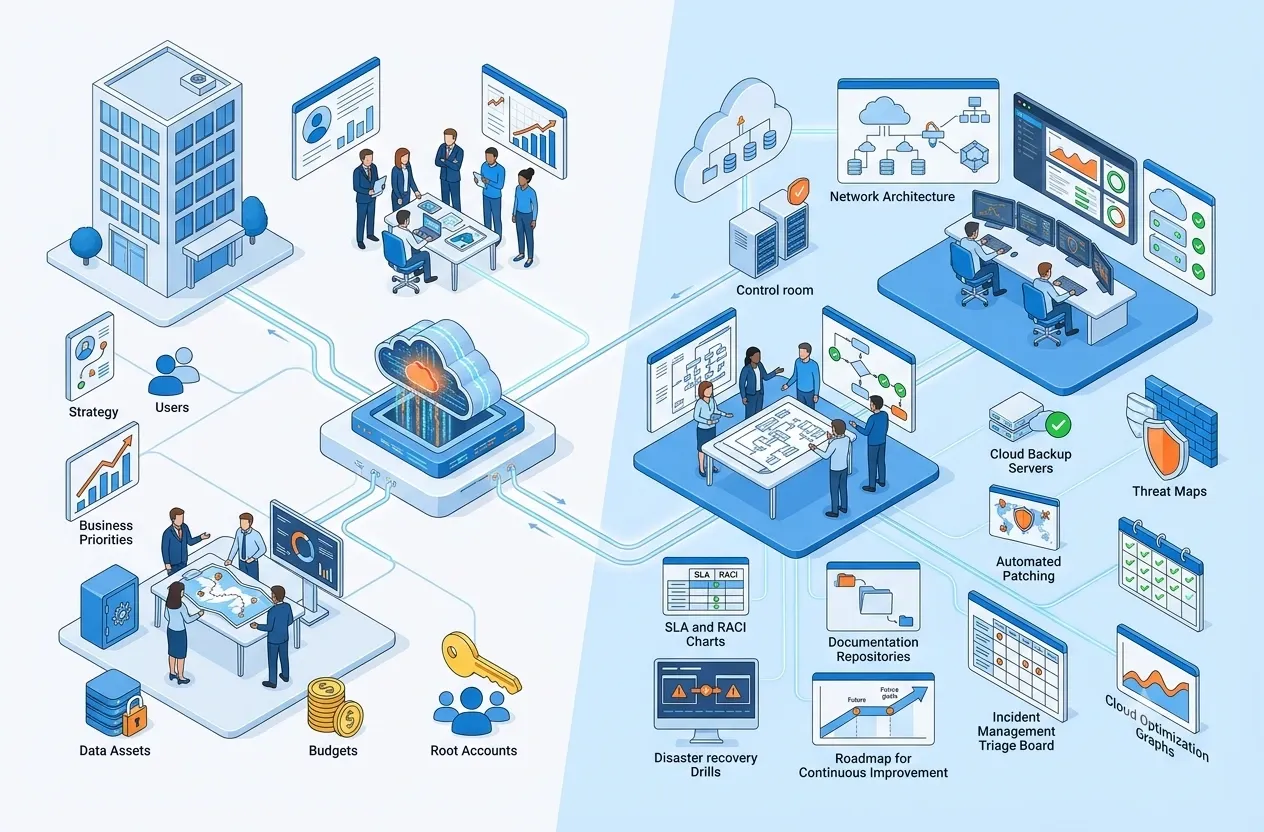
Managed Services do not remove the business's responsibility. A provider may operate technology, but the business must still own decisions, data, accounts, budgets, and accepted risk.

Overview

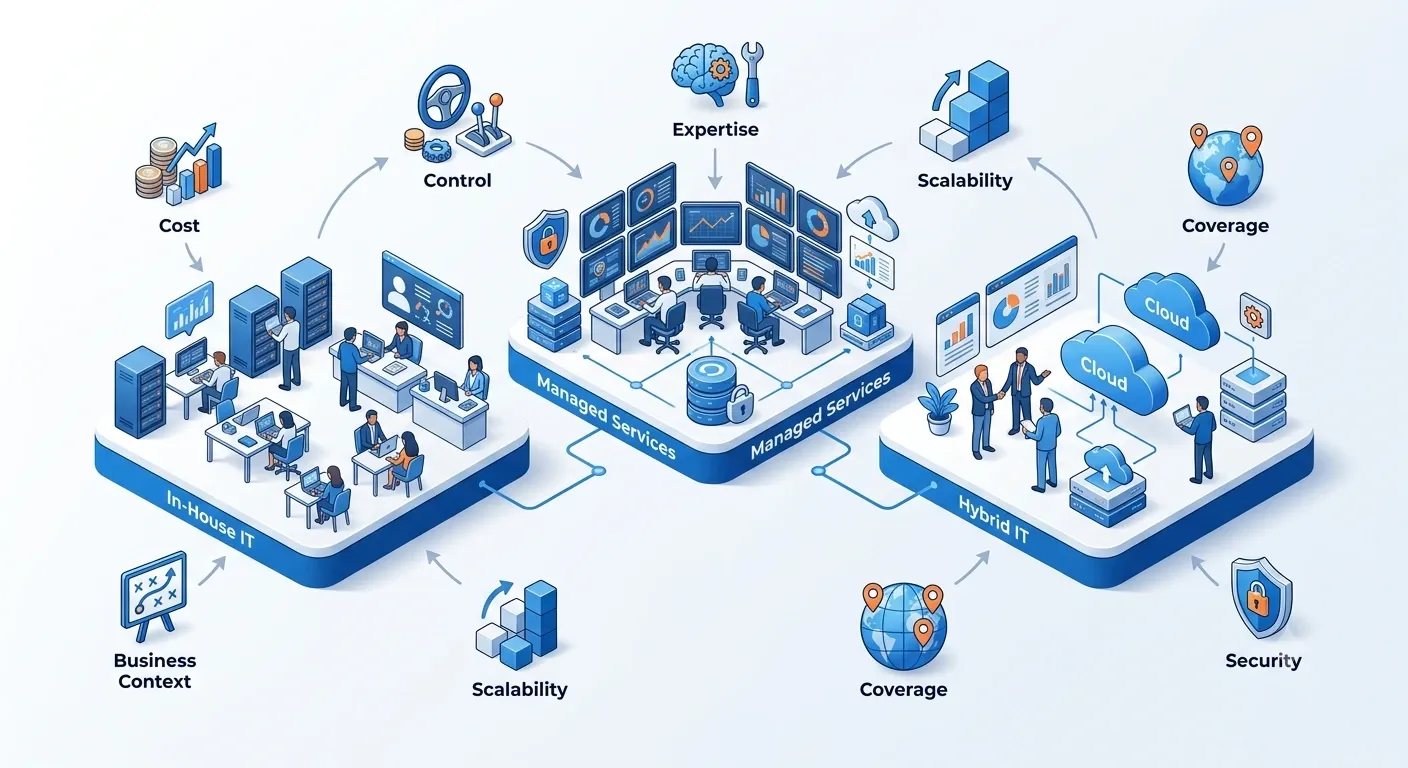
Three common IT operating models

In-house IT, Managed Services, and hybrid operations each have different strengths, limits, and conditions for success.
Models

The three main options

The comparison should not be based only on monthly staffing cost.

In-house IT

The business hires and directly manages the team responsible for systems, users, and vendors.

Managed Services

An external provider delivers operational capability under an agreed scope, SLA, and service model.

Hybrid

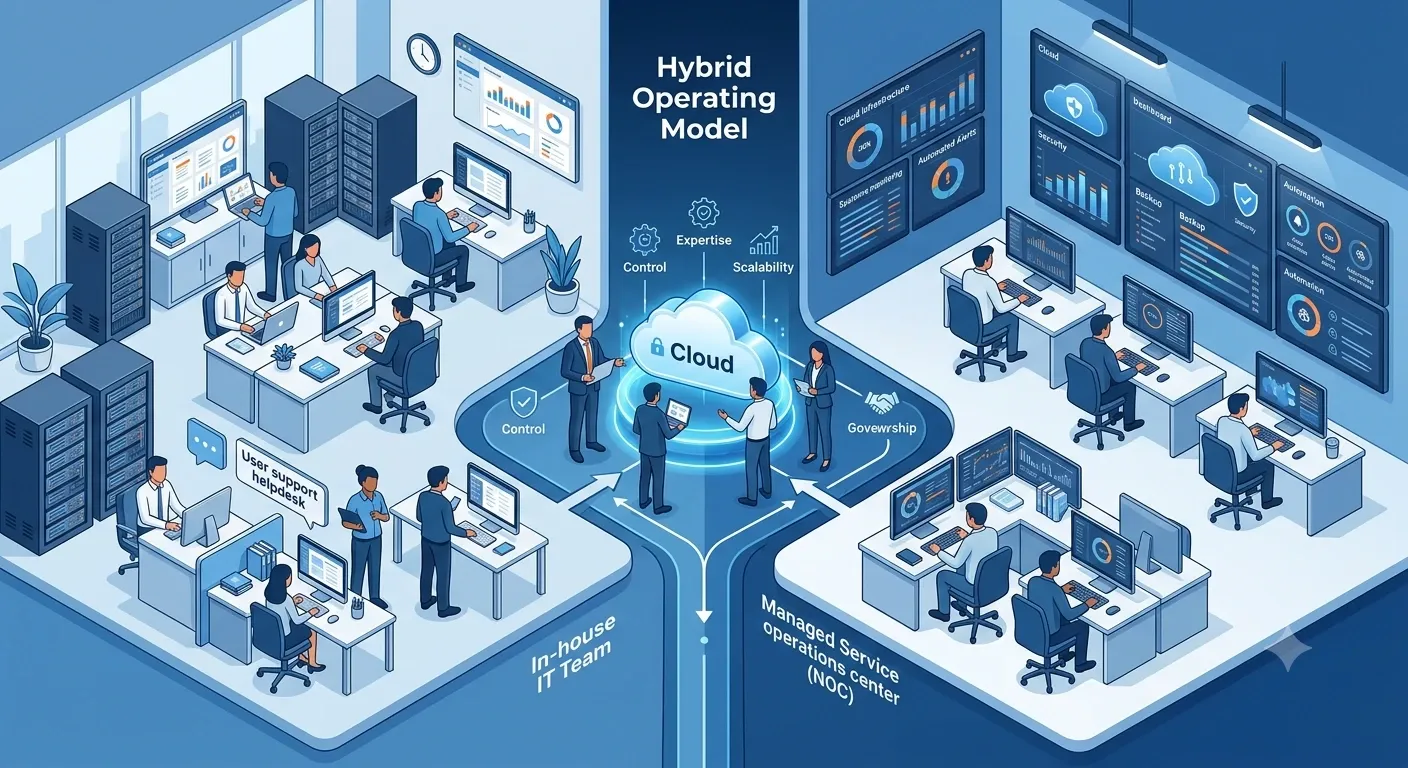
The internal team retains business context and governance while the provider supplies specialist or 24/7 capabilities.

In-house IT

When does an internal team create an advantage?

In-house IT is valuable when business context, direct collaboration, and immediate control matter.

Advantages

Strengths of an in-house team

The primary advantage is deep knowledge of the business and direct access to users.

Business-process knowledge

The team understands users, applications, data, and operational priorities.

Fast on-site response

Device, office network, and user-support issues can be handled directly.

Priority control

The business can assign resources to its most important initiatives.

Internal knowledge retention

System history and operational knowledge remain inside the organization.

However, building a complete IT function requires more than hiring one technician. A business may need helpdesk, networking, systems, Cloud, security, DevOps, database, backup, and compliance skills. For SMEs, one or two people rarely provide sufficient depth across every area.

Limitations

Common risks of a small internal team

Risk rises quickly when systems depend on one individual.

Low bus factor

A resignation or absence can interrupt operations.

Difficult specialist hiring

Cloud, security, and DevOps skills are expensive and competitive.

Limited after-hours coverage

Incidents may not be detected or handled quickly.

Competing priorities

Daily support work can consume time needed for improvement and security.

Inconsistent standards

Runbooks, patching, restore tests, and monitoring may be neglected.

Managed Services

What does a Managed Service actually provide?

The value comes from process, tooling, team capability, and repeatable operations rather than outsourced labor alone.

Capabilities

Typical Managed Service scope

The actual scope must be clearly defined in the contract and SLA.

Monitoring and alerting

Track availability, performance, capacity, and critical events.

Backup and recovery

Manage backup schedules, retention, restore tests, and disaster recovery.

Security operations

Patching, vulnerability management, access review, audit, and incident support.

Cloud operations

Operate AWS, Azure, Kubernetes, databases, storage, and networking.

User and SaaS administration

Microsoft 365, accounts, licensing, onboarding, and offboarding.

Reporting and governance

Provide periodic reports on incidents, changes, risks, cost, and improvements.

Managed Services are useful when a business needs specialist capability quickly without hiring every role. They can also standardize operations through tickets, SLAs, monitoring, escalation, change management, and reporting.

Risks

Managed Services also have limitations

Outsourcing does not transfer every responsibility to the provider.

Unclear scope

Out-of-scope work may be delayed or create additional cost.

Provider dependency

Weak documentation and account ownership increase vendor lock-in.

Limited business context

A provider may solve the technical issue without understanding business priority.

Misleading SLA

Fast response time does not always mean fast recovery.

Uneven quality

Capability depends on the actual team, process, and provider transparency.

Cost

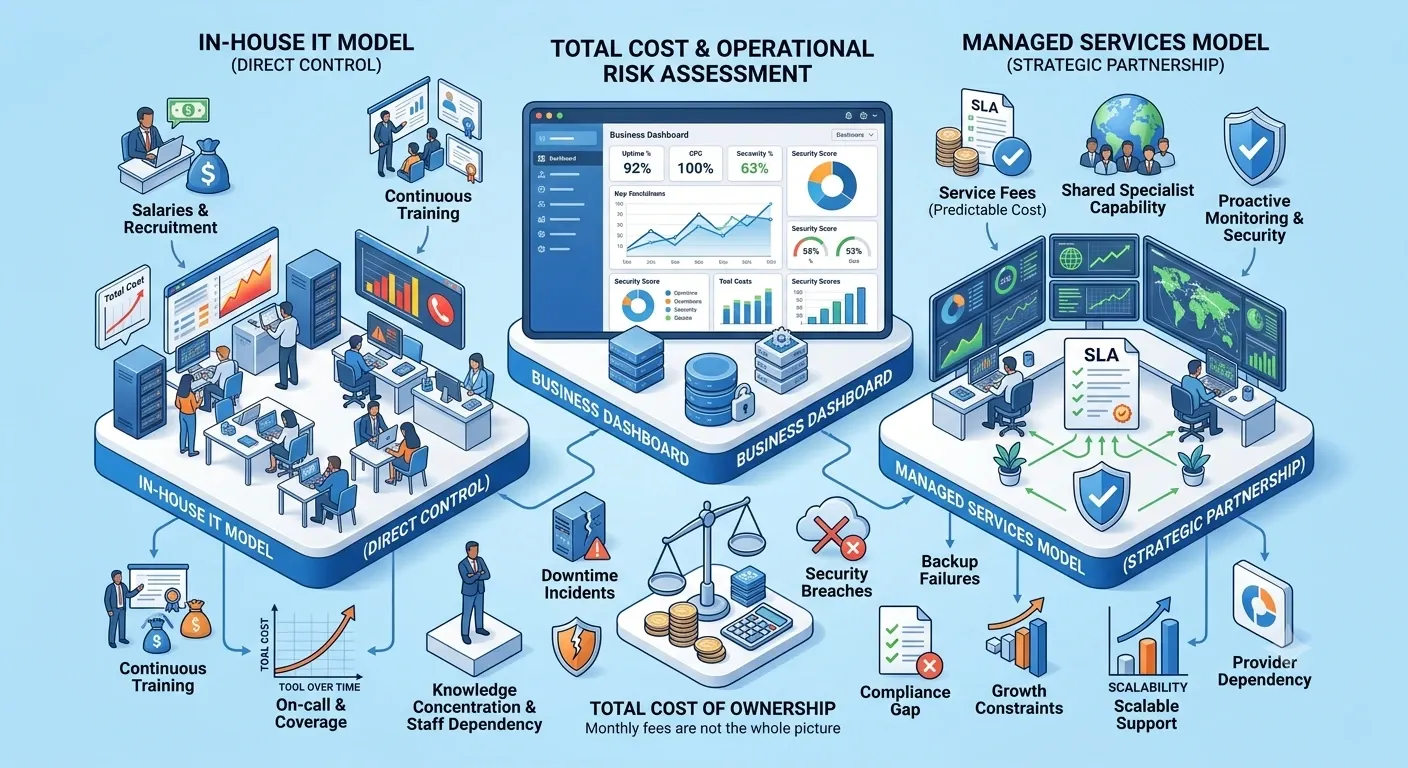
Do not compare only salaries and service fees

Total cost includes recruitment, tooling, after-hours coverage, training, downtime risk, and specialist capability.

TCO

Costs to include

A model that looks cheaper on paper may become expensive during an incident.

People

Salary, benefits, hiring, onboarding, training, and replacement.

Tools

Monitoring, ticketing, backup, security scanning, logging, and password management.

After-hours coverage

On-call, overtime, escalation, and 24/7 incident response.

Downtime

Lost revenue, productivity, data, and reputation.

Specialist expertise

Cloud architecture, security, database, DevOps, and compliance.

Governance

Audit, reporting, documentation, change management, and vendor oversight.

Decision framework

When should a business choose in-house IT, Managed Services, or hybrid?

The decision should reflect system criticality, current capability, and business growth.

There is no single operating model that fits every business. The decision should reflect system criticality, hiring capability, after-hours support requirements, specialist needs, and the role technology plays in business operations. The model should also be reviewed periodically because operational requirements change as the business grows.

In-house IT

Prioritize an internal team when

This model works when the business can sustain multiple technical capabilities.

IT is a core capability

Technology directly creates product or operational advantage.

Continuous business collaboration is required

The team must work closely with departments every day.

Recruitment scale and budget are available

The business can support a team, career paths, and on-call coverage.

Data or compliance requires direct control

Some responsibilities must remain inside the organization.

Managed Services

Prioritize a provider when

This model works when capability is needed quickly and predictably.

The current IT team is small

Cloud, security, monitoring, or backup expertise is missing.

Systems require after-hours operations

Continuous monitoring, alerting, and escalation are needed.

Operations must be standardized quickly

The business needs runbooks, SLAs, tickets, reports, and change process.

Workload changes over time

Demand increases or decreases by project and growth stage.

Recommendation

For many SMEs, a hybrid model is the most practical

The business retains ownership and context while the provider adds specialist and operational capability.

Responsibilities

An effective hybrid model

A clear RACI prevents gaps and duplicate work.

The business owns

Strategy, budget, data, root accounts, priorities, and risk decisions.

The internal team handles

Business context, user support, department coordination, and vendor management.

The provider handles

Cloud, monitoring, backup, security, patching, incidents, and optimization.

Both parties coordinate

Architecture reviews, change approval, DR drills, audits, and improvement roadmap.

Governance

What a Managed Service agreement must include

Do not select a provider only from a list of supported technologies.

SLA and control

Minimum checklist

These items help maintain control and measure service quality.

Service scope

Define systems, environments, support hours, and out-of-scope work.

SLA and severity

Define response, updates, escalation, and recovery objectives.

Ownership

The business must own tenants, domains, Cloud accounts, source code, and data.

Access control

Use least privilege, MFA, and auditable administrative access.

Documentation

Keep inventory, architecture, runbooks, backup, and contacts updated.

Exit plan

Define handover of data, accounts, documents, and access at termination.

FlowNexa

FlowNexa delivers Managed Services alongside internal teams

The goal is to increase operational capability without removing business control.

Services

Areas FlowNexa can support

A business can begin with a focused scope and expand when needed.

Cloud & Infrastructure Operations

AWS, Azure, VPS, networks, servers, containers, and Kubernetes.

DevSecOps & CI/CD

Pipelines, security scanning, IaC, release governance, and automation.

Monitoring & Observability

Prometheus, Grafana, logs, traces, alerts, and incident visibility.

Backup & Recovery

Backup policy, retention, restore testing, and disaster recovery.

Microsoft 365 Administration

Domains, email, licensing, user lifecycle, security, and support.

Security Hardening

IAM, MFA, vulnerability management, patching, audit, and remediation roadmap.

FlowNexa's view

A good Managed Service does not make the internal IT team unnecessary. It allows the internal team to focus on the business while specialist operational work is delivered through the right process and capability.

FAQ

Frequently asked questions

These answers help businesses define an initial operating model.

FAQ

Quick answers

The right model depends on scale, systems, and hiring capability.

Are Managed Services cheaper than in-house IT?

Not always; compare total cost, risk, and capability received.

Will the business lose control?

No, when accounts, data, domains, source code, and approvals remain business-owned.

Is internal IT still needed?

At least one internal owner should retain business context, vendor management, and decision authority.

Do Managed Services provide 24/7 support?

It depends on the agreed service tier, SLA, and on-call scope.

Can a business start with a small scope?

Yes. Monitoring, backup, Microsoft 365, and Cloud operations are common starting points.

When is hybrid the best option?

When the business needs internal context but lacks specialist or after-hours capability.

FlowNexa Managed Services

Assess the right IT operating model for your business

FlowNexa can review the current team, systems, risks, cost, and responsibilities before recommending in-house, Managed Service, or hybrid operations.

Book a consultation

Discuss systems, team capability, operational issues, and growth objectives.

Request an IT Operations Assessment

Review monitoring, backup, security, process, ownership, and capability gaps.

Read next

Related insights

Customer Experience

A Customer Starts on Facebook and Continues on Zalo: How Do You Preserve Context?

Design omnichannel customer context across Facebook, Zalo, and CRM without incorrect identity merges, data exposure, or forcing customers to repeat themselves.

Workflow Automation

Automation Says Success but the Business Process Failed: Verify the Outcome

Separate technical success from business success and design workflows with outcome assertions, reconciliation, audit trails, and recovery.

Business Automation

Quotation Sent, Customer Silent: Automate Follow-Up Without Becoming Annoying

Design a quotation follow-up process with ownership, SLAs, behavioral signals, and stop conditions so Sales protects opportunities without pressuring customers.

FlowNexa

FlowNexa helps small and mid-sized businesses bring AI into customer service, workflow automation, and efficient data operations. Cloud-native and DevSecOps provide the foundation that keeps these solutions secure, reliable, and easy to scale.

FLOWNEXA COMPANY LIMITED

Tax ID: 0319612776

Address: 228/6 Au Duong Lan, Chanh Hung Ward, Ho Chi Minh City, Vietnam

Website: flownexa.ai

Services

AI chatbots & supportAI assistantsAutomationCloud & infrastructure

Company

AboutBlogPrivacyTerms

Contact

hello@flownexa.ai
0948 279 029
Chat on Zalo
Chat on Messenger
Replies within one business day

© 2026 FlowNexa. All rights reserved.

Microsoft, Azure, Microsoft 365, AWS, Kubernetes, and Cloudflare are trademarks of their respective owners. FlowNexa is not claiming partnership unless expressly stated.

B2B service website — no online ordering or online payment.

Practical AI · Automation · Secure CloudPrivacyTermsCookiesLegal
Share:
FacebookZaloLinkedIn
Share:
FacebookZaloLinkedIn