



n8n at scale: loop, batch, or queue for thousands of records?
How to choose loops, batches, or queues when n8n processes thousands of records, with production controls for retries, idempotency, and load.


When n8n must process thousands of records, the best answer is rarely one of the three in isolation. Do not add a loop when a node already processes all input items; use batching to cap data volume and request rate within an execution; use a queue or durable job store when work needs independent distribution, retries, and recovery. A common production pattern reads data by page or batch, creates jobs with idempotency keys, and lets workers process them under bounded concurrency.
Record count alone is not enough to decide. Ask whether the destination supports a batch API, what rate limits apply, whether one failed record needs an independent retry, and whether the SLA permits a long-running execution. Writing 5,000 rows through a database bulk operation is fundamentally different from making 5,000 external API requests. The design must control throughput, memory, duplicate side effects, and restart behavior.
Decision
Loops, batches, and queues solve three different problems
Separating the orchestration layers prevents queue mode from hiding an oversized execution or loops from hiding weak recovery controls.
Direct processing fits when a node accepts multiple items or supports a bulk operation, data fits within memory limits, and retrying the group is safe. Loop Over Items fits when work must advance in rounds, such as fetching 100 records at a time, pausing between groups, or stopping when pagination ends. Batching is the broader strategy of dividing a dataset into bounded chunks; it may use Loop Over Items, pagination, or a node's native batching options.
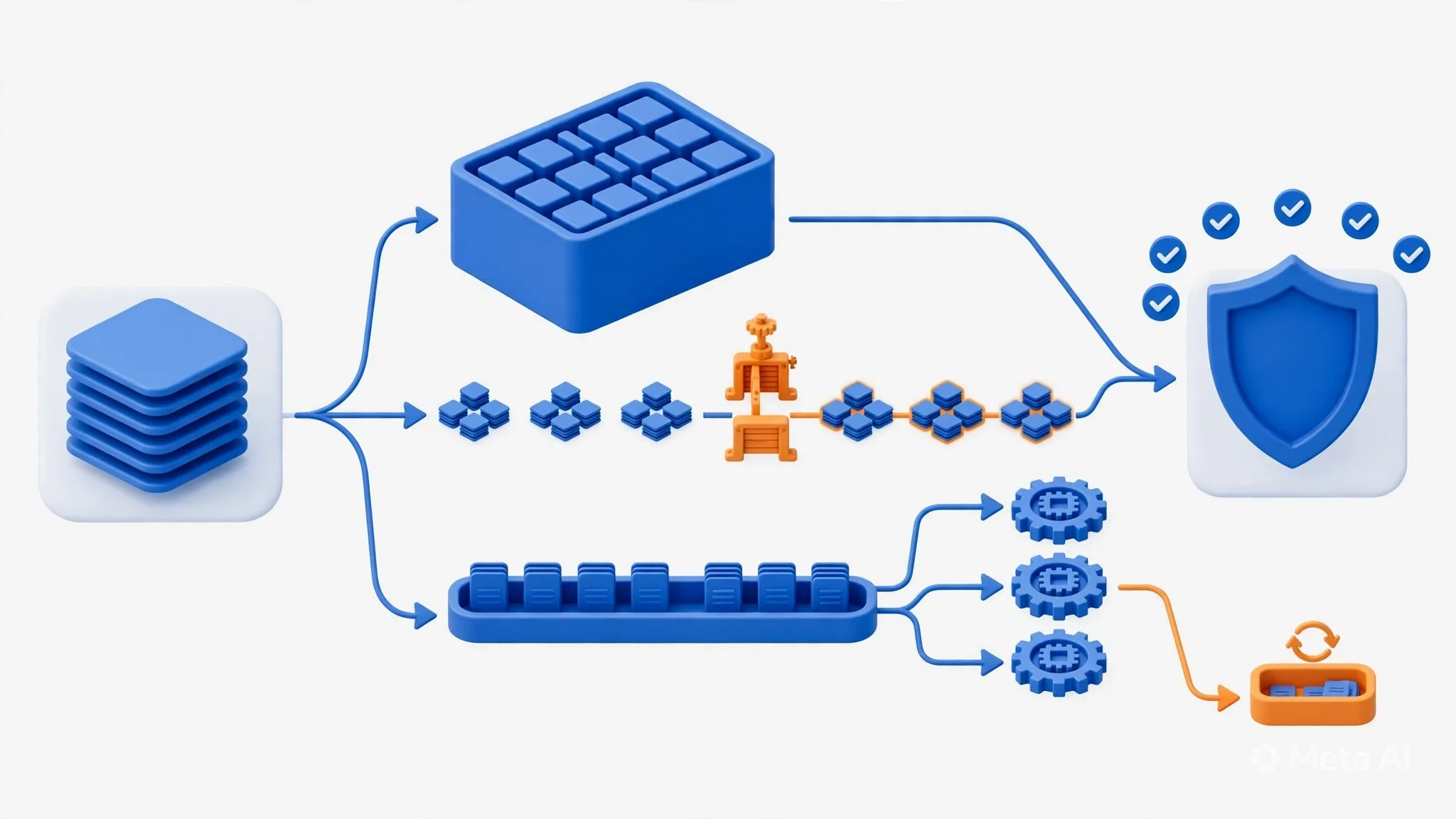
Queue mode scales n8n itself: the main instance receives a trigger, places an execution job in Redis, and a worker runs the workflow. Worker concurrency limits how many jobs run simultaneously. A workflow that receives 10,000 items is still typically one execution job; queue mode does not automatically create 10,000 independently retryable jobs. That requires explicit chunk executions or a durable job table/outbox.
Decision matrix
Choose by failure boundary and downstream capacity
Record count is only an initial signal; failure behavior and destination capacity should determine the architecture.
Direct / bulk
Use when the connector or API supports bulk calls, payloads fit limits, and whole-group retries are safe.
Loop
Use for pagination, stop conditions, sequential processing, or logic that changes by iteration.
Batch
Use to cap memory, request size, transaction size, and downstream request rate.
Queue mode
Use to distribute workflow executions across workers and scale total n8n throughput.
Durable jobs
Use when each chunk needs state, leases, independent retries, a DLQ, and resumability.
Loop
Do not add a loop when the node already processes items
A loop is an orchestration tool, not a mandatory wrapper for every list.
Many n8n nodes naturally process each incoming item. Adding Loop Over Items with a batch size of one can increase execution time and overhead without adding reliability. First, pass multiple items directly to the destination node and verify whether the selected operation supports bulk input or iterates over items itself.
A loop is justified for explicit requirements: paginate until no records remain, insert a Wait step between batches to respect a quota, accumulate results across rounds, or preserve ordering. Define what happens when one item fails. Do not enable continue-on-error blindly; failed records need a correlation ID, reason, and retry state so they cannot silently disappear from a successful execution.
Batch
Batching is a strong default for a large but bounded dataset
Batch size should follow payload and downstream limits, not a universal record count.
Batching limits the number of active items, request size, transaction duration, and pressure on an API or database. When an API provides a bulk endpoint, one call with 100 records may outperform 100 individual calls. When quotas apply per request or payload, the batch must respect both. The n8n HTTP Request node supports item batching and intervals, while n8n's rate-limit guidance describes combining Loop Over Items with Wait.
Start with a defensible small batch based on documented destination limits, then load-test it. Measure throughput, p95 latency, 429/5xx rates, peak memory, and retry duration. Increase batch size until just before latency or errors rise sharply. Give every batch a batch_id, record range, attempt count, and idempotency key. Mark it complete only after downstream confirmation so a checkpoint can resume unfinished chunks instead of replaying the entire dataset.

Queue
Queue mode scales executions; it does not replace batching and checkpoints
Workers increase aggregate throughput but do not automatically make one oversized execution lighter.
Queue mode fits when many workflows or chunks can run independently and workers need horizontal scaling. In n8n's architecture, the main instance handles timers and webhooks, creates an execution, and places a job in Redis; a worker runs it and persists results to the database. Per-worker concurrency is configurable, but excessive concurrency merely moves the bottleneck to PostgreSQL, Redis, CPU, memory, or the destination API.
Queue mode is not a business message queue for every record. If a producer loads 50,000 records into one execution, a worker still owns that payload. For safe parallelism, split data into chunks and create smaller executions, or persist jobs in a database/outbox and trigger worker workflows by job ID. Useful states include pending, processing, completed, retryable_failed, and dead_lettered; lease timeouts let another worker recover abandoned jobs.
Production
Recommended architecture: producer, durable job store, and bounded workers
Use this model when data is large, side effects matter, and failed subsets must be replayed independently.
The producer reads the source using a stable cursor, normalizes identifiers, and writes chunk jobs to a job table or outbox. A unique constraint on (source, record_id, operation_version) prevents duplicate job creation. A dispatcher atomically claims a job, assigns a lease, and calls a worker workflow with job_id instead of passing a large payload through the queue. The worker fetches required data, processes one batch, records the result under an idempotency key, and acknowledges completion.
Retry transient timeouts, 429, and 5xx responses with exponential backoff, jitter, and a bounded attempt count. Send invalid data or permission failures to a DLQ rather than retrying forever. If the destination lacks idempotency support, maintain an operation ledger around the side effect and check it on retries. In Kubernetes, scale workers using queue depth and oldest-job age, with a ceiling tied to database pool capacity and downstream quotas.
Controls
Production guardrails matter more than raw throughput
A fast pipeline that duplicates data, overloads dependencies, or cannot resume is still a failed design.
Implement four guardrail groups. Correctness: idempotency keys, unique constraints, deterministic cursors, and post-run reconciliation. Load control: batch size, worker concurrency, rate limiting, and backpressure as queue age rises. Recovery: bounded retries, exponential backoff, checkpoints, lease timeouts, and selective DLQ replay. Observability: records per second, success and failure by reason, retry count, queue depth, oldest-job age, p95 job latency, and peak memory.
Avoid carrying binary data or complete payloads through every node; discard unused fields early. n8n recommends splitting workflows and limiting data returned by sub-workflows to reduce memory pressure. Configure execution-data retention and pruning according to audit needs rather than retaining every payload indefinitely. Before production, kill a worker mid-batch, simulate 429, submit the same input twice, and verify that processing resumes without omissions or duplicate side effects.
FAQ
1. At what record count is a queue mandatory?
There is no universal threshold. A queue helps when executions are independent, workers must scale, or retries need separation. Thousands of records may still fit a bulk or batch workflow when payload and SLA allow it.
2. What batch size should we use?
Treat documented API or database limits as the ceiling, start smaller, and load-test throughput, p95 latency, errors, and memory. Do not copy one number across unrelated connectors.
3. Is Loop Over Items with batch size one safer?
Not inherently. It reduces items per iteration but increases calls and runtime. Reliability comes from checkpoints, a retry policy, and persistent failed-record tracking.
4. Does n8n queue mode distribute items automatically across workers?
No. It distributes workflow executions. To use workers for independent chunks, the design must create separate executions or jobs.
5. How do we retry without duplicate writes?
Use an idempotency key or unique constraint derived from record identity and operation version, persist job state, and retry only transient failures.
FlowNexa
Design n8n pipelines around real load and failure boundaries
If higher volumes make workflows slow, memory-heavy, or prone to duplicate writes during retries, FlowNexa can review and redesign the pipeline around batching, queues, and idempotency.
Workload assessment
Measure volume, payload, quotas, latency, and failure modes before selecting the architecture.
Reliable processing
Design chunks, checkpoints, idempotency, bounded retries, and a DLQ around each failure boundary.
Production scaling
Balance worker concurrency against database pools, API quotas, and throughput objectives.


