


What Data Does a Business Need Before Deploying an AI Chatbot?
A readiness checklist covering approved web content, FAQs, product and policy data, ownership, metadata and chatbot acceptance tests.
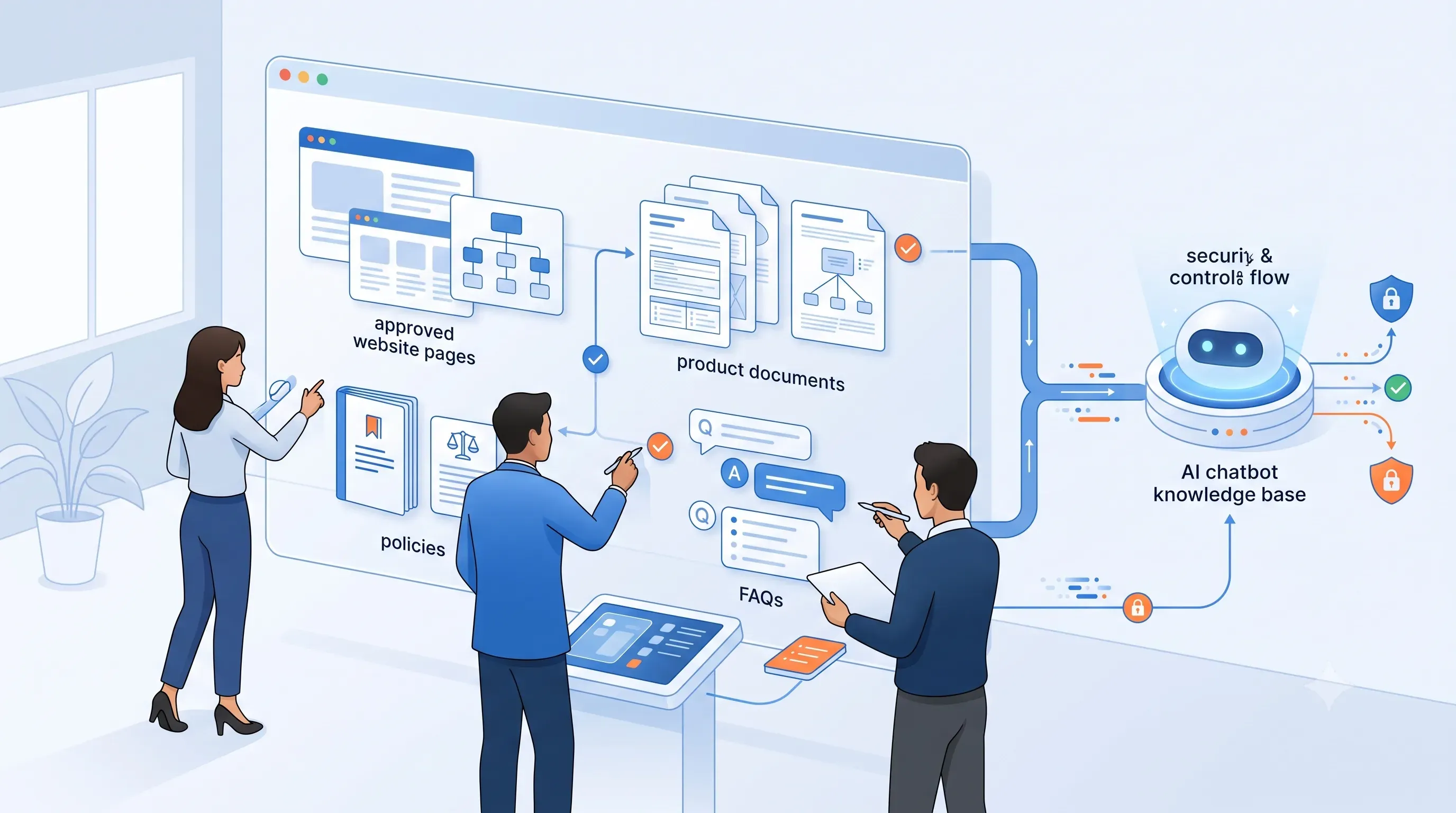
An AI chatbot does not need every piece of company data. It needs the right evidence for a defined answer scope, with authoritative sources, accountable owners and an update cycle. Uploading more files without classification often increases contradictions.
Prepare six groups: approved website content, real customer FAQs, product and service information, versioned prices and policies, contact and escalation details, and an acceptance-test set. Record owner, effective date, locale, sensitivity and missing-evidence behavior for every source. Exclude passwords, unnecessary personal data, out-of-scope internal material, drafts and competing price lists.
Quick decision
Source quality matters more than file count
Reliable knowledge has provenance, validity and usage rights.
Criteria
Evaluate the whole operating model
Do not choose from one feature or one number alone.
Public sources
Service pages, products, hours, locations and customer instructions.
Operational content
FAQs, support processes, applicable conditions and handoff rules.
Volatile information
Prices, promotions, stock and schedules need owners and expiry dates.
Excluded data
Personal data, secrets, drafts and content without usage rights.
Analysis
Four data failures that destabilize answers
Retrieval cannot repair incorrect, conflicting or expired sources.
No authoritative source
The website, an old PDF and a Sales sheet disagree. Define a source of truth and precedence before retrieval.
Internal shorthand lacks customer context
Codes, acronyms and implicit exceptions need a glossary, explicit conditions and examples.
Missing lifecycle metadata
Every source needs an owner, version, effective date, locale and draft/approved/retired state.
No test set from real questions
A document list does not prove useful answers. Use Sales, support and site-search questions, plus ambiguous, unsupported, sensitive and handoff cases.
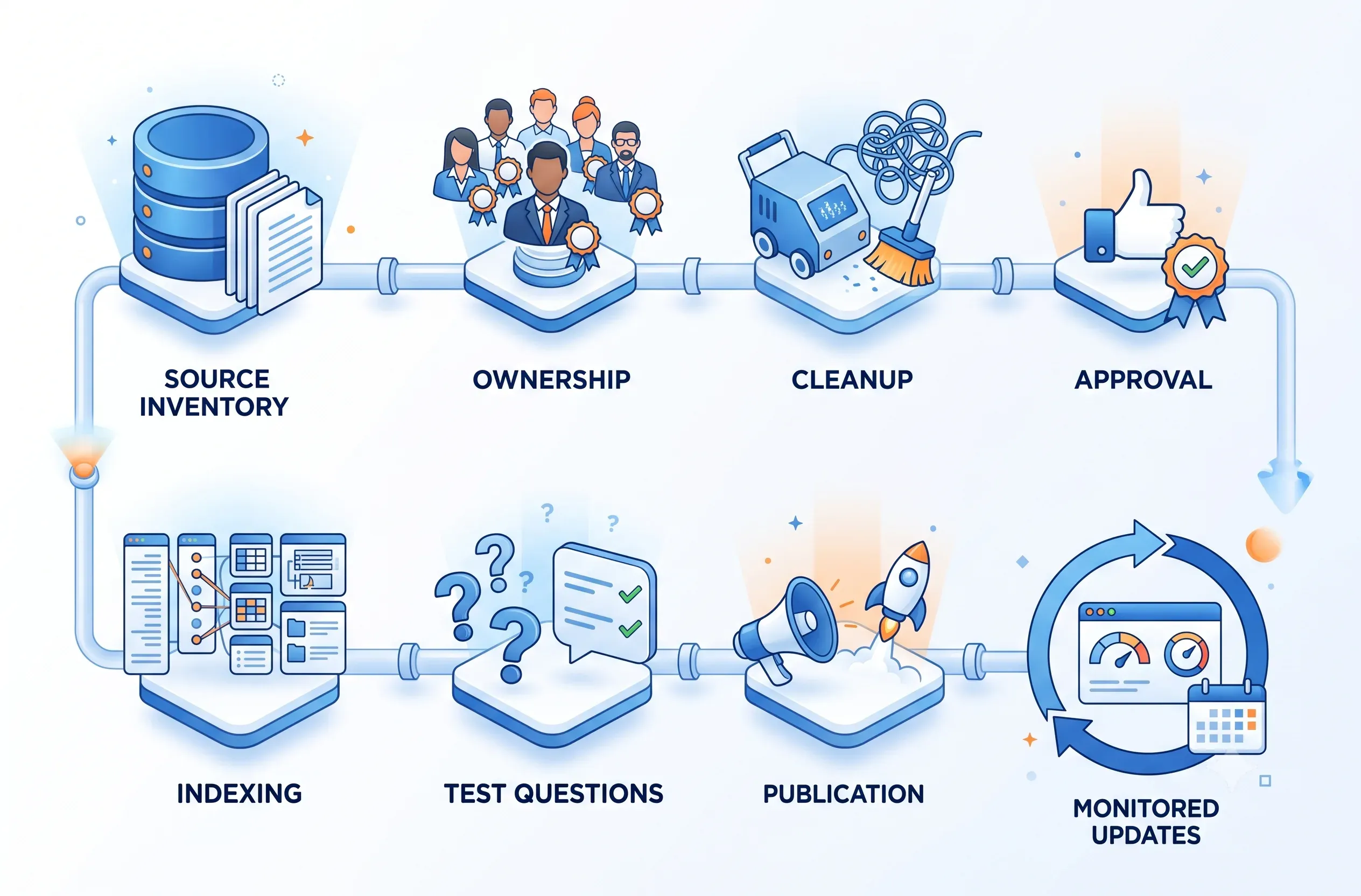
Implementation
A seven-step knowledge onboarding flow
Separate editorial readiness from technical ingestion.
Roadmap
From assessment to operations
Every step needs a clear output and accountable owner.
1. Fix scope
Write what the chatbot may and may not answer.
2. Inventory sources
List URLs, files, owners, locales, sensitivity and validity.
3. Resolve authority
Remove duplicates and settle conflicts before ingestion.
4. Normalize
Repair headings, tables, terminology, links and missing context.
5. Approve
Publish only approved versions to the production index.
6. Test
Run golden, unsupported, ambiguous and adversarial questions.
7. Operate
Monitor gaps, source changes and controlled re-indexing.
Controls
Knowledge acceptance checklist before launch
Important answers must be traceable to a source version.
- Every production source has an owner and approved status.
- Prices, policies and promotions have effective and expiry dates.
- Drafts, sensitive records and retired content are excluded.
- VI and EN are governed separately rather than assumed equivalent.
- Tests include supported, unsupported, ambiguous and adversarial questions.
- Missing evidence triggers clarification, abstention or handoff.
- Source-version logs support investigation and rollback.
NIST emphasizes context and lifecycle risk management. OWASP identifies poisoning and prompt injection risks, making access-controlled ingestion and approval essential.
FAQ
AI chatbot data questions
Good preparation reduces post-launch rework.
Can the chatbot crawl the entire website?
Technically yes, but exclude irrelevant legal pages, stale content, duplicates and sources not intended for advice.
Can it use PDFs and spreadsheets?
Yes if parsing preserves structure and tables. Validate extraction, ownership and validity.
How many FAQs are needed?
There is no universal count. Prioritize questions driving workload or purchase decisions.
Who approves content?
Business owners approve accuracy; IT governs access, ingestion and audit.
What happens when prices change?
Update the authority, approve the new version, re-index and rerun regression tests before retiring the old one.
Conclusion
Ready data means operable knowledge
The system knows which source is valid and who owns it.
A reliable chatbot begins with small, explicit governance: scope, authority, ownership, versions and tests. Start with a narrow dataset for one question family, measure it and expand.
Do not wait for perfect data, but do not treat ingestion as a one-time upload. A knowledge base is an operational product with change, approval, testing and rollback.
FlowNexa
Assess your chatbot knowledge readiness
FlowNexa can inventory sources, define authority and establish ingestion scope before configuration.
Review sources
Identify content to use, exclude and update.
Build acceptance tests
Turn real customer questions into quality gates.
