


An AI Chatbot at 8.9 Million VND a Year or Another Chat Agent? A Real Total-Cost Comparison
The full cost of a chat agent (salary, 21.5% employer insurance, 24/7 coverage) compared with a Standard AI chatbot plan, plus how to calculate the break-even point on your own data.
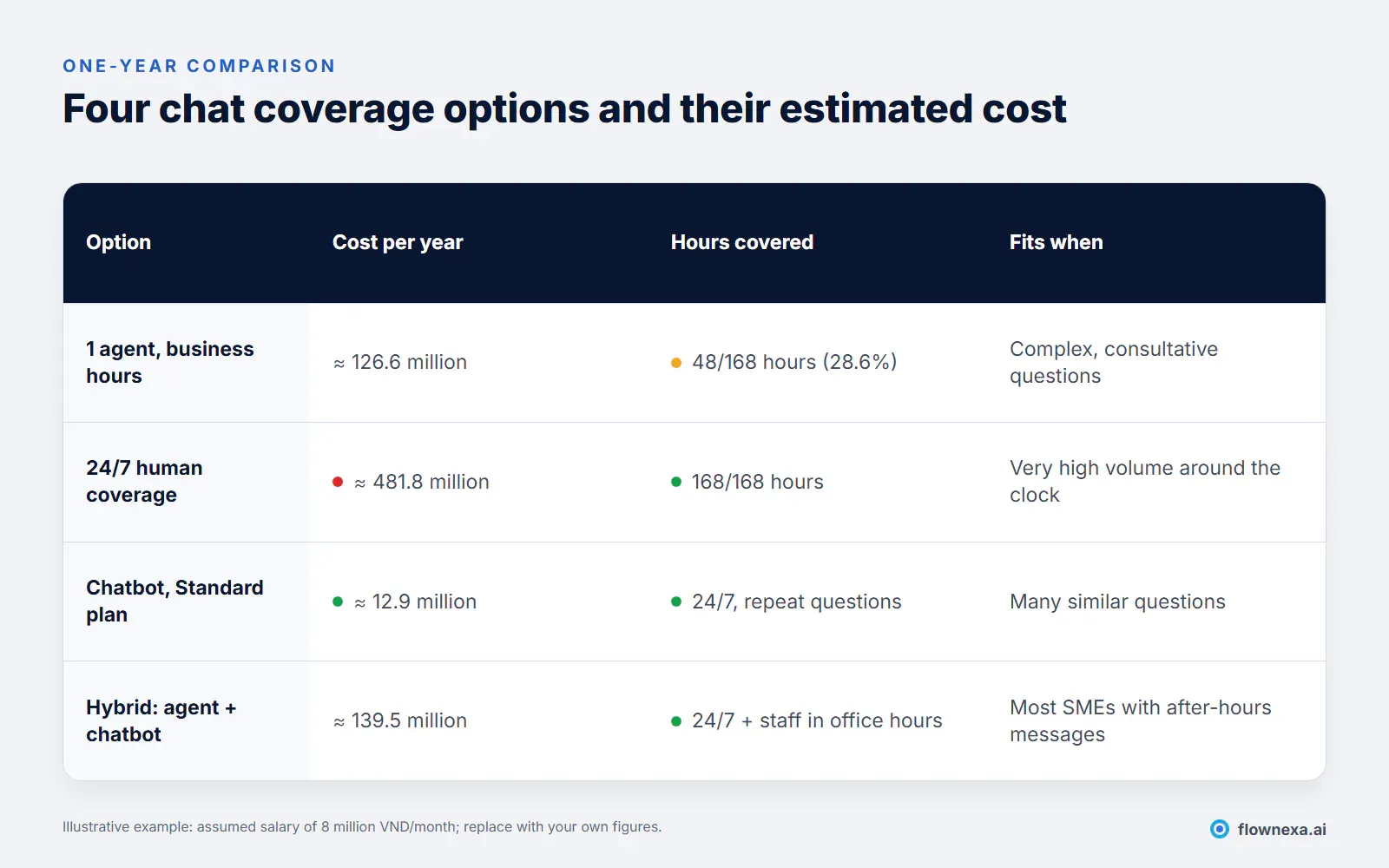
Short answer: An AI chatbot does not replace a chat agent; it replaces the repetitive work and the after-hours gap. With an example salary of 8 million VND a month, one business-hours agent costs about 126.6 million VND a year and covers only 28.6% of the hours in a week. The Standard chatbot plan costs about 12.9 million VND a year including the time spent updating content, and breaks even if it saves about 6.4 staff hours a week.
"Chatbot or another hire" is usually the wrong question, because the two options do not do the same job. This article calculates both sides in full with sourced figures, shows which assumptions you should replace with your own numbers, and helps you choose the right option.
All figures exclude VAT. The salary of 8 million VND a month is an illustrative assumption, not a market rate; replace it with your company's actual cost.
The staff side
What does one chat agent really cost?
An employee costs more than their salary. Assuming a salary of 8,000,000 VND a month with insurance paid on the full salary:
| Item | Calculation | Per year |
|---|---|---|
| Salary | 8,000,000 × 12 | 96,000,000 |
| Employer social, health, and unemployment insurance | 21.5% × insured salary × 12 | 20,640,000 |
| Recruitment, training, equipment, software | Assumption | 10,000,000 |
| Total | ≈ 126,640,000 |
A few notes to bring the figure closer to reality:
- The 21.5% rate is the employer's share for Vietnamese employees (retirement and survivorship, sickness and maternity, occupational accidents, health insurance, unemployment insurance) under the 2024 Law on Social Insurance.
- Salary cannot be below the regional minimum wage. From 1 January 2026, under Decree 293/2025/ND-CP, the monthly minimum is 5,310,000 VND (region I), 4,730,000 VND (region II), 4,140,000 VND (region III), and 3,700,000 VND (region IV).
- Not included: a 13th-month bonus (if any), allowances, management overhead, and time lost to leave, sickness, or replacing someone who resigns.
Coverage is the biggest weakness. Under the 2019 Labour Code, normal working hours may not exceed 8 hours a day and 48 hours a week. One agent working the full 48 hours covers 48 of the 168 hours in a week, or 28.6%. Messages sent at 9 p.m. or on a Sunday morning wait until the next working day.
24/7 coverage
What if you want a person answering 24/7?
Covering 168 hours a week with people takes at least 168 ÷ 48 = 3.5 full-time employees, before leave, public holidays, or sickness, so in practice you usually need 4 or more. The Labour Code also requires night work (10 p.m. to 6 a.m.) to be paid at least 30% extra.
| Item | Calculation | Per year |
|---|---|---|
| Salary for 3.5 people | 3.5 × 8,000,000 × 12 | 336,000,000 |
| Employer insurance | 21.5% × 336,000,000 | 72,240,000 |
| Minimum night-work premium | 30% × 2,912 night hours × 38,462 VND/hour | 33,600,000 |
| Recruitment, training, equipment (4 people) | 4 × 10,000,000 | 40,000,000 |
| Minimum total | ≈ 481,840,000 |
The hourly cost of 38,462 VND is 8,000,000 VND divided by 208 working hours a month. For most SMEs, night-time message volume does not justify spending almost half a billion VND a year.
The chatbot side
What does a Standard AI chatbot plan cost?
Taking the FlowNexa Chatbot Standard plan as a concrete example (public pricing at the time of writing):
| Item | Detail | Per year |
|---|---|---|
| Subscription | 8,900,000 VND per year, 12-month commitment | 8,900,000 |
| Onboarding fee | 2,900,000 VND, currently waived until 31 December 2027 | 0 |
| AI cost | Included within the limits | 0 |
| Internal time updating content | Assumed 2 hours/week × 52 weeks × 38,462 VND/hour | 4,000,000 |
| Total | ≈ 12,900,000 |
Points to read carefully before comparing:
- Limits: 1,000 conversations and 5,000 AI replies per month, reset monthly, whichever is reached first. Going over requires a higher limit or an additional quote.
- Channels: the Standard plan covers a chatbot on one website. Zalo OA and Facebook Messenger are quoted per deployment.
- Not included: CRM, ERP, PMS, or API integration; workflow automation and AI agents; dedicated infrastructure or advanced SLAs.
- Internal time is a real cost. A chatbot is only right when its source content is right; someone has to update prices and policies and handle what the chatbot cannot.
The general cost items for chatbots are covered in how much does an AI website chatbot cost?
A fair comparison
Why can’t you compare a chatbot and an agent one-for-one?
The two options do different jobs:
- A chatbot is good at answering instantly, at any hour, for many customers at once; answering questions with fixed answers consistently; and collecting initial details with consent.
- A person is good at advising on solutions, understanding complex context, negotiating, handling sensitive complaints, building relationships, and closing sales.
So the right question is not "can a chatbot replace an agent?" but "which work should the chatbot take so people can focus on what generates revenue?"
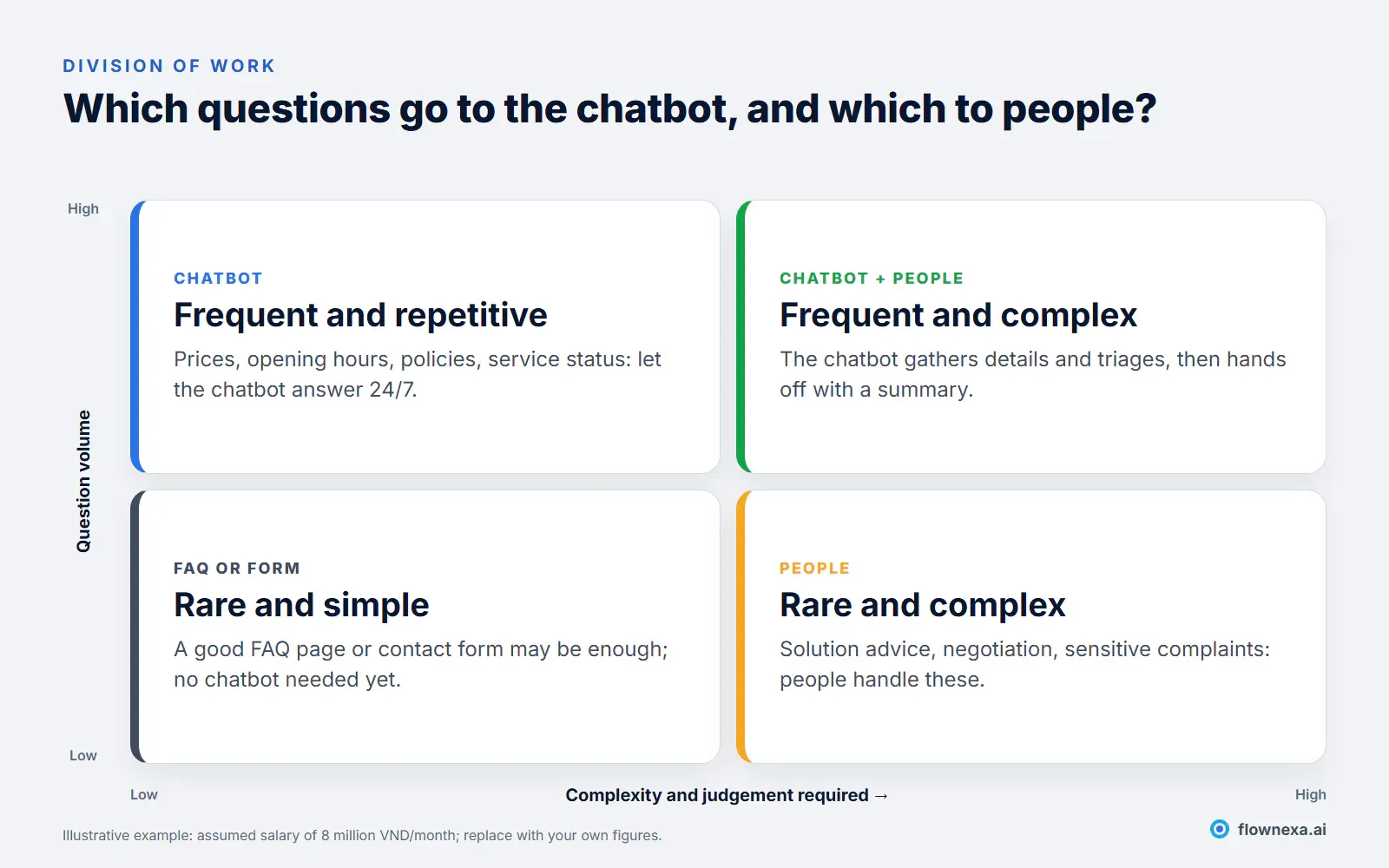
For most SMEs whose customers message both during and outside office hours, the hybrid option is usually the most sensible: keep your existing staff in business hours, let the chatbot answer repeat questions 24/7, and hand off cases that need a person with a conversation summary. In the example, the total is about 139.5 million VND a year, far below 24/7 human coverage. The model only works with a well-designed handoff: a chatbot-to-human handoff that never makes customers repeat.
Break-even
How do you work out whether a chatbot pays off for you?
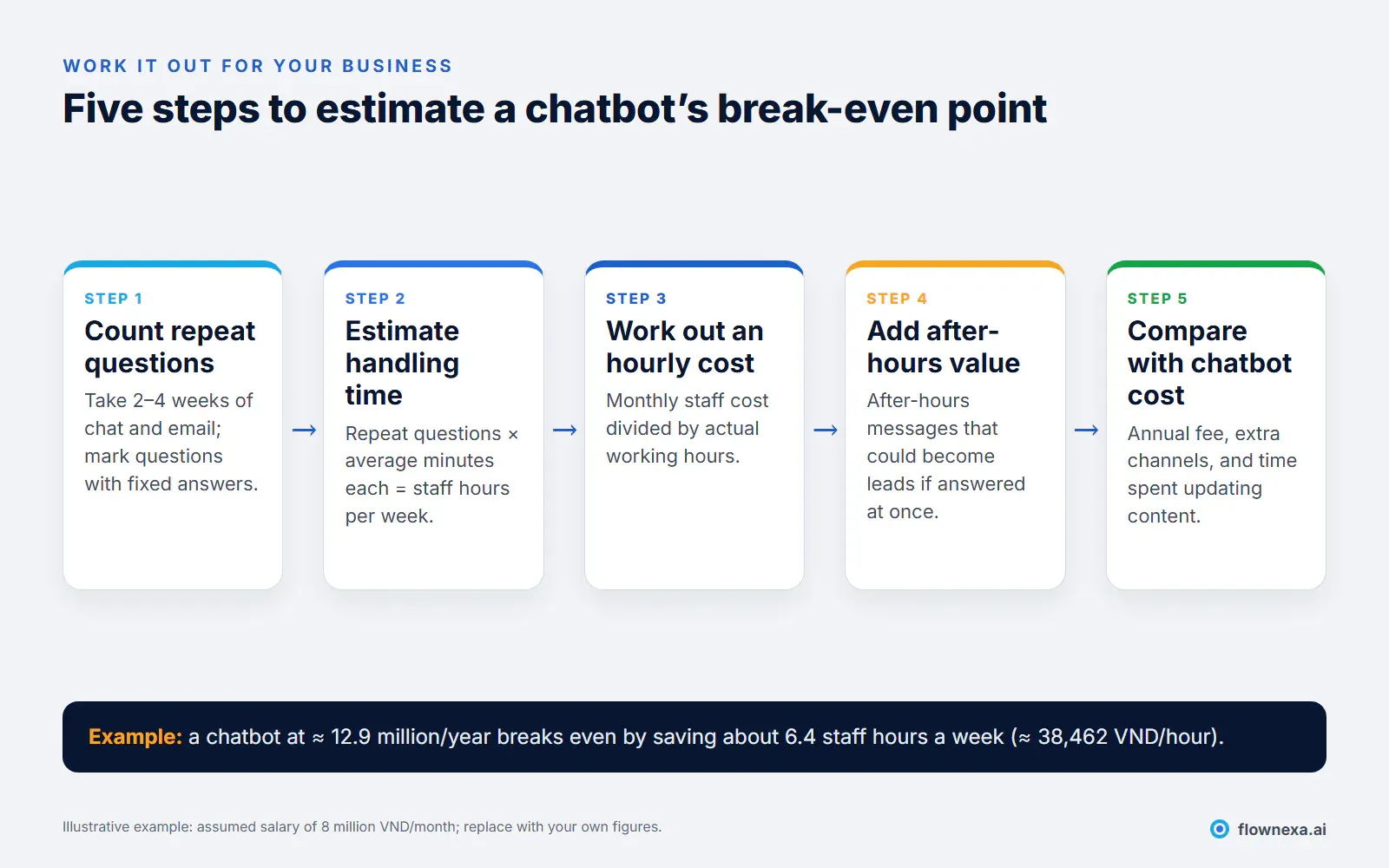
In the example, the chatbot costs about 12.9 million VND a year, equal to 335 staff hours (12,900,000 ÷ 38,462), or about 6.4 hours a week. If the chatbot answers enough repeat questions to save more than that, it has broken even on staff time alone.
That is the easy part to measure. The second source of value is usually larger but harder to measure: after-hours customers. Someone asking for a price at 10 p.m. who has to wait until morning may already have contacted a competitor. If the chatbot answers immediately and captures contact details, just a few such customers converting each year covers the cost. How to measure it is covered in 10 KPIs to track and what a chatbot should ask before passing a lead to sales.
A worked example of steps 1–2: over 4 weeks, staff answered 600 messages, of which 360 had fixed answers (price, opening hours, delivery fees, return policy), each taking 3 minutes on average. The hours that could move to the chatbot are 360 × 3 ÷ 60 ÷ 4 = 4.5 hours a week. That is below the 6.4-hour break-even point, so the decision depends on the value of after-hours customers. This is only an example; count on your own data.
When not to
When should you hold off on a chatbot?
A chatbot is not always the answer. Consider waiting if:
- Message volume is very low, a handful a day and mostly in office hours. A good FAQ page or contact form may be enough; see AI chatbot, live chat, or contact form.
- Almost every question needs individual advice, such as custom design projects where every customer is a different problem.
- Information is not stable yet: prices change daily, policies are not agreed. Standardise the content first.
- Nobody is responsible for updating chatbot content and handling the questions it cannot answer.
If your website has little traffic, do not rule it out too quickly; AI chatbots for a low-traffic website looks at visitor intent rather than page views. And if customers tend to call after hours rather than message, consider starting with automated responses to after-hours missed calls.
Checklist
Checklist before you decide
- You have counted messages over 2–4 weeks and the share with fixed answers
- You know what percentage of messages arrive outside working hours
- You know the real cost of one staff hour (salary, insurance, other costs)
- You have checked the plan's conversation limit against your current volume
- You know which channels you need (website, Zalo OA, Messenger) and which cost extra
- Someone is responsible for updating the chatbot's content
- You have agreed how customers are handed from the chatbot to staff
- You have metrics to evaluate after 90 days
Q&A
Frequently asked questions
Can a chatbot completely replace customer service staff?
For most businesses, no. A chatbot handles repeat questions and after-hours messages well; people are still needed for advice, negotiation, complaints, and exceptions. The most effective model is usually hybrid.
Why does the article use a salary of 8 million VND a month?
It is an illustrative assumption that keeps the calculations easy to follow, not a market rate. Replace it with your actual cost; the method stays the same.
Is the 21.5% insurance rate right in every case?
The 21.5% rate is the employer's share for Vietnamese employees. The insured salary base, contribution caps, and foreign employees have their own rules; check with your accountant or the social insurance agency before applying it.
What happens above 1,000 conversations a month?
Standard plan limits apply whichever is reached first and reset monthly without rolling over. If you regularly exceed the limit, you need a higher limit or an additional quote. It is also a good sign: demand is high enough for the chatbot to create value.
Do customers find chatbots more frustrating than talking to a person?
They can, if the chatbot tries to answer everything or will not let customers reach a person. A chatbot should answer quickly what it knows for certain, say clearly when it does not know, and make it easy to reach a person.
How long until we know whether the chatbot is working?
About 60–90 days is enough to get data: resolution rate, after-hours messages answered, qualified leads, and staff time saved.
Sources
- Decree 293/2025/ND-CP on regional minimum wages, effective 1 January 2026 (summary in Vietnamese at LuatVietnam)
- 2024 Law on Social Insurance, employer contribution rates (summary in Vietnamese at LuatVietnam)
- 2019 Labour Code: normal working hours (Article 105) and night-work pay (Article 98)
- FlowNexa pricing: Standard plan price, limits, and scope at the time of writing (November 2026)
FlowNexa
Work out the break-even on your data
Send FlowNexa a sample of chat or email history (with personal details removed) and we will help you estimate the work a chatbot could take on.
An AI chatbot that answers from approved content and hands off to staff when needed.
Standard plan price, limits, and scope.
Talk through your message volume and channels.
