


Chatbots Collecting Customer Data: 8 Personal Data Protection Principles to Apply
Vietnam’s Personal Data Protection Law took effect on 1 January 2026. Eight operating principles for chatbots that ask for names and phone numbers: purpose, consent, minimisation, retention, permissions, and requests.
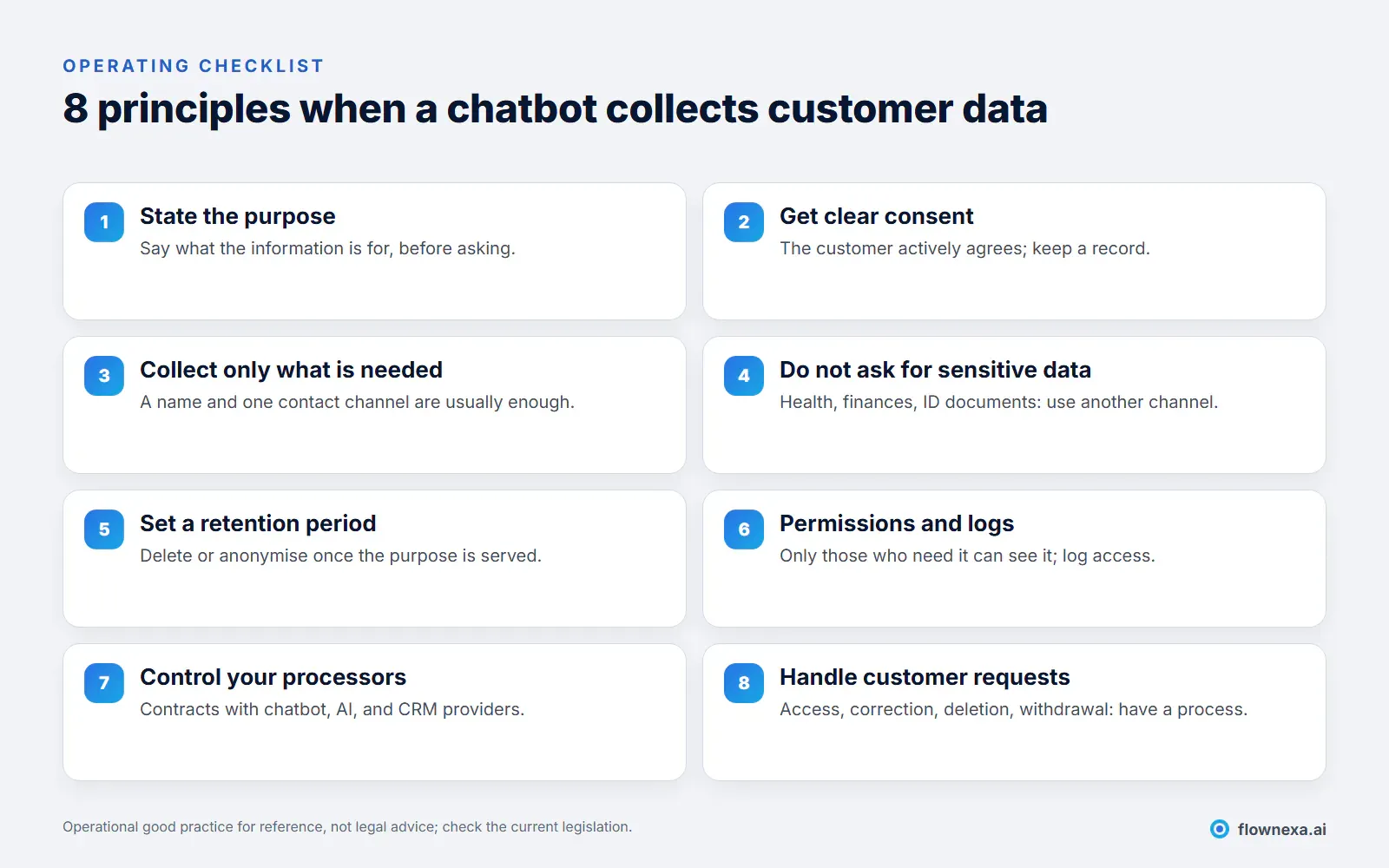
Short answer: When a chatbot asks for a customer's name, phone number, or email, the business is processing personal data. Eight operating principles are worth applying: state the purpose, get clear consent and keep a record, collect only what is needed, never ask for sensitive data through a chatbot, set a retention period, apply permissions and access logs, control every processor involved, and have a process for customer requests.
Since 1 January 2026, Vietnam's Law on Personal Data Protection No. 91/2025/QH15 has been in force. Chatbots are one of the places businesses collect the most customer data, yet they are usually configured to "capture as many leads as possible" and rarely designed from a data protection angle.
Important: this article shares chatbot operating practice from a technical and customer-experience perspective. It is not legal advice. Each business's obligations depend on the data involved, its scale, and its activities; check the current legislation and consult a legal professional where needed.
Context
Why should a chatbot be designed for data protection from the start?
A typical sales chatbot can collect a name, phone number, email, delivery address, purchase needs, conversation history, and sometimes photos the customer sends. That data then passes through several places: the chatbot platform, the AI model provider, the CRM, and sales staff.
Three reasons to design carefully from day one:
- Regulation: the Law on Personal Data Protection took effect on 1 January 2026, according to the Government portal and the Ministry of Public Security (both in Vietnamese).
- Customer trust: customers are more willing to leave details when they understand how they will be used.
- Cost of fixing later: adding consent, retention, or permissions to a live chatbot, with data already spread across a CRM, costs far more than designing them in.
Principles 1–2
State the purpose and get clear consent
1. State the purpose before asking
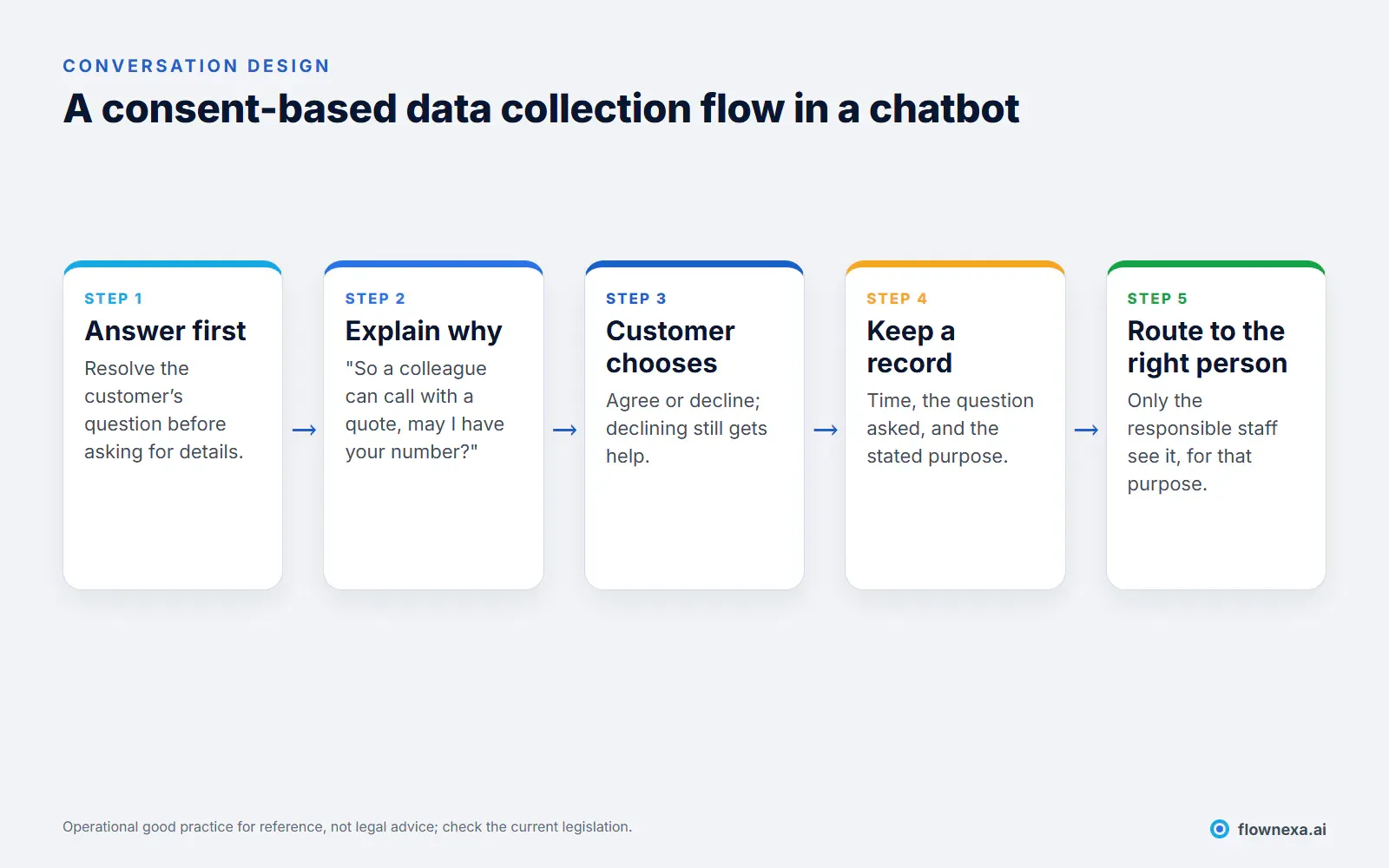
Instead of "Please leave your phone number", the chatbot should say "So a colleague can call you with an accurate quote, would you like to leave your phone number?". The customer knows what it is for and decides.
The stated purpose also limits use: a number collected for a quote should not automatically go onto a promotions list unless the customer agrees to that purpose too.
2. Get clear consent and keep a record
- The customer actively agrees, for example by tapping "I agree" or typing their details after the explanation; silence is not consent.
- Allow declining while still helping. A customer who does not leave a number still gets an answer.
- Keep a record: the time, the exact question the chatbot asked, the stated purpose, and the channel, so you can demonstrate consent if asked.
- Link to your privacy policy inside the conversation or chat window.
Principles 3–4
Collect only what is needed, avoid sensitive data
3. Collect only what you truly need
Every extra field adds risk and protection duties. For most advisory scenarios, a name and one contact channel are enough for staff to continue. An address is only needed once delivery is agreed; date of birth, occupation, or income are rarely needed at the chatbot stage.
Review your chatbot script with one question: if we drop this field, can staff still do their job?
4. Do not ask for sensitive data through a chatbot
Health, financial, or identity document information, including photos of ID, should not be collected through an ordinary chatbot. If a customer volunteers it, the chatbot should:
- Not repeat or confirm those details in its reply.
- Suggest a more suitable channel (in person, or an authenticated channel).
- Keep that content out of training material and reports.
If your business genuinely needs to handle this kind of data, that is the point to get legal advice and design a dedicated process, not to add another question to the chatbot.
Principles 5–6
Retention, permissions, and access logs
5. Set a clear retention period
Conversation history and customer details should not be kept indefinitely "just in case". Decide in advance:
- How long conversations without a transaction are kept.
- How long leads that never became customers are kept.
- What happens at expiry: deletion, or anonymisation to keep statistics.
The exact period depends on the purpose and your other record-keeping duties (accounting records, for example); what matters is having a rule and actually applying it.
6. Apply permissions and log access
- Only the staff member handling a lead can see that lead's contact details.
- Admin accounts on the chatbot platform and CRM use multi-factor authentication.
- Log who viewed, exported, or changed customer data.
- Revoke access as soon as someone leaves; see the offboarding access checklist.
When sending leads to a CRM, send only the fields that are needed; see connecting a chatbot to your CRM without polluting data.
Principles 7–8
Control processors and handle customer requests
7. Control every party that processes the data
Chatbot data usually flows through the chatbot platform provider, the AI model provider, and the CRM. For each one, the business should know:
- Where the data is stored and for how long.
- Whether the provider uses the data to train models.
- Which subprocessors are involved, and whether data leaves the country.
- How the contract or data processing agreement (DPA) assigns responsibility.
When a chatbot calls an AI model API hosted abroad, the cross-border transfer of data is something to assess under the current rules. Ask the provider about it from the outset; see 12 questions before choosing a chatbot provider.
8. Have a process for customer requests
Customers may ask what information you hold about them, or ask you to correct it, delete it, or withdraw consent. Prepare:
- A clear intake channel (email, form) named in your privacy policy.
- A responsible person and an internal response deadline.
- A way to find one customer's data across every system: chatbot, CRM, email.
- A chatbot that routes these requests to the right process instead of replying "not supported".
Do and don’t
What a chatbot should and should not say
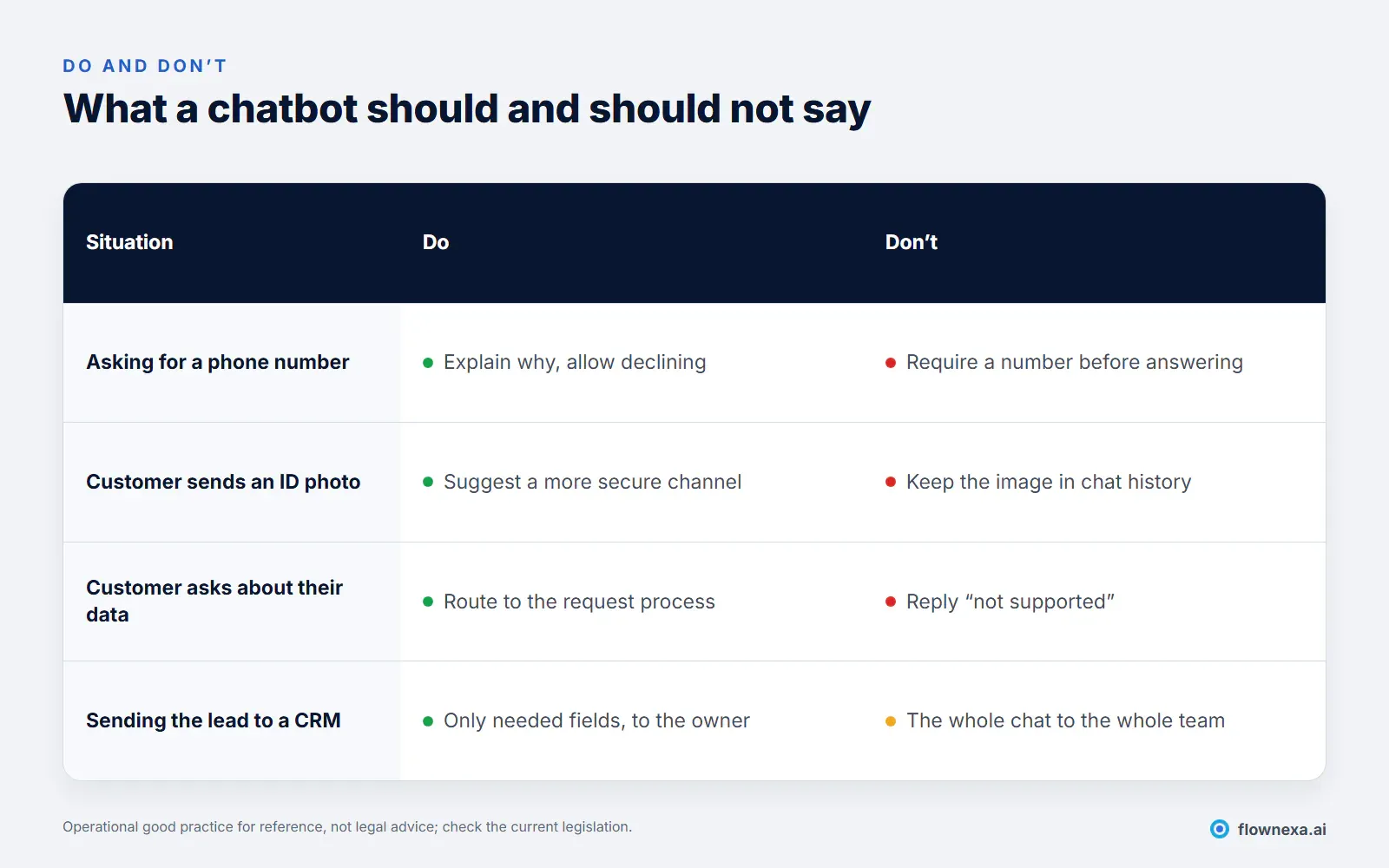
These four situations come up often once a chatbot is live. Add them to your pre-launch test set alongside price and policy questions; see the 30-day go-live operations checklist.
Checklist
Checklist before switching on data collection
- Every field the chatbot asks for has a written purpose
- The consent prompt states the purpose and allows declining
- Customers who decline still get their question answered
- The time and content of consent are recorded
- The privacy policy is linked in the chat window
- The chatbot never asks for health, financial, or ID information
- Retention periods for conversations and leads are decided
- Only the responsible staff can see lead details
- You have asked the chatbot and AI providers about storage and training use
- There is a channel and an owner for access, correction, and deletion requests
Q&A
Frequently asked questions
When did the Law on Personal Data Protection take effect?
According to the Government portal, Law on Personal Data Protection No. 91/2025/QH15 was issued on 26 June 2025 and took effect on 1 January 2026. Read the original text for its specific provisions.
Does a chatbot that only asks for a name and phone number need consent?
A name and phone number are personal data. As operating practice, the chatbot should state the purpose and let the customer actively agree before collecting them. For legal questions specific to your business, consult a legal professional.
Can we use a customer's phone number for something else later?
Good practice is to use it only for the purpose stated when you asked. If you want to use it for another purpose, such as promotions, ask for separate consent.
Is it a problem that chatbot data goes to an AI model abroad?
It is something to assess under the current rules on cross-border data transfer. Ask your provider where data is processed, what its training policy is, and what the contract commits to, then consult a legal professional if needed.
How long should chatbot conversation history be kept?
There is no single right number. Set periods based on the purpose (customer support, improving content) and your other record-keeping duties, write them into an internal rule, and delete or anonymise data when they expire.
How does FlowNexa handle chatbot customer data?
Per our published commitments, customers keep rights to the content and data they provide, and export, return, and deletion follow the contract and data processing policy. See the data processing overview and privacy policy.
Sources
- Law No. 91/2025/QH15 on Personal Data Protection, Government of Vietnam portal (in Vietnamese)
- Personal Data Protection Law in force from 1 January 2026, Ministry of Public Security portal (in Vietnamese)
- This article is operating practice for reference, not legal advice (November 2026)
FlowNexa
Capture leads while respecting customer data
FlowNexa designs consent prompts, limits collected fields, and sets permissions when connecting your chatbot to a CRM.
Captures needs with consent and hands off to staff when needed.
Roles, subprocessors, and data processing agreements.
Review how your current chatbot collects data.
