


12 Questions to Ask Before Choosing an AI Chatbot Provider
Twelve questions across four risk areas for evaluating an AI chatbot provider: answer sources, acceptance testing, customer data, total cost, and support, with red flags and FlowNexa’s own answers.
Short answer: Before choosing an AI chatbot provider, ask 12 questions in four areas: what the chatbot answers from and who keeps it current; how testing, staff handoff, and reporting work; how customer data is stored, protected, and returned; and the two-year total cost and real support level. Ask for written answers and a demo on your own customers' real questions.
A chatbot talks to your customers on your behalf. Choosing the wrong provider costs more than money: a chatbot that quotes wrong prices or policies, or holds customer data you cannot get back, damages your reputation directly.
The questions below apply to any provider, including FlowNexa. At the end, we answer all 12 for our own service so you have a reference example.
Area 1
Scope and data: what does the chatbot know, and who keeps it right?
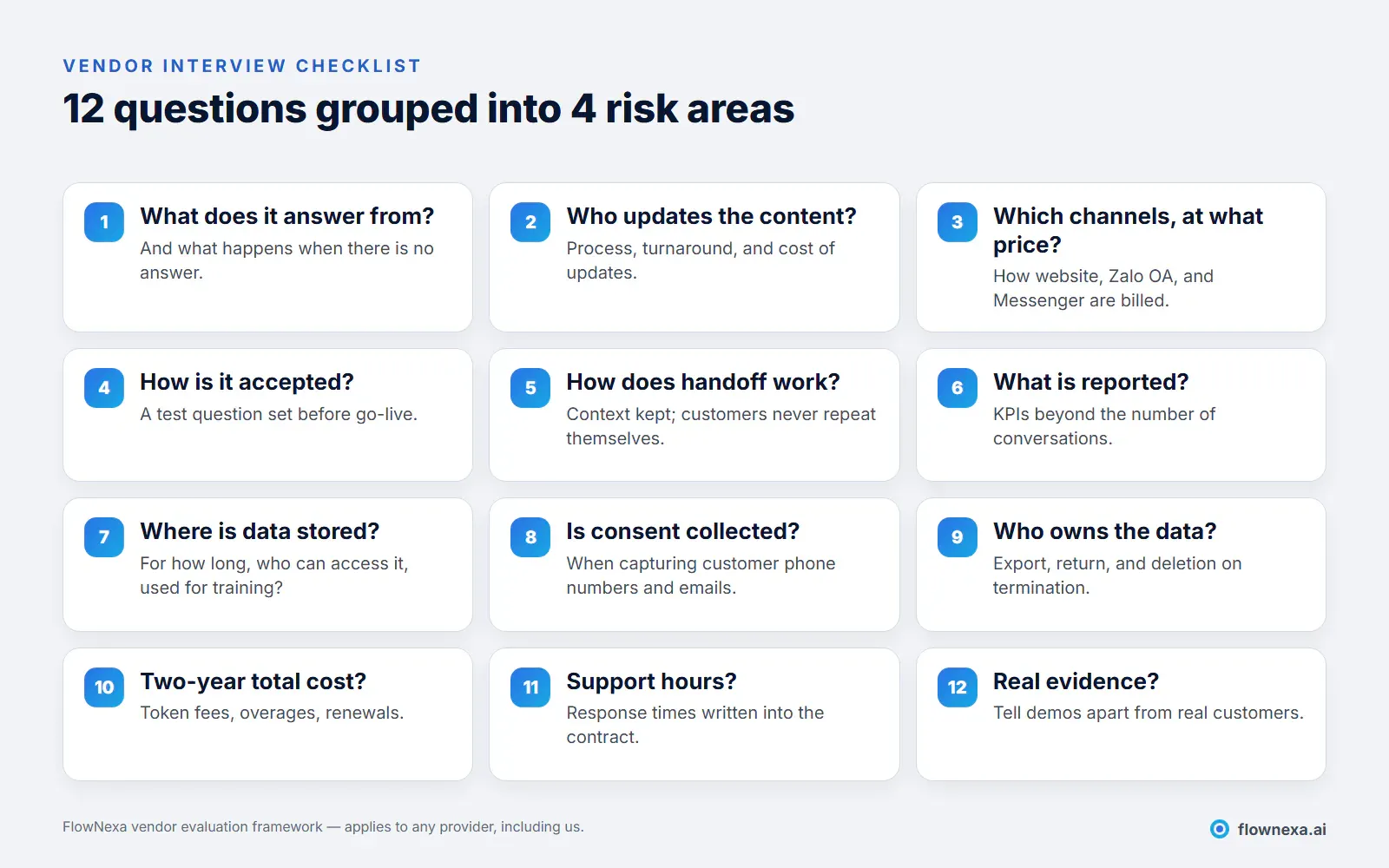
1. What does the chatbot answer from, and what happens when there is no answer?
Why it matters: chatbots built on language models can "fill the gap" with an answer that sounds plausible but is wrong. The biggest risks are wrong prices, wrong return policies, and wrong warranty commitments.
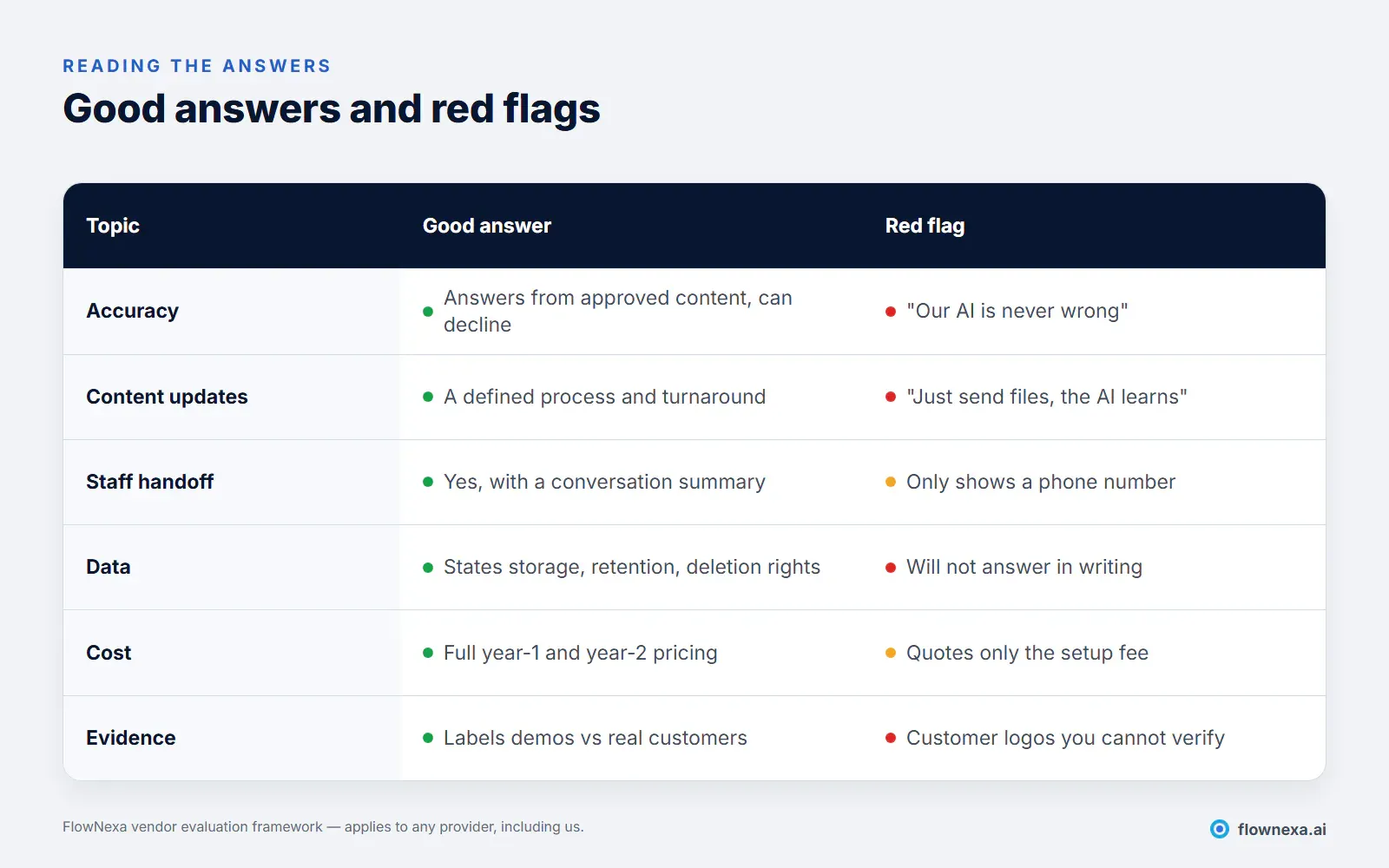
A good answer: the chatbot answers only from content the business has approved; when a question is out of scope, it says the information is not available and hands off to staff. See also where business AI chatbots get their information and when AI should refuse to answer.
2. Who updates the content, and how long does an update take?
Why it matters: prices, promotions, and policies change often. A chatbot that is correct today can be wrong next month if nobody owns updates.
A good answer: a clear process (who submits, who approves, when it takes effect), with any cost for updates beyond the plan written down. Be wary of "just send files, the AI learns". AI chatbot giving wrong prices and policies explains why.
3. Which channels are supported, and which cost extra?
Why it matters: in Vietnam, customers usually message through the website, Zalo OA, and Facebook Messenger. A "chatbot" quote may cover only one of them.
A good answer: each channel is listed as included or quoted separately, with prerequisites (for example a Zalo OA or Facebook Page owned by the business), plus channels that are not supported yet. See which channel to start a chatbot on.
Area 2
Quality and control: how do you know it is good enough to go live?
4. How is the chatbot accepted before go-live?
Why it matters: "it looked fine when we tried it" is not an acceptance criterion. You need to know what share of real questions it answers correctly.
A good answer: a test set built from your own chat and email history, clear pass criteria, and a limited rollout before opening to all customers. See the 30-day go-live operations checklist.
5. How does handoff to staff work, and do customers have to repeat themselves?
Why it matters: a chatbot cannot handle every case. The worst experience is being transferred and then having to tell the whole story again.
A good answer: clear handoff triggers (the customer asks, a sensitive topic, the AI is unsure), and staff receive a summary and the conversation history. See designing a handoff that never makes customers repeat.
6. What gets reported?
Why it matters: more conversations do not mean the chatbot is working.
A good answer: resolution rate, handoff rate, unanswered questions (to fill content gaps), and qualified leads. See 10 KPIs to track. If leads go to a CRM, also ask about deduplication: connecting a chatbot to your CRM.
Area 3
Data and security: where does your customers’ information go?
7. Where is conversation data stored, for how long, and who can access it?
Why it matters: conversations contain names, phone numbers, needs, and sometimes sensitive information. You need to know which infrastructure holds it, how long it is kept, and whether the AI model provider uses it for training.
A good answer: written details of the storage location, retention period, subprocessors (infrastructure, email, AI model), and who has access.
8. When the chatbot collects phone numbers and emails, does it ask for consent?
Why it matters: collecting personal data requires a clear purpose and customer consent under applicable personal data protection rules. A chatbot that asks for a number without explaining why creates legal risk for your business.
A good answer: the chatbot explains how the information will be used before asking, links to the business's privacy policy, and records that the customer agreed.
9. Who owns the data, and how is it exported and deleted on termination?
Why it matters: if you switch providers, you need to take your conversation history, leads, and cleaned-up content with you.
A good answer: the contract states that the business keeps rights to the content and data it provides, defines an export format, and sets deadlines for return and deletion after termination. For a subscription, also ask whether source code and platform administration rights are transferred (usually not, and that should be written down).
Area 4
Cost and operations: the real total cost and the real support level
10. What is the total cost for year one and year two?
Why it matters: many quotes show only a setup fee or a low monthly fee, while AI usage fees, overage charges, extra channels, or renewal pricing appear later.
A good answer: every cost for two years, with limits stated (conversations, messages, documents) and overage prices. How much does an AI website chatbot cost? lists the items to compare.
11. What are the support hours, and how fast are responses?
Why it matters: a chatbot running 24/7 does not mean a person is on call 24/7. When it gives a wrong answer on a Friday evening, you need to know when someone will fix it.
A good answer: staffed support hours, response times by severity, and which commitments are in the contract (not just on the website).
12. Is there real evidence, and which parts are demos?
Why it matters: a prepared demo always looks perfect. Customer logos on a website are not always active customers.
A good answer: the provider clearly separates simulated demos from real deployments, is willing to demo on 20–30 of your real questions, and any reference customer has agreed to be contacted.
Process
Which steps should you follow to choose a provider?
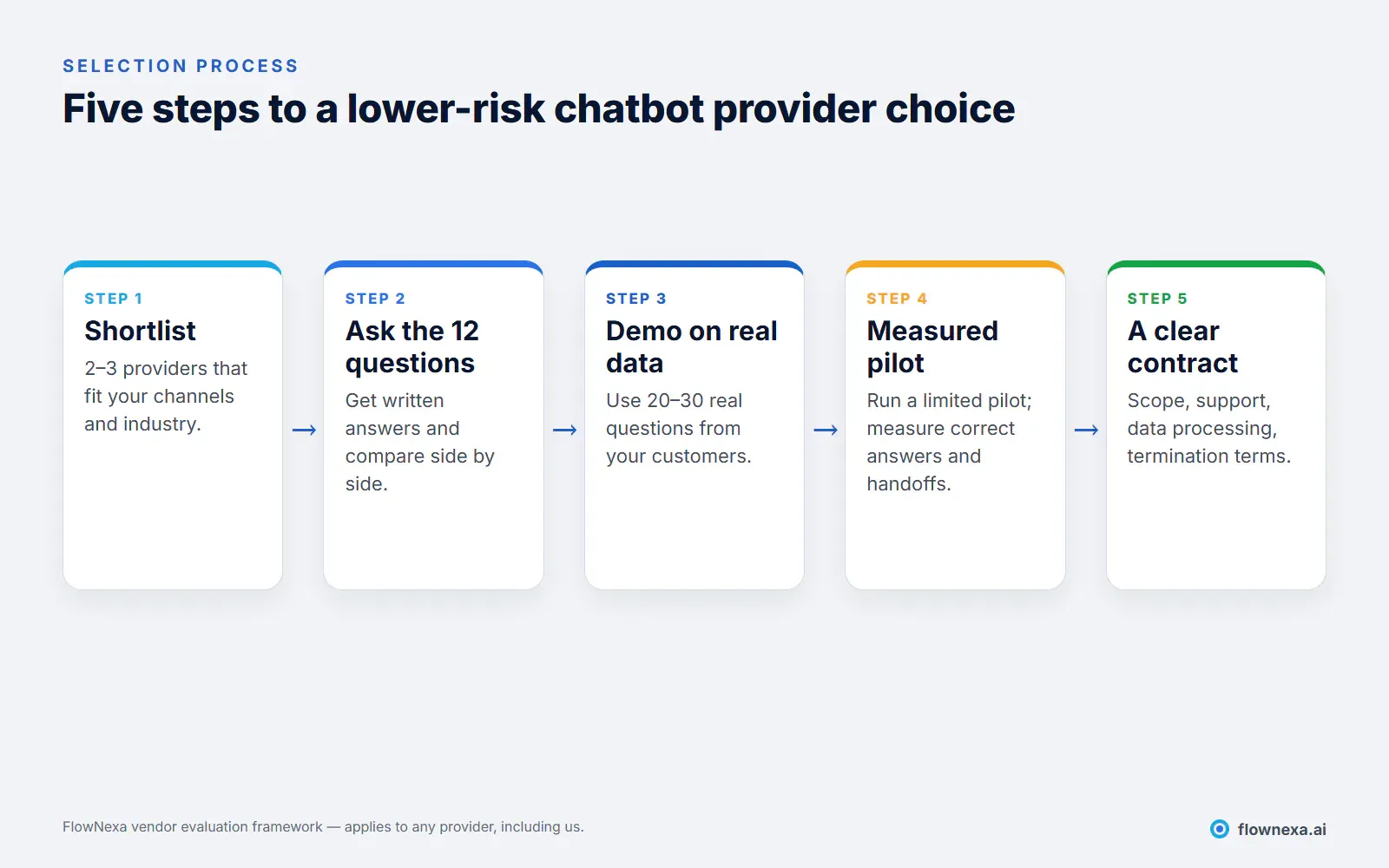
If you are weighing building in-house against a fully managed service, read build an AI chatbot or use a fully managed service before step 1. Before step 3, prepare your data using this guide so the demo reflects reality.
Transparency
How does FlowNexa answer these 12 questions?
Below are the answers for FlowNexa Chatbot, based on commitments published on our website. Where something depends on the contract, we say so.
| # | Question | FlowNexa's answer |
|---|---|---|
| 1 | Answer source | Prioritises business-approved content; out of scope, it directs customers to staff or a contact channel. We do not promise the AI is never wrong. |
| 2 | Content updates | Knowledge and configuration are reviewed with FlowNexa when business information changes; update scope follows the plan and contract. |
| 3 | Channels | The website widget is in the Standard plan; Zalo OA and Messenger are quoted per deployment (the business's own OA/Page is required). WhatsApp is not offered at present. |
| 4 | Acceptance | Per deployment scope; we recommend a real question set and a limited rollout as described above. |
| 5 | Handoff | Conversations can pass to staff or a contact channel when judgement, exceptions, or out-of-scope requests arise. |
| 6 | Reporting | Per service plan; specific metrics are agreed during consultation. |
| 7 | Data storage | Infrastructure providers such as cloud platforms may be used; subprocessors are listed in a DPA or contract on request. |
| 8 | Customer consent | The chatbot is designed to capture needs with customer consent. |
| 9 | Data rights | Customers keep rights to the content and data they provide; export, return, and deletion follow the contract. A subscription does not include source-code transfer or platform administration rights by default. |
| 10 | Cost | Standard plan in Vietnam: 8,900,000 VND per year (excluding VAT), prepaid for 12 months; multi-market and enterprise deployments are quoted per scope. |
| 11 | Support | Vietnam business hours, typically replying within one business day; out-of-hours cover and response commitments apply only when contracted. |
| 12 | Evidence | The demo page includes simulated industry scenarios and some live deployments; demos are not paid customer case studies. |
Details: pricing, Trust Center, data processing overview, and demos.
Q&A
Frequently asked questions
Should I choose the cheapest provider?
Only after comparing the full two-year cost for the same scope. Cheap plans often limit channels or usage, or exclude content updates; later charges can exceed the initial difference.
Can I trust a provider that promises 100% correct answers?
No. Chatbots built on language models always carry some probability of error. A trustworthy answer explains how the provider reduces errors (approved content, limited scope, staff handoff) and how errors are detected and fixed.
Do I need a separate data processing agreement (DPA)?
You should have one when the chatbot collects your customers' data. A DPA sets out each party's role, the purpose of processing, subprocessors, and how data is returned and deleted.
How many questions are enough for a demo?
About 20–30 real questions: easy ones, hard ones, out-of-scope ones, and ones that could be misread on price or policy. The out-of-scope questions show whether the chatbot knows when to decline.
Does a small business need all 12 questions?
Yes, but it does not have to be complicated. For a small business, the most important are the answer source (questions 1–2), data rights (question 9), and total cost (question 10).
What if we already use a chatbot and are not happy with it?
Start with question 9: confirm you can export the conversation history, leads, and content. Then use the same 12 questions to reassess your current provider before switching.
Sources
- FlowNexa's published commitments: pricing, Trust Center, Support Center, data processing overview, at the time of writing (November 2026)
- OWASP Top 10 for LLM Applications 2025, a reference for technical risks such as misinformation and sensitive data disclosure
FlowNexa
Ask us these 12 questions
Bring this question set to your consultation. FlowNexa answers in writing and demos on your customers’ real questions.
An AI chatbot for your website, Zalo OA, and Messenger.
Standard plan scope and DIY vs managed comparison.
Schedule a conversation and a demo.
