


From Room Availability to Confirmed Reservations: A Direct Booking Guide for Hotels
Separate availability, quotes, holds, and confirmation in a direct booking workflow. Handle last-room conflicts, late deposits, and discrepancies across channels.

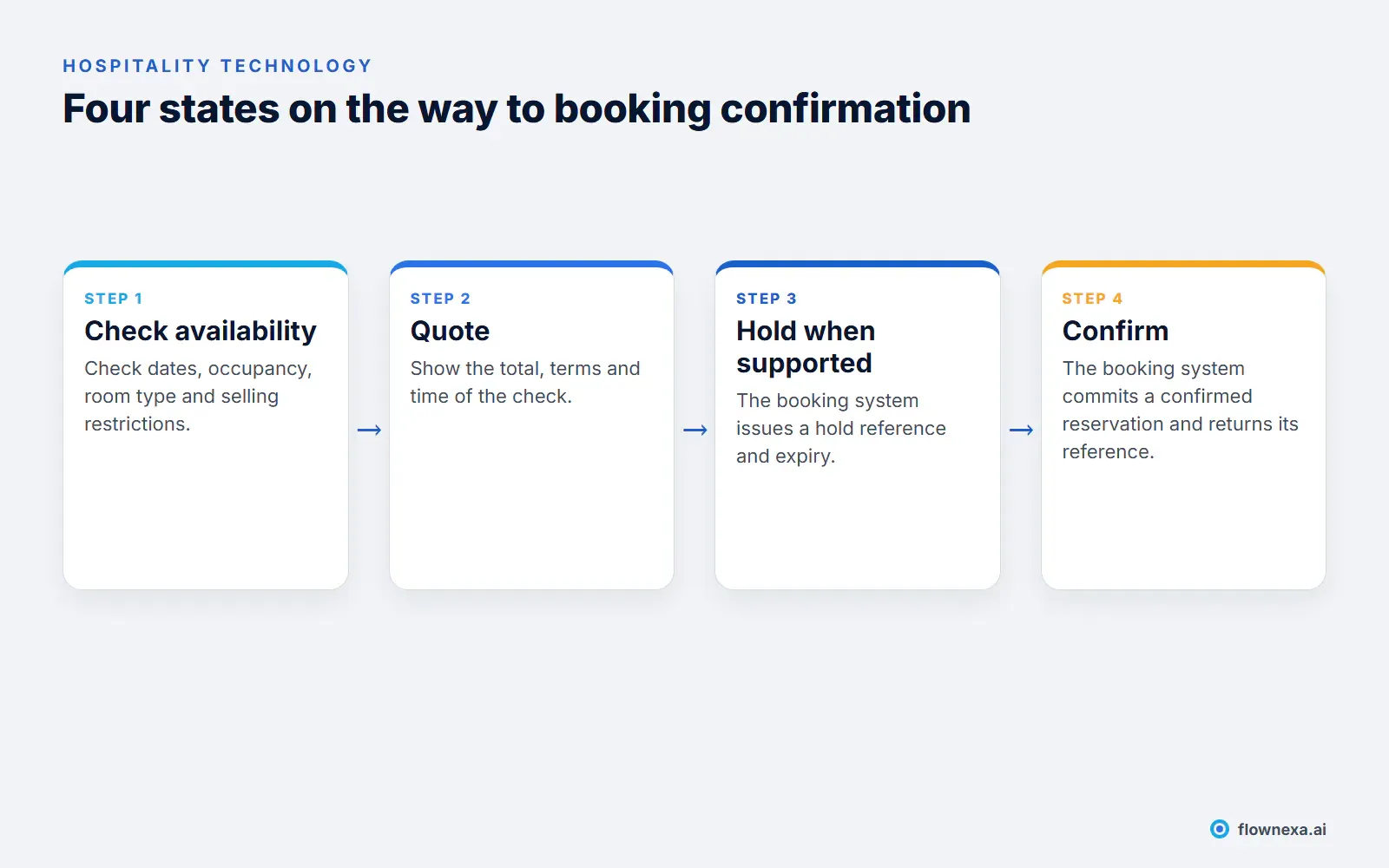
Short answer: Separate the states a guest can encounter in direct booking: availability check, quote, hold if supported, and confirmation. Send confirmation after the booking system commits a confirmed reservation and issues a reference. If room availability or payment cannot be verified, keep the request pending and identify who will resolve it.
A guest asks on the website whether a double room is available next weekend. Reception sees one remaining room and quotes a price while waiting for a reply. A third-party channel sells the last room in the meantime. If the assistant or receptionist says the room is held without a valid hold reference, the guest may send a deposit for a room the property can no longer sell. This guide is for small hotels, homestays, and serviced apartments connecting a website or guest conversation to an existing booking process.
States
An availability check and a hold have different consequences
| State | What does the system need? | What can the guest be told? |
|---|---|---|
| Availability check | Property, stay dates, occupancy, room type, and rate restrictions | “There is a suitable option as of this check.” |
| Quote | Total, applicable taxes and fees, currency, rate plan, and cancellation terms | “This quote reflects the current check. The room has not been held.” |
| Hold | Hold reference, deadline, and defined impact on sellable inventory | “We’re holding the room until 6:30 p.m. local time.” |
| Confirmation | A committed booking, reservation reference, and payment status under the agreed terms | “Your booking is confirmed. Here are the reference and terms.” |
The time shown is illustrative. Some properties confirm immediately without a separate hold. Others require a deposit. Set rules for each property and rate plan. If a system only acknowledges receipt, tell the guest that reception or the booking system still needs to complete the request. Housekeeping status, a room taken out of service, sellable inventory, and availability under a given rate plan also describe different things. For the operating roles, see what a hotel PMS does and when a small hotel needs one.
Architecture
Identify which system decides what can still be sold
A property management system (PMS) may own bookings and room status. A booking engine serves direct web reservations, and a channel manager distributes rates, inventory, and restrictions to third-party channels. The exact responsibilities depend on the integration. Document which system decides what can be sold, which system issues the confirmation, which readers may receive delayed copies, and who investigates when records disagree. Read the integration's contract so your team knows which response acknowledges a request and which response establishes the final outcome.
An availability request should include the property, local check-in and check-out dates, adult and child counts, and room type or acceptable alternatives. Ask for exact dates when a phrase like “next weekend” is ambiguous. Availability on the first night alone cannot cover a longer stay. Occupancy rules, minimum stays, closed dates, rate plans, and channel allocations can all affect what guests can book. Document whether inventory is shared across room types or channels, or separately allocated. Adding the numbers from two views of the same pool will overstate the supply.
A quote should retain the terms shown, the time of the check, and a quote reference where supported. Check again at the next step when the quote has expired or the data may have changed. If the new price is higher, show the change and ask the guest whether to proceed. If a lookup fails or its data is too old, route the request to reception for verification. The guide to AI-ready PMS for hospitality teams explains how to prepare the underlying data and access.
Holds and deposits
Handle another channel selling the last room
Two guests can see the last available room at the same time. The decisive operation happens in the system that controls inventory when it grants a hold or confirms a reservation. Where supported, the inventory system should check and reserve capacity as one operation. A chatbot recording “held” in a separate table does not prevent the other channel from selling the room. If holds are unsupported, use a request-to-book flow or recheck when the reservation is committed. Even with a valid hold, delayed updates across third-party channels may create a conflict. Decide who can resolve it and which messages may go out while the records are checked.
Show the deadline with its time zone. Let the inventory authority release capacity on expiry. Include a test for a deposit paid after a hold expires. A verified payment event establishes the movement of money, while a confirmed booking still requires a valid reservation and corresponding inventory. If no room remains, hand the case to staff to review alternatives or handle the deposit under the agreed terms. A transfer screenshot can be evidence for review, but it should not automatically mark a deposit as verified. With provider events, verify their source, account for repeats and out-of-order delivery, and track payment, booking-request, and reservation references separately.
Keep the same request reference when retrying a single operation. If a booking call times out, look it up before sending it again. If the API offers neither lookup nor documented idempotency, route the case to reception so someone can check evidence in the booking system. See the guide to processing duplicate webhooks.
Worked example
Give the guest a clear answer when a deposit arrives late
Imagine a 12-room property piloting direct reservations for double rooms. At 6:00 p.m. there is one option for a two-night stay. The website displays a total of VND 1.8 million and a quote deadline. The guest continues at 6:05 p.m. and receives a hold until 6:20 p.m. The deposit event arrives at 6:22 p.m. The workflow checks the hold reference, booking state, and availability. If there is no valid confirmed record, it queues the case. Once it verifies payment, it can tell the guest: “We’ve received your deposit and reception is checking your reservation.” If the room has sold, reception can review another option or handle the deposit under the agreed terms. The property size, price, and times are illustrative.
Give reception the stay details, request and hold references, expiry, verified payment amount, transaction reference, and time of the last update from the booking system. Staff can then review what happened without asking the guest to repeat everything. Record the outcome where other channels can see it so the guest does not get conflicting answers over the website and phone. If confirmation is still pending, say when the next update will arrive. See what a hotel AI assistant needs and the StayLedger PMS design story.
Pilot
Start with one property and one room type
Begin with request intake and a reliable handoff to reception. Once the data stays in sync, introduce read-only checks. Assess whether the booking integration supports holds or confirmation under the property's rules before enabling those steps. Test two people competing for the last room, a third-party booking arriving while a guest waits, a changed price, a stay with one unavailable night, late deposits, repeated events, and a booking call that times out. For each case, write down what the guest sees and who resolves it.
Measure the share of requests with complete details, time to confirmation, quote-to-booking price changes, unreconciled deposits, and cases handled manually. Track confirmed direct bookings per eligible request. Record the reason a request fell through where known, such as sold inventory, a changed price, or the guest leaving the process. If booking sources diverge beyond your agreed tolerance, return the channel to request intake until the records are reconciled. This gives reception a way to keep serving guests while protecting the accuracy of confirmations.
Q&A
Frequently asked questions
Does a guest message count as a reservation?
It can create a request. Say the reservation is confirmed only after the booking authority has committed it and issued a reference.
Does every booking require a room hold?
No. Some systems can confirm in one step. If your system cannot hold a room, make that clear and verify availability when committing the booking.
What if an OTA shows a room and our website does not?
Check channel allocation, restrictions, stay dates, rate plan, and last sync time. Let reception verify which source controls the affected inventory if the difference remains unexplained.
What if the guest pays twice after a retry?
Look up both transactions and reconcile them with the booking. Staff can verify the amount received and handle excess funds according to the agreed terms.
Should an AI assistant be allowed to create bookings from day one?
A first release can answer FAQs and collect booking requests. Introduce read access and write actions in stages after testing inventory, policies, and exceptions.
Sources
- Booking.com Connectivity: Rates & Availability API explains inventory, availability, pricing, and restrictions.
- Stripe: Receive webhook events documents the possibility of repeated and out-of-order payment events. The workflow here is a reference design to adapt to the property's integration.
FlowNexa
Review your direct booking workflow
Map the guest journey from enquiry to confirmation, identify the inventory authority, and decide which exceptions reception should handle.
