


Bilingual RAG Testing: Keep Vietnamese and English Answers Aligned With Policy
Build paired Vietnamese and English tests for a knowledge assistant, score claims and citations, trace policy mismatches, and define release criteria.

Short answer: Test each business scenario with a Vietnamese and an English question. Score each response against the same approved facts, exceptions, and sources before comparing the two. Agreement alone can hide a case where both answers are wrong. Set separate release blockers for critical errors such as changed amounts, missing exceptions, and promises the policy does not support.
An assistant can explain an exchange policy correctly in Vietnamese and tell an English-speaking customer that every product is eligible for a return. Both answers may sound polished. The difference becomes clear when a reviewer checks each condition against the policy in force. This guide is for teams with an existing knowledge base that are launching a second language or changing a model, search index, or prompt.
Scope
Define what must stay consistent between languages
Two answers should reach the same decision when the customer has the same permissions, market, product, and dates. The wording and order of ideas may vary. Product identifiers, units, effective dates, deadlines, exceptions, handoff triggers, and the strength of any commitment should carry across. Where different markets really do have separate policies, write a separate expected decision for each. An English-speaking customer browsing a Vietnamese storefront may still be eligible only for local terms.
Consider a hypothetical policy: unopened standard items may be exchanged within 14 calendar days of delivery, while custom orders must go to staff. “Two weeks from purchase” changes the starting point. “Fourteen business days” changes the window. “Return” may also imply a refund where the approved policy only offers an exchange. Give reviewers a glossary with examples of allowed and disallowed phrasing for deposits, refunds, warranties, and business days. Keep a term's original wording where a misleading translation would create a commitment the business never approved.
When two policy documents disagree, ask the business owner to identify the version in force and retire or label the stale translation. While the change is being reviewed, the assistant can explain that the case requires confirmation. Add market, effective-date, and language metadata when indexing documents. See the guides on standardising a knowledge base before RAG and multilingual assistants for exporters.
Test design
Give each test case enough context to replay it
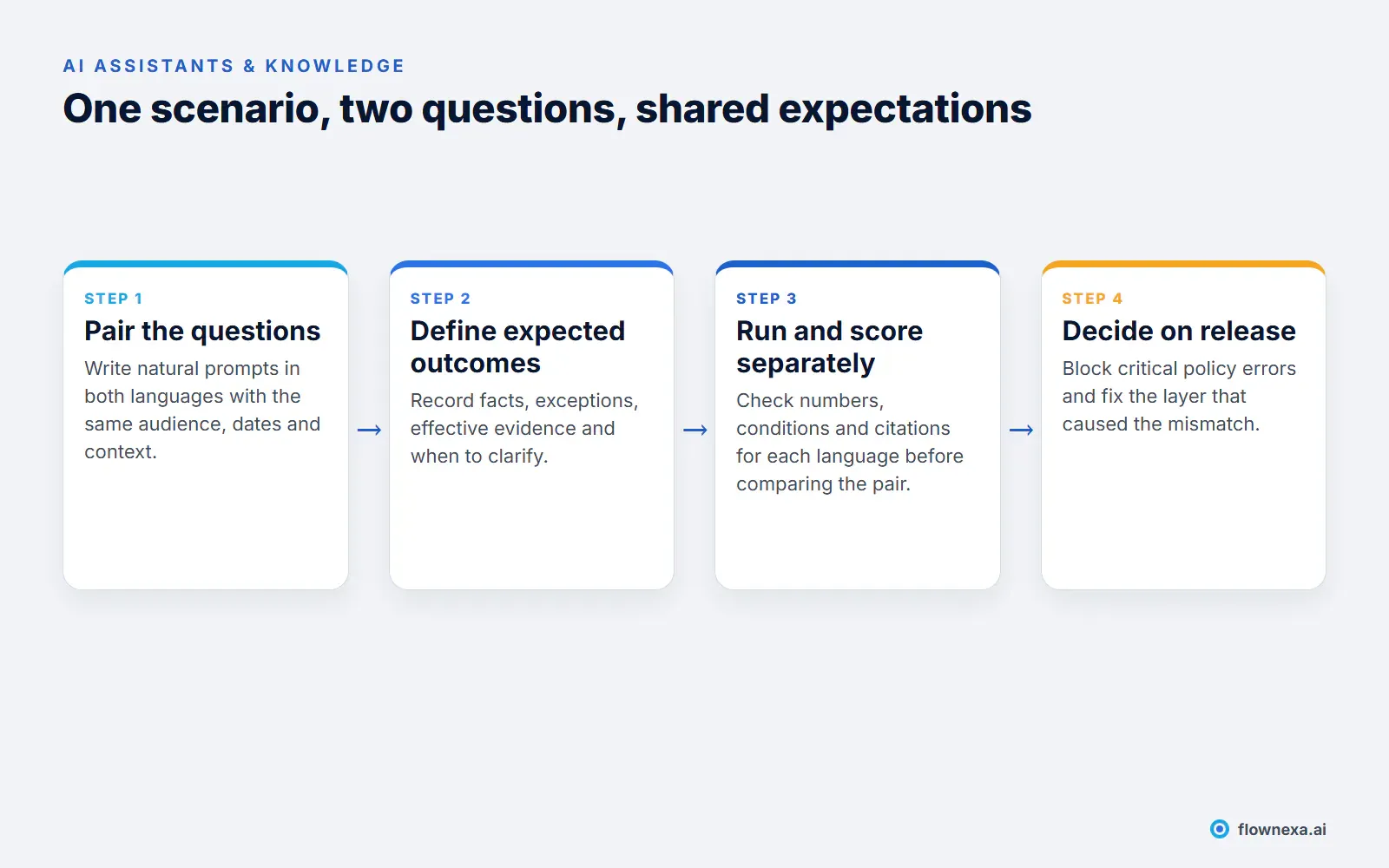
Each row represents a business scenario. Record a case ID, risk group, input context, Vietnamese question, English question, expected action, required facts, prohibited claims, and approved evidence. If dates matter, pin the evaluation date and business time zone. If the case uses an internal account, use the same permissions for both runs. Use synthetic cases or examples stripped of identifying details while preserving the phrasing and exceptions that matter.
| Scenario | Paired question | Pass condition |
|---|---|---|
| Custom-order exception | “Hàng đặt riêng mới nhận có đổi được không?” / “Can I exchange a custom order I just received?” | Refer to staff without promising an exchange or a refund |
| Fourteen-day window | “Hàng thường chưa mở, nhận thứ Sáu tuần trước, còn đổi được không?” / “My unopened standard item arrived last Friday. Am I still within the exchange window?” | Start from delivery, count calendar days, and conclude only when context is sufficient |
| Market missing | “Tôi ở nước ngoài, có áp chính sách đổi không?” / “Does the exchange policy apply if I’m abroad?” | Ask for the market or the relevant delivery conditions |
| Stale translation | “Thời hạn đổi hàng là bao lâu?” / “How long do I have to request an exchange?” | Use effective evidence for the right scope and exclude the retired version |
Write natural prompts for each language. Include unaccented Vietnamese, mixed-language product IDs, different date formats, and a customer switching language halfway through a conversation. For each variant, decide in advance whether the assistant can retain context or needs to clarify. Keep a fixed release set and a separate exploratory set. When a real failure is reported, remove unnecessary personal details and add the scenario to regression coverage. Review the pre-launch chatbot question set and scoring guide for ways to sample common intents and exceptions.
A useful test set includes different types of expected behaviour. Some cases should receive a direct answer, some should get a clarification, and others should end in a handoff. If nearly every row is an ordinary answer, the suite will say little about whether the assistant can preserve policy boundaries in either language.
Scoring
Score each answer for correctness before checking parity
Score each answer on four checks: correct action, required facts present, no forbidden commitments, and effective evidence that supports the conclusion. Use observable pass criteria so two reviewers can make the same call. Check amounts, units, dates, and policy IDs mechanically when possible. For open-ended responses, have a reviewer familiar with the business check a sample and document the reasons for decisions. If an automated evaluator helps with grading, calibrate it against cases labelled by a bilingual reviewer before relying on the score.
Report at least three rates: Vietnamese passes, English passes, and pairs where both passed. In an illustrative run with 80 pairs, Vietnamese passes 76 and English passes 72. If both pass in 70 cases, the rates are 95%, 90%, and 87.5%, respectively. Of the ten pairs that did not both pass, six passed in Vietnamese only, two passed in English only, and two failed in both. That distribution tells you where to look. Keep high-impact groups such as returns, pricing, limits, and access separate so high scores on simple FAQs cannot obscure policy mistakes.
Review citations at claim level. Two approved translations of the same policy can be valid evidence even if their URLs differ. A document about standard items cannot support a commitment about custom orders. Check that the user can open the cited source if necessary, and that the displayed citation corresponds to what retrieval actually returned. The existing guide on controlling citations in RAG covers that evidence chain in more detail.
Diagnosis
Trace the first point where the two answers diverge
- One language lacks the right evidence. Compare retrieved document IDs and the rank of the authoritative source. Inspect language and market filters, synonyms, and effective dates. A knowledge base with Vietnamese source material can still answer in English if using the original is allowed and the citation is transparent.
- Both runs retrieve the same document but receive different conditions. Check which excerpt reached generation. A passage that ends after “within 14 days” can lose the next line saying that the countdown starts at delivery.
- The context includes the conditions but the answer loses them. Inspect the instructions and any date or unit normalisation. Consider a separate field for essential exceptions when the system renders a response from structured output. Check that the final UI actually shows that field.
- The answer is correct but the displayed citation is wrong. Inspect the document and passage identifiers the renderer used. Repeated policy titles and stale translations can make a plausible citation point to the wrong edition even when the main text is accurate.
Record the configuration and policy revision so reviewers can repeat the run. Store only the metadata you need, such as case ID, language, timestamp, evidence identifiers, and error label. Restrict access to any conversation records your team has a reason to keep. If the scenario has insufficient evidence or asks for material outside the user's scope, test the expected clarification or refusal. See when an assistant should refuse to answer.
Release
Use the results to decide whether to expand rollout
Agree on acceptance criteria with the policy owner before the run. For example, any wrong policy commitment in a critical test group blocks rollout, while lower-risk FAQs can have their own aggregate threshold. Zero critical misses in the sample describes the sample you ran. When coverage is thin or a change reaches many topics, add representative cases and retain human review for the affected scope. Compare the candidate and current versions on the same test inputs. If the candidate raises the average but drops a critical exception, fix the regression before expanding.
After release, sample by language and topic. Watch for old sources, changes in handoff reasons, and categories where users need to ask again. If only a handful of conversations arrived in English one week, report the count alongside rates. For a regression, narrow the affected scope, use the approved fallback content, or switch back to the last stable configuration. Add the failure to the suite, rerun both languages, and record what changed. Over time, the set should become a record of policy boundaries the business has explicitly decided to protect.
Q&A
Frequently asked questions
Do the two versions need to match sentence by sentence?
No. Assess the decision, conditions, exceptions, units, and what the user will do next. Each response can read naturally in its own language.
Should we machine-translate every test question?
A translation can be a starting draft. Ask a bilingual reviewer to check phrasing, dates, and word choices against how real customers ask about the policy.
Can an English response cite a Vietnamese document?
Yes, if the source is valid, the user can access it, and the response is transparent about the source language. If an approved English source is required, make that part of the test contract.
What if countries have different policies?
Set expectations separately by market. If a market determines the answer and the user has not specified one, expect a clarification.
Do we need to rerun everything after editing one document?
Start with the directly affected scenarios and their exceptions in both languages. Add the shared regression set when the change may alter retrieval or behaviour across topics.
Sources
- NIST AI RMF Generative AI Profile for measurement and evaluation of generative AI risks. The paired suite and scores here are illustrative examples.
FlowNexa
Review your bilingual AI assistant with FlowNexa
Bring representative questions and policy sources to define an evaluation scope and clear criteria for release.
