


Building StayLedger PMS: Lessons in Designing an AI-Ready Hospitality System
The StayLedger build story from FlowNexa: why it started with a PMS rather than a chatbot, four design decisions for AI readiness, the real status of the AI assistant, and five lessons for hospitality businesses.
Short answer: StayLedger PMS is the property management system FlowNexa built to bring bookings, rooms, guests, housekeeping, payments, and reports onto one data flow, replacing spreadsheets, Zalo messages, and scattered notes. The biggest lesson: to use AI in hospitality, you have to solve data and permissions first. That is why StayLedger is AI-ready at the data architecture level, while StayLedger AI Assistant is still in development and testing.
This is not a customer case study. It is the product build story from the FlowNexa team: why we built it, the key design decisions, and what we learned that applies to any hospitality business choosing or building a management system.
All product status information here comes from the StayLedger pages published on flownexa.ai: StayLedger PMS is ready to deploy; StayLedger AI Assistant is in testing and has not been announced as a live feature.
Why
Why did FlowNexa build StayLedger?
Small hotels, homestays, serviced apartments, and villas often run on disconnected tools: bookings in a spreadsheet, room status discussed in a group chat, payments tracked in a ledger or another app, and reports compiled by hand at month end. Add a second or third property and control gets harder: revenue mixes between properties and access to data becomes unclear.
When we started thinking about AI for hospitality (answering guests about check-in times, room status, policies), one thing became clear: AI cannot answer correctly if the operational data itself is not correct and not in one place. That is why StayLedger started with a PMS, not a chatbot.
If you are weighing whether a small hotel needs a PMS at all, what is a hotel PMS, and does a small hotel need one? goes deeper.
Decision 1
One data flow for the whole operation
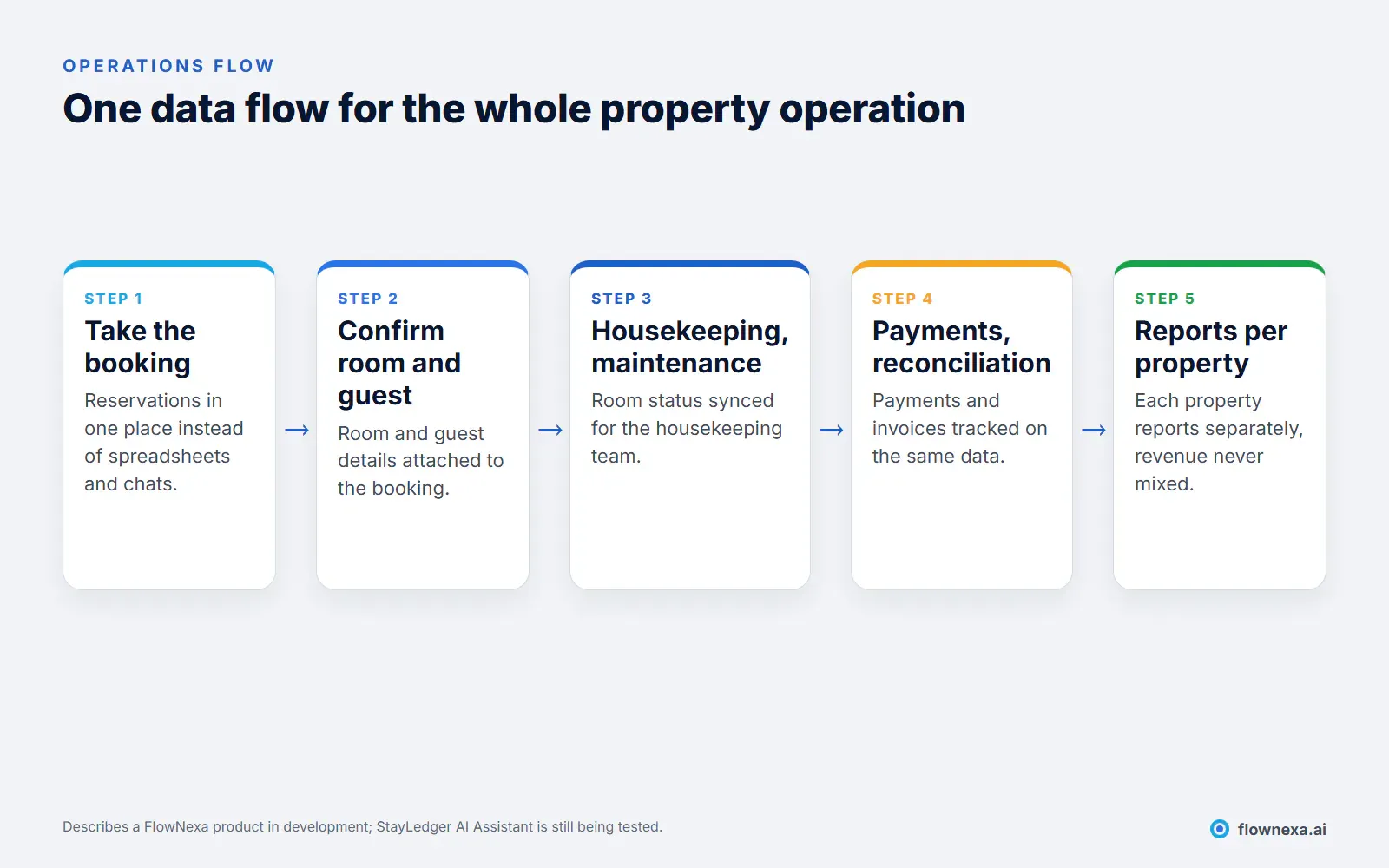
The first decision was that every operational step reads and writes the same data: taking the booking, confirming the room and guest, syncing housekeeping and maintenance, tracking payments and reconciliation, and reporting per property.
In practice:
- Front desk, housekeeping, and accounting see one operational truth, with no more "whose spreadsheet is right".
- A room status changes once and every team sees it, instead of messages back and forth.
- Reports come from the data used every day, not a month-end reconstruction.
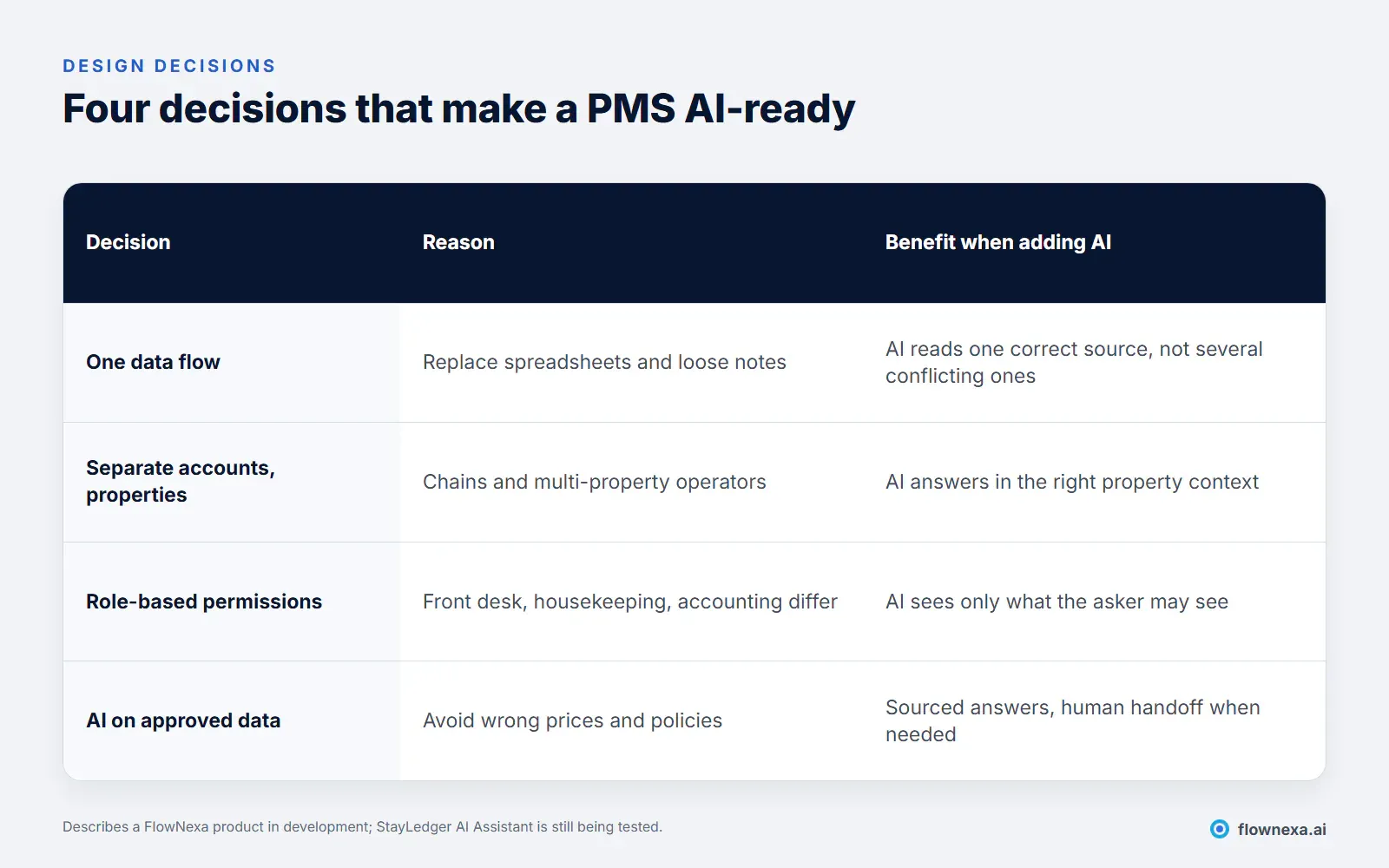
This is also the foundation for adding AI later: one correct source is far better than an AI having to "guess" between conflicting ones.
Decisions 2–3
Separate properties, role-based permissions
Multi-tenant for chains and operators. StayLedger separates accounts, properties, roles, and data clearly. An operator managing several properties can grow without mixing permissions or revenue between them.
Role-based permissions. Front desk, housekeeping, managers, and accountants need different parts of the data. Permissions are not just a security feature; they decide what an AI may see when answering a specific person.
These decisions sound "technical", but they are exactly what trips up many hotel AI projects: an assistant answering with another property's information, or staff able to query data they should not see. The same principle applies to internal AI in any industry; see department-aware enterprise AI assistants.
Decision 4
An AI assistant that answers only within its scope
StayLedger AI Assistant is the AI layer FlowNexa is developing to connect the knowledge base and PMS data under control, supporting both guests and operations staff. The design principles:
- Approved data first, to reduce the risk of wrong answers about prices, policies, or check-in times.
- Identify the scope before answering: which topic, and which source it needs.
- Use PMS tools only once approved, always checking the asker's permissions.
- Log and hand off when a question is out of scope.
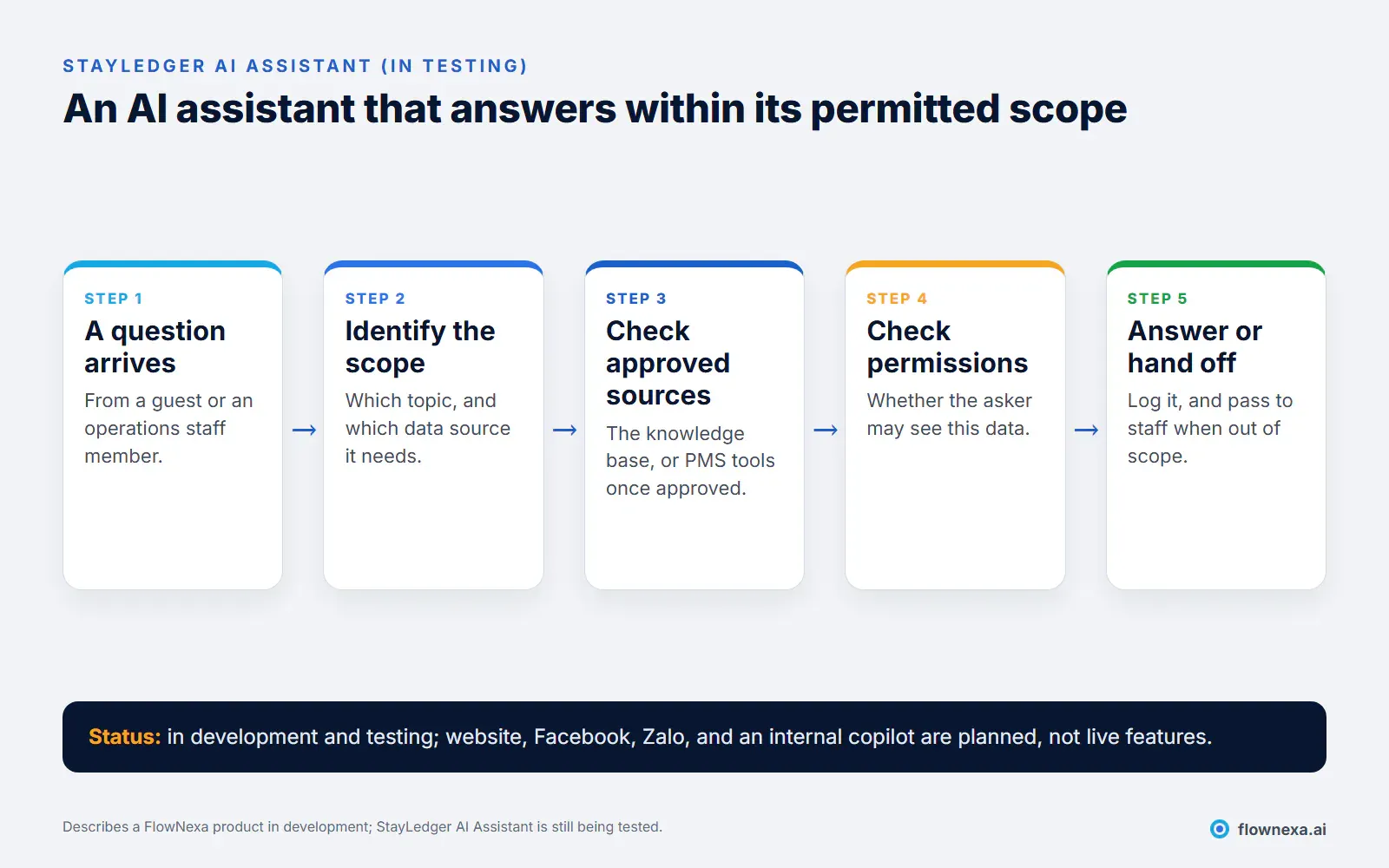
On status: the assistant is in development and testing. Website, Facebook, Zalo, and an internal copilot are planned, not live features. We chose to publish the real status rather than promote features that are not ready, because in hospitality a wrong answer about a room rate or cancellation policy does more harm than having no assistant. See also why a hotel AI assistant is not just a chatbot.
Lessons
Five lessons for hospitality businesses that want to use AI
- Data first, AI second. If bookings and room status are not in one place, AI just exposes the mess faster.
- Permissions are a product feature, not an afterthought. Designing them in costs far less than patching them once AI can reach the data.
- Property context matters. Check-in times, policies, and amenities differ between properties; the AI must know which one it is answering for.
- People remain at the heart of hospitality. An AI assistant should resolve repeat questions and hand situations that need flexibility to staff.
- Be transparent about status. Saying clearly which features are live and which are in testing helps customers set the right expectations.
These lessons apply even if you never use StayLedger. What is an AI-ready PMS? offers concrete criteria for assessing your current system.
Mistakes
What mistakes do hotels make when adding AI too early?
Talking with hospitality operators while building StayLedger, the same patterns kept coming up. None of them are about the AI model itself.
- Starting with the channel instead of the data. A chatbot on the website or Zalo looks like quick progress, but if room rates live in three places, the bot repeats whichever version it was given, and guests screenshot the wrong price.
- One knowledge base for every property. Operators with several properties often paste all policies into one document. The assistant then mixes check-in times, parking rules, or breakfast hours between locations.
- No owner for answers. Someone has to approve what the assistant may say and update it when policies change. Without an owner, content drifts out of date within weeks.
- Letting AI touch bookings before permissions are clear. Reading a policy is low risk; changing a reservation or revealing guest details is not. Those actions need role checks and an audit trail first.
- Promising features before they are tested. Announcing a "24/7 AI receptionist" before it handles real edge cases sets expectations that staff then have to repair.
If several of these sound familiar, that is normal. The fix is rarely a better AI tool; it is usually one week spent consolidating data and agreeing who owns which answers. Our article on when AI must refuse to answer covers how to design that boundary.
Getting started
Where should a small property start?
A practical order for a small hotel, homestay, or serviced apartment:
- List the questions guests ask most (check-in time, parking, breakfast, cancellation) and write one approved answer per property.
- Move bookings and room status into one system, whether StayLedger or another PMS that meets the checklist below.
- Decide roles: who can see revenue, who can change bookings, who only updates housekeeping status.
- Only then add an assistant, starting with document-based answers and a clear handoff to staff.
Checklist
Questions to judge whether a PMS is ready for AI
- Do bookings, rooms, guests, housekeeping, and payments share one set of data?
- Is data separated by property, with no mixed revenue?
- Are there role-based permissions for front desk, housekeeping, accounting, and managers?
- Does the system offer an API or controlled integration for other applications?
- Are policies and check-in/check-out times managed as standard content?
- Is there a change log to trace errors?
- Does the vendor say clearly which features are live and which are in development?
Q&A
Frequently asked questions
Is StayLedger PMS ready to use?
According to the information published on flownexa.ai, StayLedger PMS is ready to deploy. Deployment and integration scope are agreed per business; contact FlowNexa for details.
Is StayLedger AI Assistant the same as FlowNexa Chatbot?
No. StayLedger AI Assistant is a hospitality-specific AI assistant tied to PMS data and currently in testing. FlowNexa Chatbot is a customer-advice chatbot product for businesses in general.
When will StayLedger AI Assistant go live?
The assistant will only be announced as ready once testing and approval are complete. FlowNexa will update its status on the product page rather than promise a date in advance.
Does this article include customer figures?
No. It is the product build story from FlowNexa's side. We only publish figures or customer names with that customer's consent.
Should a small hotel invest in a PMS before using AI?
If bookings and room status are scattered, standardising operations should come first. A chatbot answering from documents (check-in times, amenities, policies) can start earlier, but questions about availability or reservations need correct PMS data.
Do these principles apply to systems other than StayLedger?
Yes. One data flow, separate properties, role-based permissions, and AI on approved data are general principles for any hospitality system that wants to add AI safely.
Sources
- StayLedger, the product overview on flownexa.ai
- StayLedger PMS and StayLedger AI Assistant, features and status at the time of writing (November 2026)
- This article is a product build story, not a customer case study
StayLedger
Explore StayLedger for your property
Talk with FlowNexa about your current operations and a path to bring hospitality data into one place before adding AI.
Bookings, rooms, guests, housekeeping, payments, and reports on one platform.
A hospitality AI assistant, in development and testing.
Talk through your property and current processes.
