


Making a Website Ready for Google and AI Search: Lessons from flownexa.ai
Google says AI Overviews need no special files or markup. These are the five layers FlowNexa standardised on flownexa.ai: crawling, indexing, content, structured data, and real authors, plus the mistakes we fixed.

Short answer: There is no special "trick" for AI search. Google states that no extra files, markup, or schema are needed to appear in AI Overviews and AI Mode; the page only has to be indexed and eligible to show with a snippet. What actually makes the difference is the foundation: clean crawling and indexing, content that answers the question directly, structured data that matches what is visible, and transparent authors and sources.
This is not theory. It is what FlowNexa did, including the mistakes we had to fix, while standardising flownexa.ai itself: 117 Vietnamese–English article pairs running on Next.js, Strapi, and Kubernetes. You can use it as a checklist for your own business website.
Context
What does Google say about AI Overviews and AI Mode?
Google Search Central's AI features and your website answers the three questions many businesses worry about:
- Are there special requirements? No. Google says there are no additional requirements or special optimisations needed to appear in AI Overviews or AI Mode. The page has to be indexed and eligible to be shown in Search with a snippet.
- Do I need new files or markup? No. Google states that you don't need to create new machine-readable files, AI text files, or markup, and there is no special schema.org structured data to add.
- How do I control it? With robots.txt for Googlebot and the
nosnippet,data-nosnippet,max-snippet, andnoindexdirectives.Google-Extendeddoes not control Search; it only limits use in some of Google's other systems.
One recommendation stands out: structured data should match the visible text on the page. That principle shaped all of the JSON-LD described below.
Mental model
Which five layers help content get found and cited?
We split the work into five layers. Each one only pays off once the one before it is solid: perfect structured data means nothing if the page is not indexed.
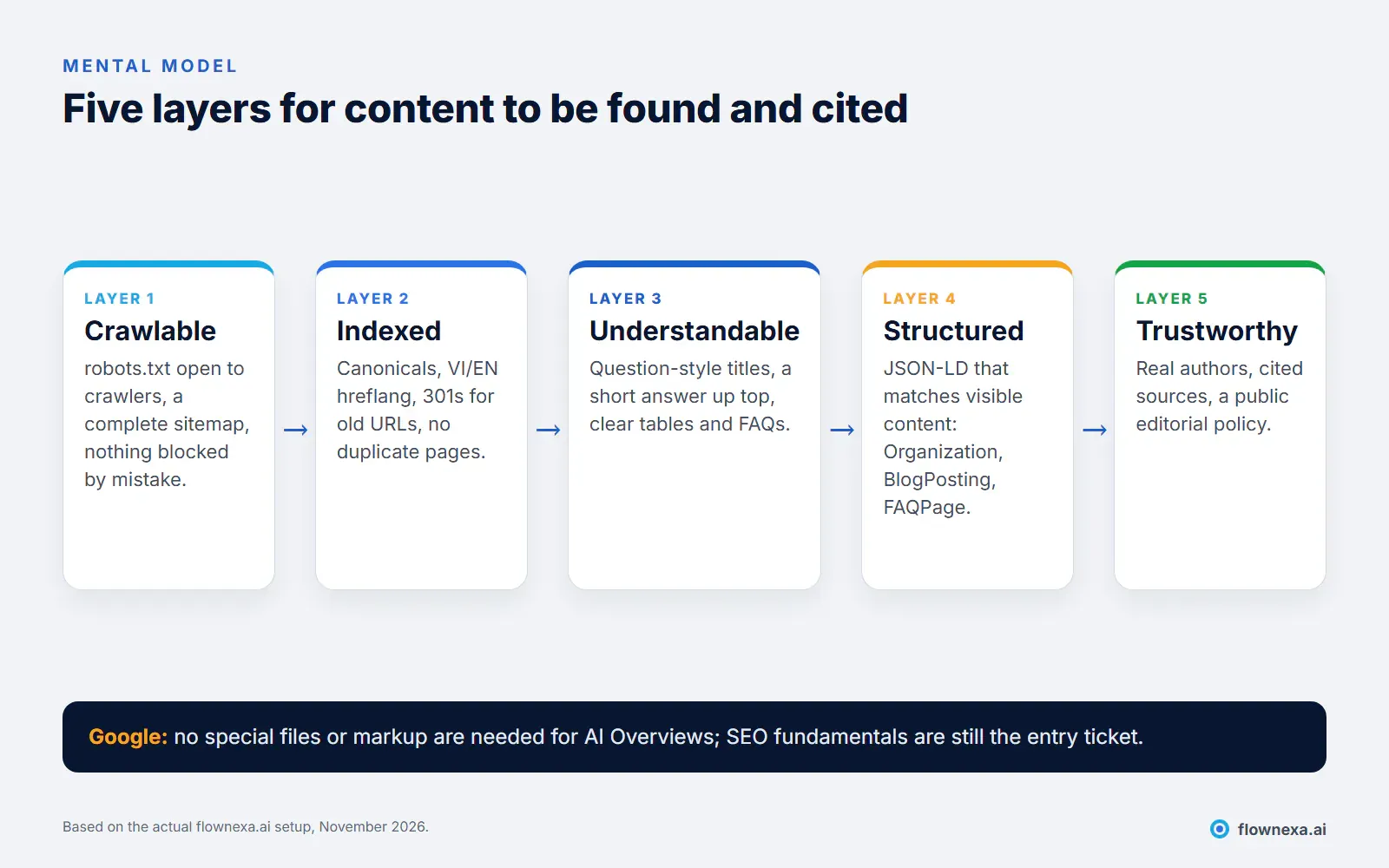
Layers 1–2
Crawling and indexing: the foundation you cannot skip
An intentional robots.txt. The site allows search and AI assistant crawlers (Googlebot, Bingbot, OAI-SearchBot, ChatGPT-User, ClaudeBot, Claude-SearchBot, PerplexityBot, Applebot…) and blocks only /api/. That is a business choice: FlowNexa wants its content to be cited. Other businesses may choose differently, but it should be a conscious decision rather than a default.
A sitemap that reflects real content. sitemap.xml lists every Vietnamese and English page with hreflang for each URL. lastmod comes from when the content materially changed, not when the system last wrote the record. Articles on an indexing hold (noindex) are left out.
Bilingual done properly. Each article has its own slug under /vi and /en, two-way hreflang, and an x-default pointing to Vietnamese, following Google's guidance on localized versions.
Old URLs must not die. When articles are merged or renamed, the old URL gets a 301 redirect to its replacement. The site currently manages 58 such URLs in code, covered by tests.
Announce new content. Whenever an article is published, the site revalidates the page and submits the URL through IndexNow. Note that IndexNow is supported by Bing, Yandex, Naver, Seznam, Yep, and Amazon; Google is not on the list. For Google, the sitemap and Search Console remain the main channels.
Layer 3
Content that both people and machines understand
AI systems cite clear answers. Every article on the FlowNexa blog therefore follows the same pattern:
- Titles phrased as real questions customers ask, such as "Webhook sent multiple times: how do you process it only once?".
- A short answer at the very top, about 40–60 words, that answers the question before going into detail.
- Each H2 is a sub-question, supported by comparison tables, checklists, and a frequently asked questions section.
- One search intent, one article. Our review found several pairs of articles answering the same question, such as two articles about moving on-premises email to Microsoft 365. They compete with each other and dilute the signal; the fix is to merge them and add a 301 redirect.
Layer 4
Structured data: describe only what is on the page
The site emits JSON-LD for its main entities, and every value comes from visible content:
| Schema | Where | Data source |
|---|---|---|
Organization | Whole site | Legal name, tax ID, address, founder |
BlogPosting | Each article | Title, description, published and updated dates, author |
Person | Article author, author page | The author profile shown on the page |
FAQPage | Articles with an FAQ | Taken directly from the questions shown at the end of the article |
BreadcrumbList | Articles, sub-pages | Home → Blog → Article path |
On FAQPage: since August 2023, Google shows FAQ rich results only for a limited set of authoritative government and health websites. We still keep the schema because it accurately describes the Q&A structure for any system that reads the page, and because it is generated from the visible FAQ, it can never drift from the content.
A small but important technical detail: the JSON-LD string escapes the < character, so CMS content can never accidentally close the <script> element.
Layer 5
Real authors and transparency about AI
This was the biggest change in the project. Articles used to be credited to "FlowNexa Team" or "FlowNexa Editorial Team", although no such editorial team existed. Now:
- Every article is credited to the person actually accountable, with an author profile page covering experience and certifications, linked to the
Organizationentity through thefounderproperty. - Each article ends with a note disclosing that it was drafted with AI assistance and technically reviewed before publication.
- The editorial policy describes the process: AI helps with drafting, articles stay in draft until reviewed, every figure and price must be verified and cited, and no case studies are invented.
The reason is practical: search systems and readers both need to know who is responsible for the content. A generic name does not answer that question.
About llms.txt
Should you create an llms.txt file?
llms.txt is a community proposal published by Jeremy Howard in September 2024, not an official standard like robots.txt. As quoted above, Google says AI text files are not needed to appear in Search's AI features.
flownexa.ai still serves /llms.txt for two reasons: it costs almost nothing to maintain, and it is a controlled summary of facts (the standard plan price, the supported channels, what we do not offer such as WhatsApp, and the editorial policy). But we do not expect it to improve rankings, and it does not take priority over any of the layers above.
Infrastructure
How does the infrastructure behind a site affect SEO?
No layer above can rescue a slow or broken page. The site runs Next.js on a lightweight Kubernetes cluster (k3s), with this publishing flow:
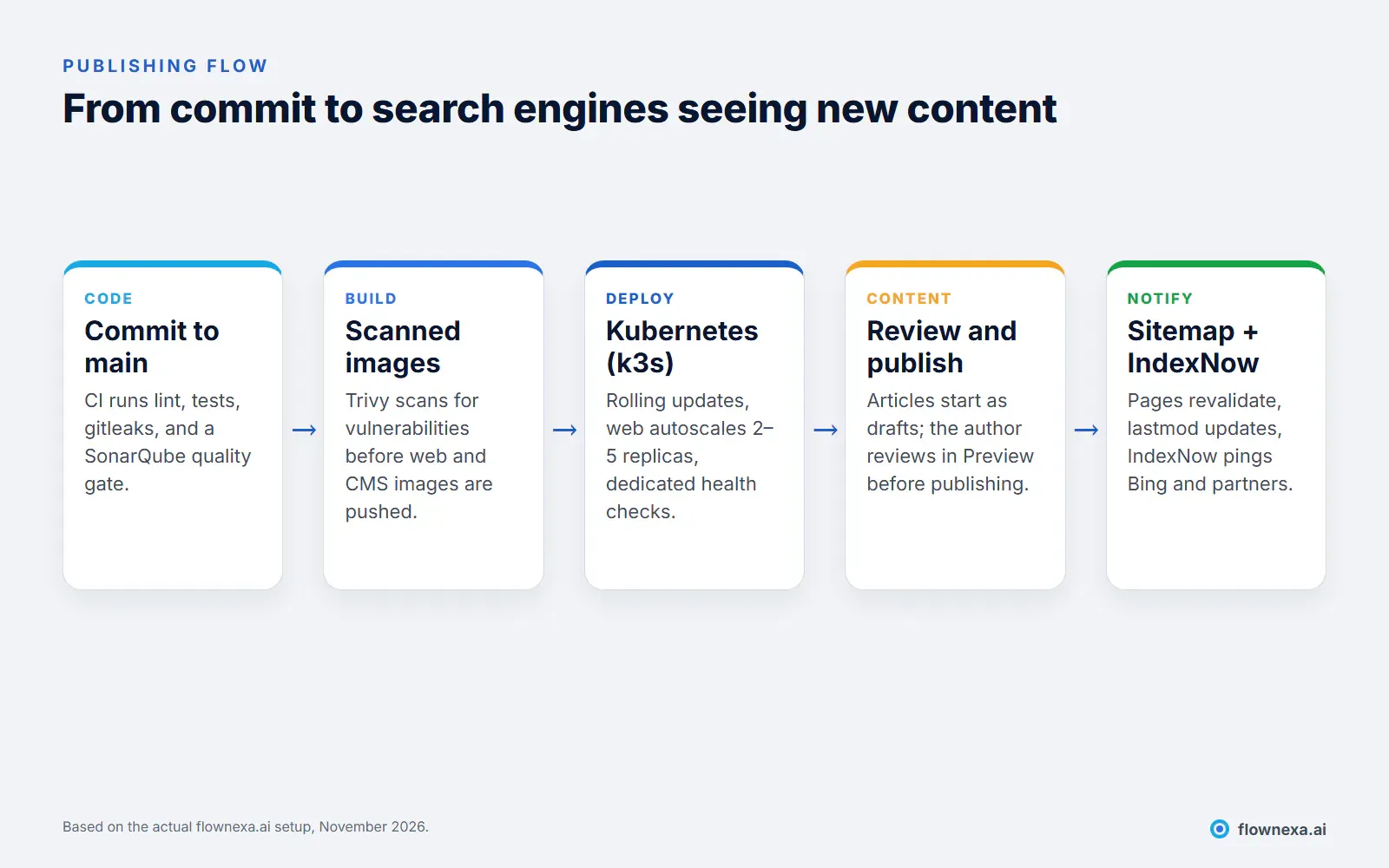
Two real incidents show how directly infrastructure affects experience and indexing:
- CPU throttled at low load. Each dynamic page render takes about 150 ms of CPU and bursts across threads. With a 1-core limit, the Linux CFS quota throttled almost every render (a CPUThrottlingHigh alert at about 27%). Raising the limit to 2 cores and moving health checks from
/vi(a full render, 8 times a minute per pod) to the lightweight/api/healthendpoint fixed it. See also website slow while CPU and memory are low. - A CDN feature broke the page. Cloudflare's Email Address Obfuscation rewrites email addresses in the HTML and injects a script. That script was blocked by the Content Security Policy and caused a React hydration error (#418). We turned the feature off for the production site and documented it in the runbook.
The pipeline and monitoring are covered in practical DevSecOps for a business website and from Git push to production.
Lessons learned
Which mistakes did we have to fix?
- Articles with the same search intent. Several articles answering one question compete with each other. Fix: merge into the strongest article and 301-redirect the rest.
- A generic author. "FlowNexa Team" does not tell readers who is responsible. Fix: a real author, a profile page, and a public editorial policy.
- Publication dates that "jump". Strapi 5 updates
publishedAton every re-publish, making old articles look new. Fix: store the first publication date and the last substantive content change separately; only those drive the visible date,dateModified, andlastmod. - Raw markdown on the page. Some link cards at the end of articles showed
[Title](https://…)instead of a link. Fix: the renderer now recognises the pattern and turns it into an internal link, with no per-article edits. - A CDN feature at odds with security. As described above, every "automatic optimisation" from a CDN should be tested against your CSP and framework.
Measurement
How do you know whether these changes work?
There is no standard tool that precisely measures "presence in AI answers" yet. The practical approach combines:
- Google Search Console: index status, sitemap errors, queries, and impressions per page. Traffic from AI Overviews and AI Mode is included in the overall Search performance report.
- Bing Webmaster Tools: confirm IndexNow is working and track indexing on Bing.
- Rich Results Test and Schema Markup Validator: check JSON-LD after every template change.
- Regular manual checks: ask your target questions in ChatGPT, Perplexity, and Gemini and record which sources are cited.
- Referral sources in analytics: once analytics is enabled, track visits coming from AI assistants.
Q&A
Frequently asked questions
Do I need special schema to appear in AI Overviews?
No. Google says there is no special schema.org structured data to add for AI Overviews or AI Mode. Structured data is still useful for Search in general, as long as it matches the visible content on the page.
Does llms.txt improve rankings?
There is no evidence that it does. llms.txt is a community proposal rather than a standard, and Google says AI text files are not needed. If you create one, treat it as a low-cost summary of facts, not an SEO tool.
Should I block AI crawlers in robots.txt?
It depends on your business goals. Blocking an AI assistant's crawler makes it harder for that assistant to cite your content. If you want to be cited, allow it; if you are concerned about training use, look at each user agent, because some serve search and others serve training.
Does IndexNow make Google index faster?
No. According to the IndexNow FAQ, participating engines are Bing, Yandex, Naver, Seznam, Yep, and Amazon; Google is not listed. For Google, use the sitemap and Search Console.
What matters most for a bilingual website?
A separate URL per language, two-way hreflang between versions, a clear x-default, and a canonical pointing to the same language. Translations should be localised rather than machine-translated sentence by sentence.
Where should a small business start?
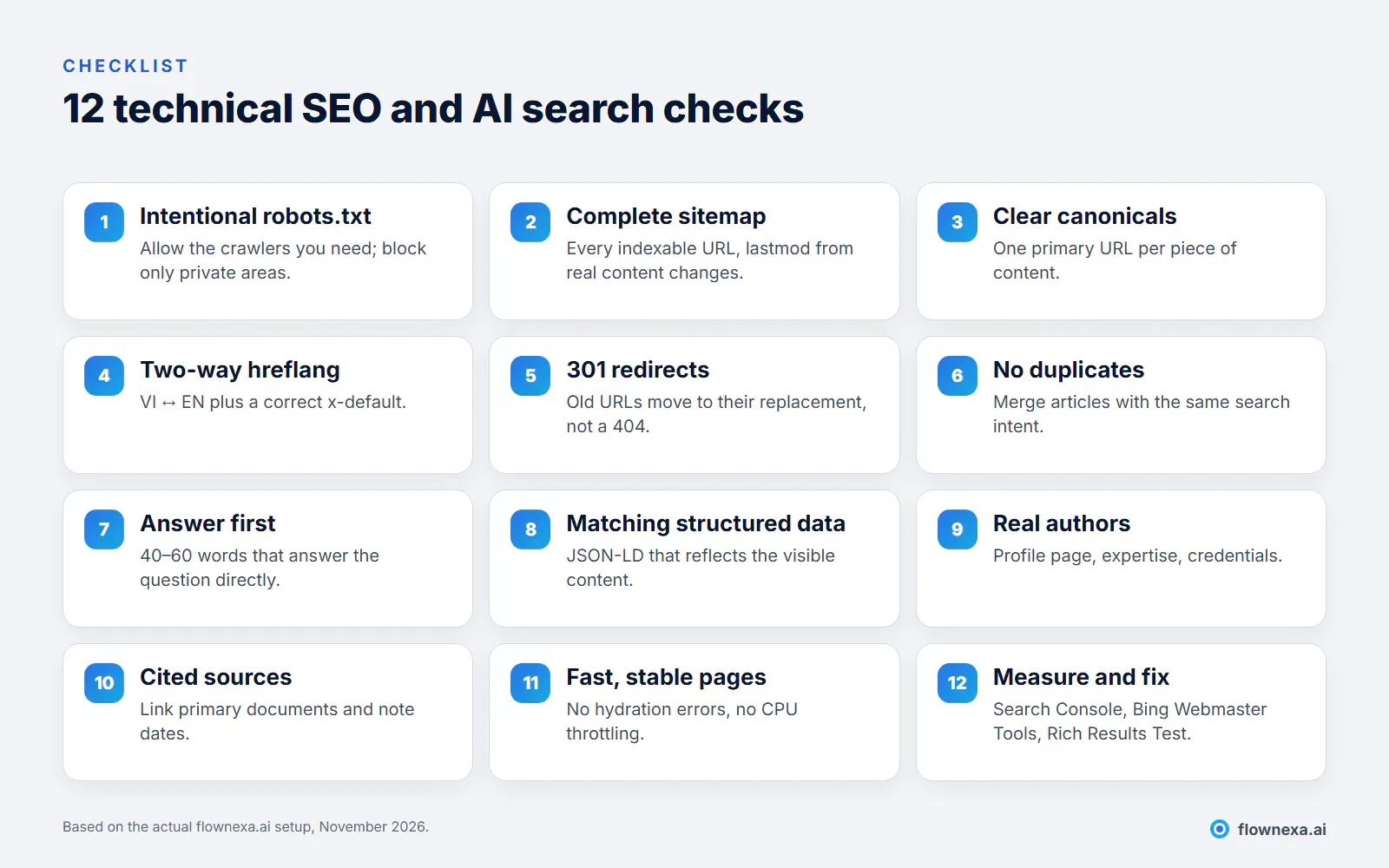
With layers 1 and 2: check robots.txt, the sitemap, canonicals, and 404 errors in Search Console. Content, structured data, and authorship come after that. The 12-point checklist above is a sensible order for an audit.
Sources
- AI features and your website, Google Search Central
- Tell Google about localized versions of your page, Google Search Central
- IndexNow FAQ, list of participating search engines
- The /llms.txt file, proposal by Jeremy Howard (2024)
- The actual flownexa.ai configuration (robots, sitemap, redirects, CI/CD, Kubernetes) at the time of writing, November 2026
FlowNexa
Audit your business website
FlowNexa checks crawling, indexing, structured data, performance, and your deployment process, then proposes fixes in order of impact.
Quality-gated CI/CD, monitoring, and alerting for your website.
Kubernetes, k3s, and infrastructure sized for your business.
Talk through your website and search goals.
