


Is Your Business Ready for AI? A 20-Question Self-Assessment for SMEs
Score 20 questions across 5 areas on a 40-point scale to see whether to standardise first, run a small pilot, add AI to workflows, or consider AI agents, with a worked example and how to read the result.
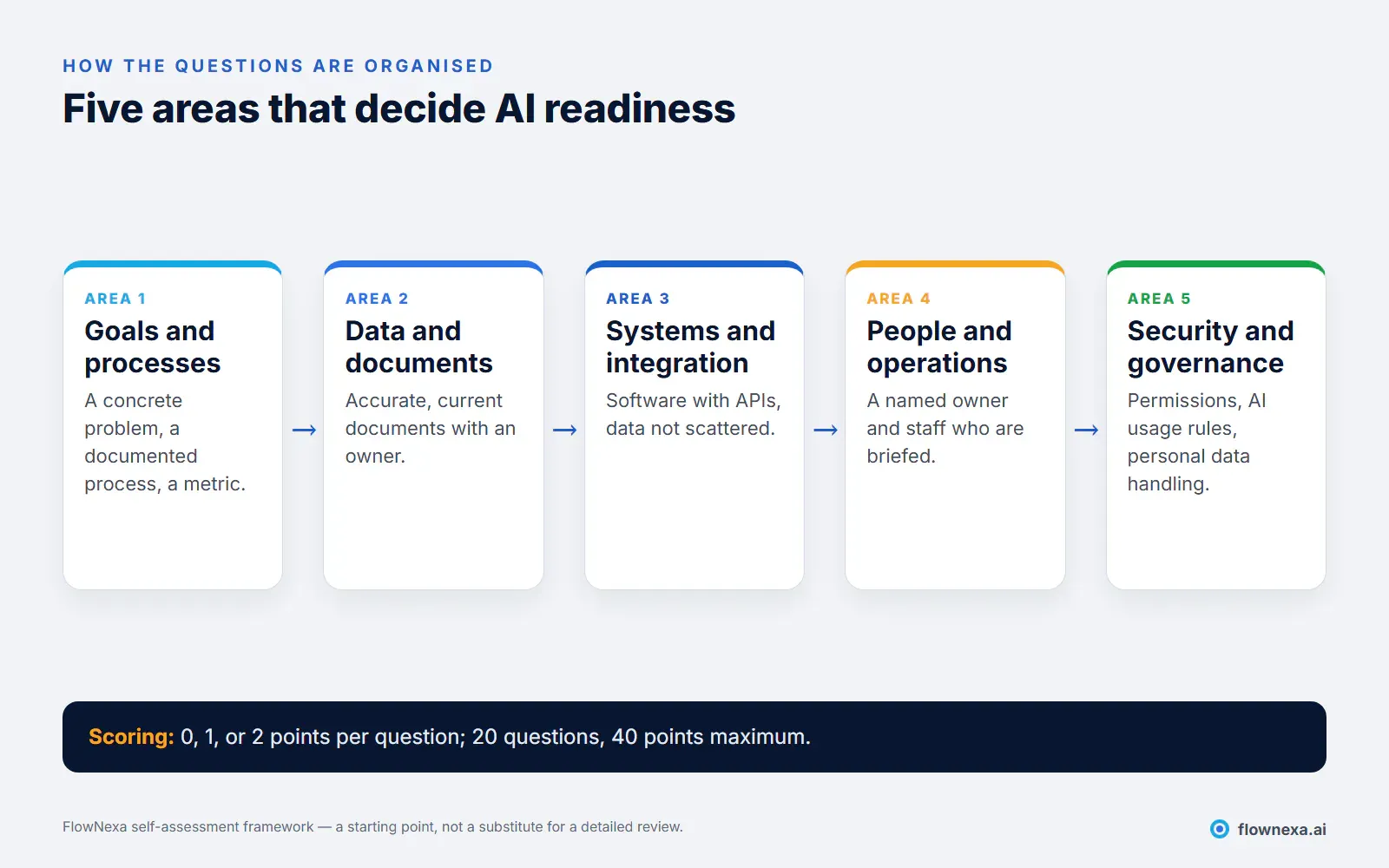
Short answer: Before choosing an AI tool, score 20 questions across 5 areas: goals and processes, data and documents, systems and integration, people and operations, and security and governance. Each question scores 0, 1, or 2, for a maximum of 40. The total tells you whether to standardise first, run a small pilot, add AI to a workflow, or consider AI agents; the lowest-scoring area is the bottleneck to fix first.
Many businesses ask "which AI tool should we use?", when the more important question is "how ready are we?". The same chatbot can work well at a company with clear documentation and fail at one where prices live in scattered Zalo messages.
The questions below are the framework FlowNexa uses in initial reviews. You can score them in about 20 minutes, ideally with your operations lead and someone who knows your IT systems.
How to use it
How do you score accurately?
- Score the current state, not the plan. "We are about to do it" scores 0.
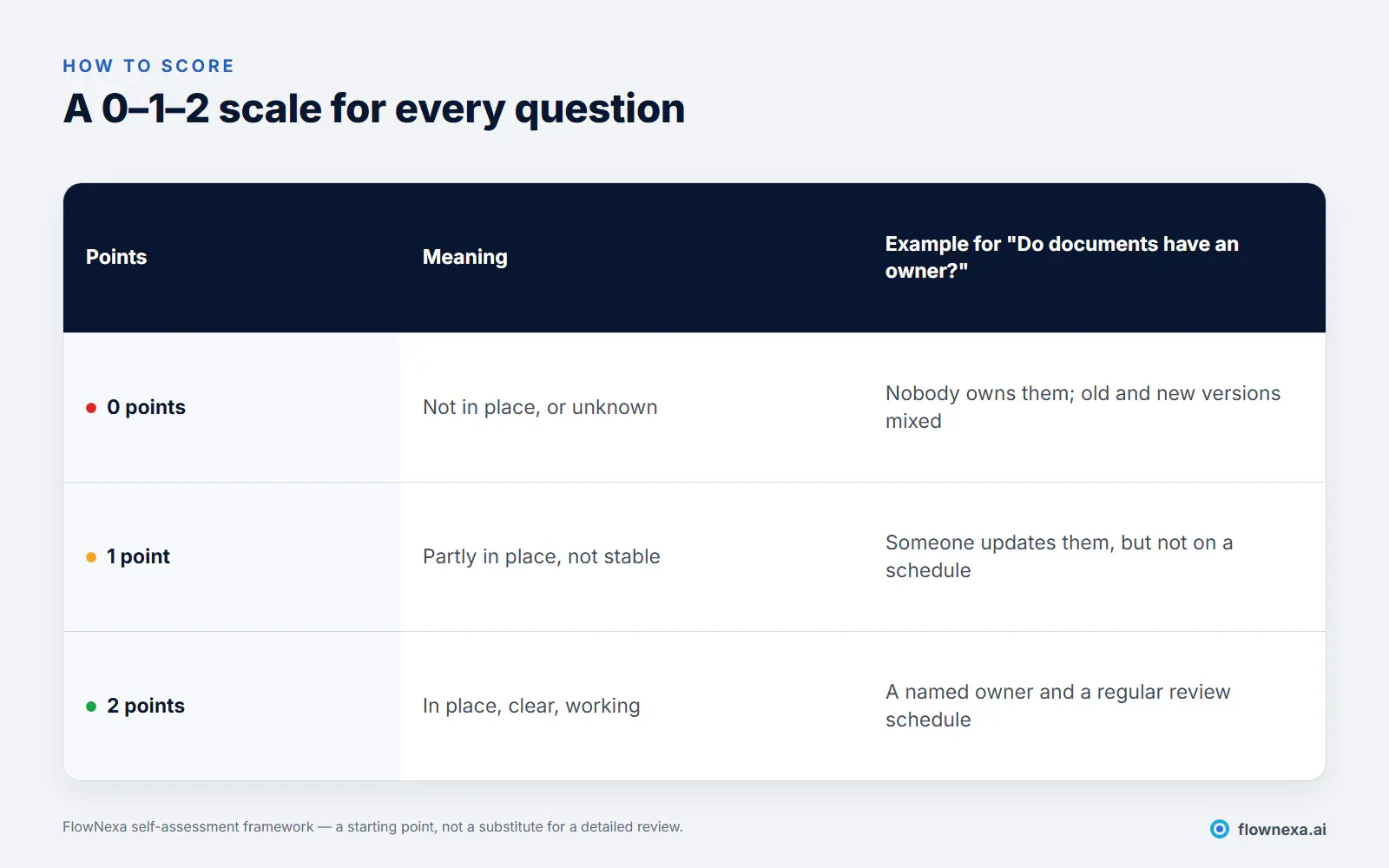
- Each question scores 0, 1, or 2: 0 means not in place or unknown; 1 means partly in place, not stable; 2 means in place, clear, and working.
- Score one specific scope. If the business has several departments, score the one where AI will be applied first (for example customer service).
- Note brief evidence for every 2, such as "price list updated on the 1st of each month, owned by Lan". Evidence keeps scores honest.
Area 1
Goals and processes
- Have you chosen one concrete problem for AI (for example "answer price and delivery-fee questions on the website"), rather than a general goal of "using AI"?
- Is the current process written down as steps, including common exceptions?
- Do you have baseline figures, such as requests per week, handling time, and error rate?
- Have you agreed success metrics and stop criteria for the first AI project?
A low score here means the project is likely to drag on because nobody knows what "success" looks like. See how to choose a process in where to start automating manual processes.
Area 2
Data and documents
- Is the information the AI needs written down (FAQs, policies, price lists, product specifications), not just in people's heads?
- Are documents current and consistent, with no parallel versions of the price list?
- Does each document group have an owner and a review schedule?
- Have you decided which data must not go into AI, such as payroll, HR records, or sensitive personal data?
A low score here is the most common reason AI gives wrong answers. See standardising your knowledge base before RAG.
Area 3
Systems and integration
- Does operational data live in software (sales, CRM, accounting, PMS) rather than scattered spreadsheets?
- Does that software offer APIs or webhooks that your current plan is allowed to use?
- Do you know who administers each system and who can grant access to external applications?
- Are your customer channels clear (website, Zalo OA, Messenger) and owned by the business?
A low score here does not stop you starting with a chatbot that answers from documents, but it blocks stock lookups, order creation, and automated reports.
Area 4
People and operations
- Is one person accountable for the first AI project, with real time to do it?
- Have affected staff been told what the AI will and will not do?
- Is there a handoff process for when the AI is unsure or a customer asks for a person?
- Does someone regularly review the questions the AI could not answer, to fill content gaps?
A low score here means even a good tool gets abandoned after a few weeks, because nobody operates it.
Area 5
Security and governance
- Have data access permissions been reviewed: who can see which documents, which sharing links are still open?
- Are there rules for staff using AI tools with company data? See governing shadow AI without banning it.
- Is there a way to obtain consent and handle personal data when AI collects customer details? See 8 principles for chatbots collecting customer data.
- Do risky actions (payments, deleting data, sending things externally) require human approval?
A low score here need not slow a first project if the AI only answers questions, but it is a prerequisite before letting AI act; see guardrails before AI agents run in production.
Reading the result
What does the total say about your next step?
| Total | Level | What to do next |
|---|---|---|
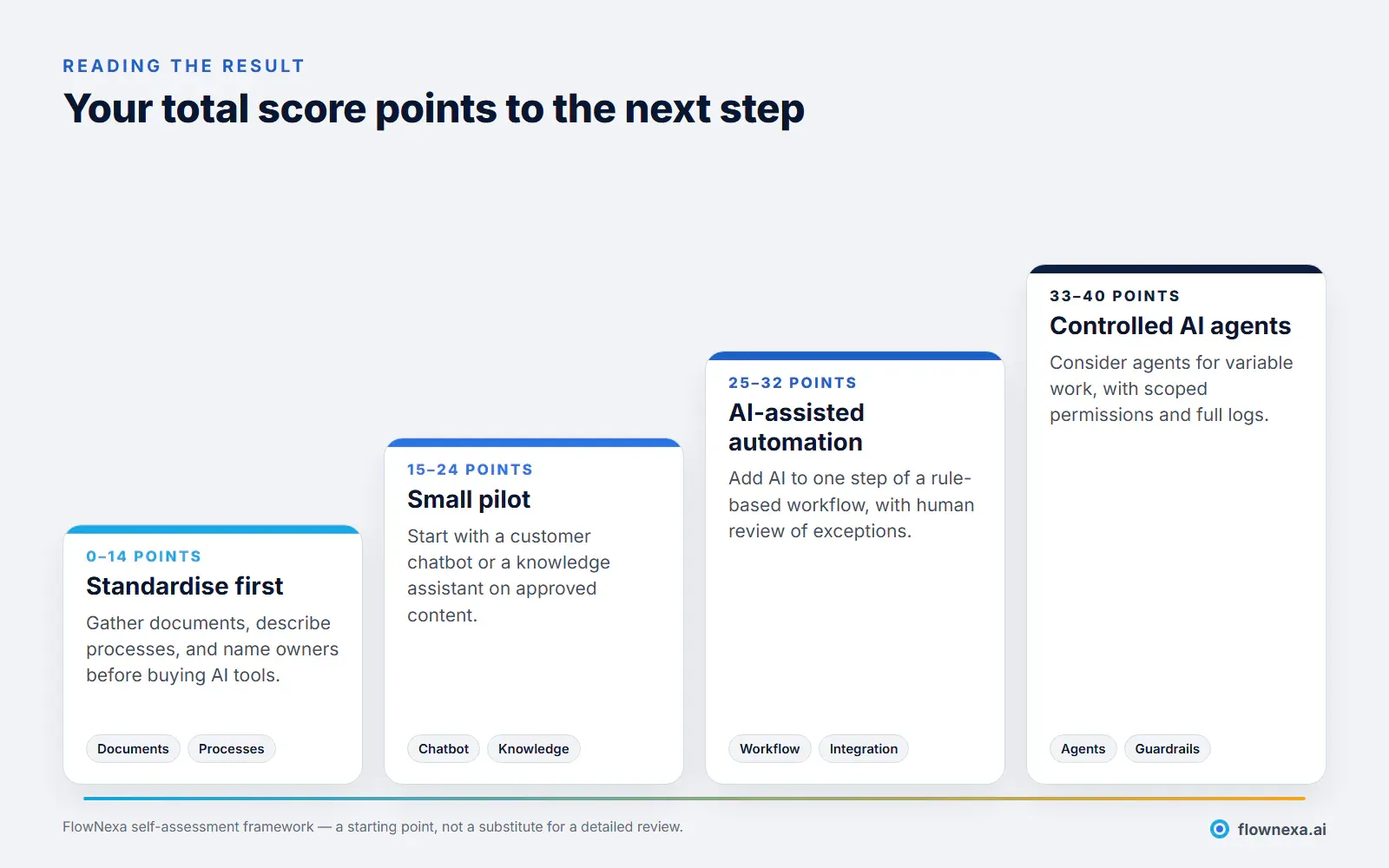
| 0–14 | Standardise first | Choose one problem, gather and approve documents, name an owner. Do not buy AI tools yet. |
| 15–24 | Small pilot | A customer chatbot or internal knowledge assistant on approved content, run for 30–60 days with metrics. |
| 25–32 | AI-assisted automation | Add AI to one step of a rule-based workflow (email classification, invoice extraction), with human review of exceptions. |
| 33–40 | Controlled AI agents | Consider agents for variable work, with least-privilege access, approval steps, and full logs. |
These four levels match the roadmap in AI for SMEs in 2026: a four-level roadmap.
The total is not enough; look at the lowest area. A business scoring 28 overall but only 2 of 8 on security and governance should not let AI act on its own, even though the total falls in "AI-assisted automation". A simple rule: no area below 4 of 8 before moving up a level.
Example
Example: how might a retail shop score itself?
A 15-person furniture shop (an illustrative example) scores itself like this:
| Area | Score | Notes |
|---|---|---|
| Goals and processes | 5/8 | Wants to answer after-hours price questions; no baseline yet |
| Data and documents | 3/8 | Has a price list, but the delivery policy lives in chat messages |
| Systems and integration | 4/8 | Uses sales software; unsure whether the plan includes an API |
| People and operations | 5/8 | The owner is accountable; no handoff process yet |
| Security and governance | 3/8 | No consent wording for collecting phone numbers |
| Total | 20/40 | Small pilot |
Conclusion: the shop is ready for a chatbot that answers questions on its website, provided that in the first two weeks it writes the delivery policy down, agrees consent wording, and sets up a handoff to staff. Stock lookups should wait until the API is confirmed with the software vendor.
Pitfalls
Common mistakes in self-assessment
- Scoring wishes: "we have documents" when there are three different versions of the price list.
- Scoring the whole company: the sales team and the accounting team can be at very different levels.
- Skipping the people area: a good tool that nobody owns produces no results.
- Skipping levels: wanting AI agents before a simple chatbot runs well.
If you want an outside check, take your scorecard to a vendor consultation and ask them the 12 questions before choosing a provider.
After scoring
What should you do in the 30 days after scoring?
A score is only useful if it changes what you do next. A simple 30-day plan after the assessment:
- Week 1: pick one process. Choose the process with the clearest goal and the most repeat work, not the most impressive one. Name one owner.
- Week 2: fix the lowest area for that process. If documents scored lowest, consolidate the price list and policies into one approved version. If people scored lowest, agree who reviews answers and how often.
- Week 3: define success. Write down two or three measures you can check without new tools, such as the share of repeat questions answered without staff or the time to first reply.
- Week 4: re-score the same process. If the total has moved up a level, you are ready to scope a pilot. If not, repeat the cycle for the next weakest area.
Re-score every quarter, per department. Readiness changes as staff, tools, and documents change, and an honest second score is often more useful than the first.
Q&A
Frequently asked questions
How often should we reassess?
After each AI project, or roughly every 6 months. Scores change when documents are standardised, new systems arrive, or the responsible people change.
Does a low score mean we should not use AI?
Not exactly. It means starting at the right level and standardising in parallel. At 0–14 points, the most valuable work is usually gathering and approving documents, which also helps onboard new staff.
Who should take part in scoring?
At least two people: someone who knows the business process and someone who knows the IT systems. Scoring separately and comparing reveals where they see things differently.
Do we need to answer all 20 questions?
You should, because the lowest-scoring area is often the one that gets skipped. If a question does not apply, for example you have no Zalo OA, score it for the channels you actually use.
Does a high score guarantee success?
No. A high score reduces the most common risks, but the project still needs a measured pilot, stop criteria, and someone operating it after go-live.
Can we use this for an internal AI assistant?
Yes. For an internal knowledge assistant, the data and documents area and the security and governance area (document permissions) usually matter most.
Sources
- AI for SMEs in 2026: a four-level roadmap, FlowNexa
- NIST AI Risk Management Framework, a reference for the security and governance area
- A framework FlowNexa built from initial-review experience; the example is illustrative, not a specific customer
FlowNexa
Review your self-assessment with FlowNexa
Send your scorecard; FlowNexa helps pinpoint the bottleneck and proposes a first step that matches your current readiness.
From choosing a process to a measured pilot.
Document standardisation and Q&A with citations.
Talk through your self-assessment results.
