


Vietnam’s AI Law: What Businesses Using Chatbots Must Do
A summary of Vietnam’s AI Law 134/2025/QH15 and Decree 142/2026/ND-CP for businesses with chatbots: roles, risk classification, transparency, labelling, paperwork, and the 1 March 2027 deadline.
Short answer: Vietnam’s Law on Artificial Intelligence No. 134/2025/QH15 took effect on 1 March 2026, and its implementing Decree 142/2026/ND-CP on 1 May 2026. For a business running a customer-facing chatbot, three things matter most: customers must be able to tell they are talking to an AI; the system must be risk-classified (chatbots that talk to the public usually need to be assessed as medium risk); and AI content published externally that could mislead must be disclosed or labelled. Chatbots already live before 1 March 2026 have until 1 March 2027 to comply (health, education, and finance: 1 September 2027).
This article summarises the provisions that apply directly to chatbots and AI assistants in small and mid-sized businesses, citing article numbers so you can check the original text. It is a reference compiled by the FlowNexa engineering team from the law and decree as of November 2026, not legal advice. The law is in Vietnamese; English terms below are our translations.
How to read this article: duties are stated with article numbers so you can check the original text; wherever we write "usually", "may", or "should", that is FlowNexa’s view of how the text applies to chatbots, not a legal conclusion. If you are unsure about classification, the law lets a provider ask the Ministry of Science and Technology for guidance based on its technical file (Article 10, clause 4), and small and mid-sized businesses receive free template files, self-assessment tools, training, and advice (Article 25, clause 1). If you spot an inaccuracy, tell us under our editorial policy.
Scope
Who does the law apply to: are you a provider or a deployer?
Article 3 defines four roles. Getting your role right comes first, because the duties differ by role:
| Role | Short definition (Article 3) | Chatbot example |
|---|---|---|
| Developer | Designs, builds, trains, tests, or fine-tunes an AI model, algorithm, or system and directly controls training data or parameters | The company that makes the language model |
| Provider | Places an AI system on the market or into use under its own name or brand, whether it built the system or a third party did | A chatbot service vendor; possibly also a business that runs a chatbot under its own brand |
| Deployer | Uses an AI system under its control in professional, commercial, or service activities | A business putting a chatbot on its website or Zalo OA to answer customers |
| User | Interacts directly with the AI system or uses its output | A customer messaging the chatbot |
Note that "provider" is defined by brand, not by who wrote the code. A business that puts another company’s chatbot on its website, names it "ABC Assistant", and presents it as its own service may be both a deployer and a provider. Because classification and notification duties sit with the provider, both parties should agree in writing who does what.
Personal, non-commercial use is outside the deployer definition (Article 3, clause 5).
Classification
Which risk level does your chatbot fall into?
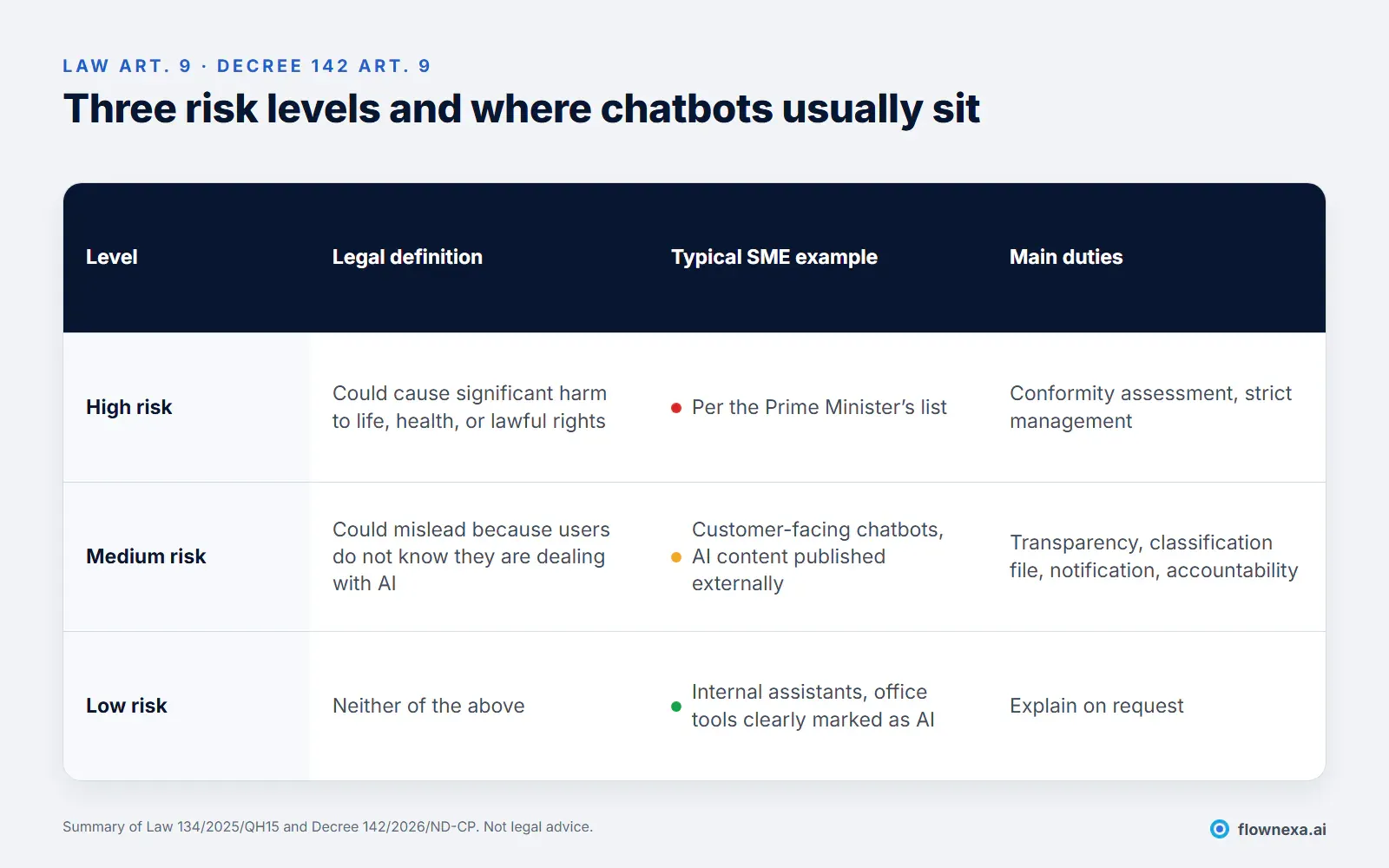
Article 9 of the law sets three levels:
- High risk: could cause significant harm to life, health, lawful rights and interests, national or public interests, or national security. Under Decree 142, high-risk systems are those on a list issued by the Prime Minister.
- Medium risk: could mislead, influence, or manipulate users because they cannot tell they are interacting with an AI or with AI-generated content.
- Low risk: neither of the above.
Article 9 of Decree 142 adds detail: a provider classifies a system as medium risk when it is not on the high-risk list and it could mislead in that way. The decree also lists cases that are not classified as medium risk, which matter for businesses:
- tools that only make technical edits and create no new content;
- office tools whose AI nature is clear to users from the context;
- systems that do not interact with, or provide services or content directly to, the public;
- systems that only process or analyse data or optimise operations without interacting directly with users.
In practice, an internal AI assistant that helps staff look up procedures usually falls under those exceptions. A chatbot answering customers on a website, Zalo OA, or Messenger interacts directly with the public, so it needs careful assessment as medium risk. The final answer depends on the design and on technical guidance from the Ministry of Science and Technology; do not conclude "my chatbot is low risk" just because its questions are simple.
Under Article 10, clause 2, a deployer may rely on the provider’s classification, but if it modifies, integrates, or changes functions in a way that creates new or higher risk (for example letting the chatbot create orders or issue refunds), it must work with the provider to reclassify.
Transparency
Transparency duties: four things chatbots and AI content must meet
Article 11 of the law and Articles 16–18 of Decree 142 are the parts that most directly shape the customer experience:
- Users must be able to tell they are interacting with an AI. The provider ensures that AI systems interacting directly with people are designed and operated so users recognise this (Article 11, clause 1). For a chatbot, the simplest way is to say so in the greeting and show an "AI assistant" label next to its name.
- AI-generated audio, images, and video must carry a machine-readable mark (Article 11, clause 2). Article 17 of Decree 142 allows marks in metadata, file structure, or digital signatures, and states that machine-readable marking is not required for text output unless another law says otherwise.
- Deployers must clearly disclose AI content they publish if it could mislead about the authenticity of events, people, or the origin of the content (Article 11, clause 3; Decree Article 18, clause 1).
- Audio, images, or video that imitate a real person’s appearance or voice, or re-create real events, must carry an easily recognisable label (Article 11, clause 4; Decree Article 18, clause 2).
The decree requires disclosures and labels to be clear, easy to understand, shown before or when the audience reaches the content, and never designed to hide the content’s nature. Deployers choose the form: on the content itself, in the title or caption, in the platform interface, or as an audio notice (Article 18, clauses 3 and 5).
Decree Article 18, clause 4 exempts from visible labelling: technical quality improvements that do not change the substance; text that has been spell-checked, grammar-checked, summarised, paraphrased, or translated without distorting the original; content used only internally; and research or test content that is not published.
A suggested chatbot greeting:
Hello, I am [Business name]’s AI assistant. I answer from information the company has provided and I can make mistakes. When needed, I will connect you to a member of staff. How can I help?
This covers "recognising it is an AI", sets the right expectations, and opens the way to a human. For a voice agent, read the notice at the start of the call; see deploying an after-hours AI voice agent safely.
Paperwork
What procedures come with medium risk?
Under Article 15 of the law, medium-risk systems are managed as follows: providers and deployers ensure transparency under Article 11; the provider explains the purpose, functional operating principles, main input data, and risk controls when a state authority asks; the deployer explains its operation, risk control, incident handling, and protection of users’ rights when asked. Explanations do not require disclosing source code, detailed algorithms, or trade secrets.
Decree 142 sets out the procedures:
- Risk classification file (Article 12): prepared by the provider before the system goes into use, with system identification, a description and context of use, a general description of the main input data, and a summary of risk controls. If the system is built on a third-party model, the provider supplies information only within what it can access. Both the provider and the deployer must keep the file for as long as the system operates.
- Reusing the personal data file (Article 12, clause 7): if the system processes personal data, the personal data processing impact assessment may replace or be merged into the classification file. If you followed our guide to chatbot customer data under Law 91/2025, most of the information already exists.
- Notifying the classification (Article 14): providers of medium- and high-risk systems notify the Ministry of Science and Technology through the national one-stop AI portal before going live, self-declaring and taking responsibility for the content; the portal issues a system identifier. Until the portal is officially live, the procedure follows the method the Ministry announces (Article 46).
- Systems built on third-party models (Article 16, clause 6): the provider must agree with the model supplier on access to the technical information needed for transparency and accountability.
Article 12 of the law also requires deployers to record and promptly report serious incidents and cooperate on fixes. For a chatbot, that means conversation logs, an error-reporting process, and a named owner, as our 30-day chatbot operations checklist recommends.
Deadlines
Key dates and the transition period
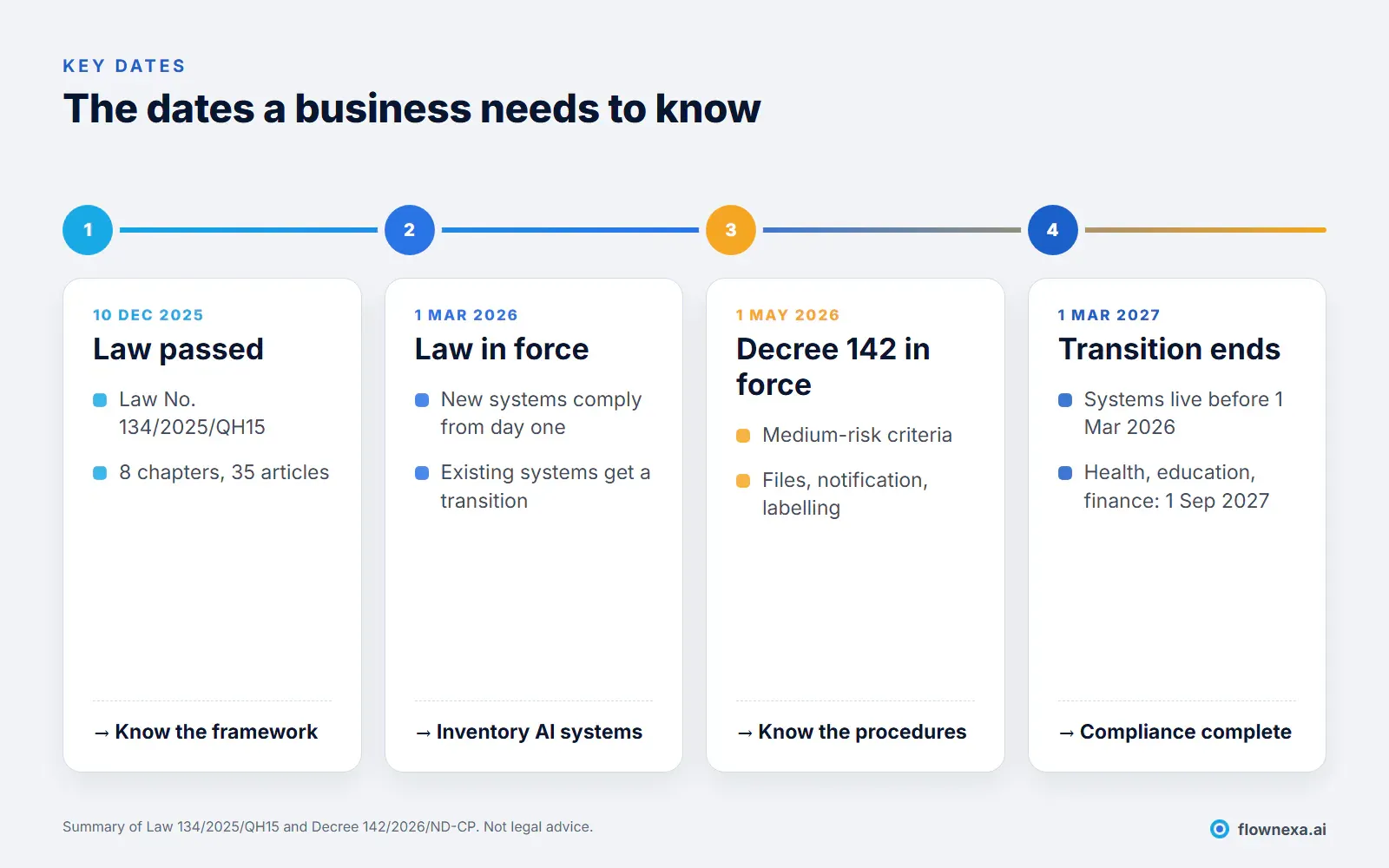
Articles 34 and 35 of the law provide:
- The law took effect on 1 March 2026. AI systems put into use from that date must comply immediately.
- Systems already operating before 1 March 2026 may keep running and have time to meet their obligations: 18 months (to 1 September 2027) in health, education, and finance; 12 months (to 1 March 2027) in all other sectors.
- During the transition, the authority can still order a suspension if a system risks serious harm.
Decree 142/2026/ND-CP was issued on 30 April 2026 and took effect on 1 May 2026. If your chatbot has been running since 2025, you have about three months from the date of this article to finish.
On enforcement, Article 29 of the law provides for administrative penalties or criminal liability depending on severity, compensation for damage, and leaves detailed administrative penalties to a government regulation. Watch for that penalty regulation rather than assuming "no fines yet, so no action yet". Article 7 also prohibits concealing information that must be disclosed, or removing or distorting mandatory labels and warnings.
Actions
Eight things a business using a chatbot should do now
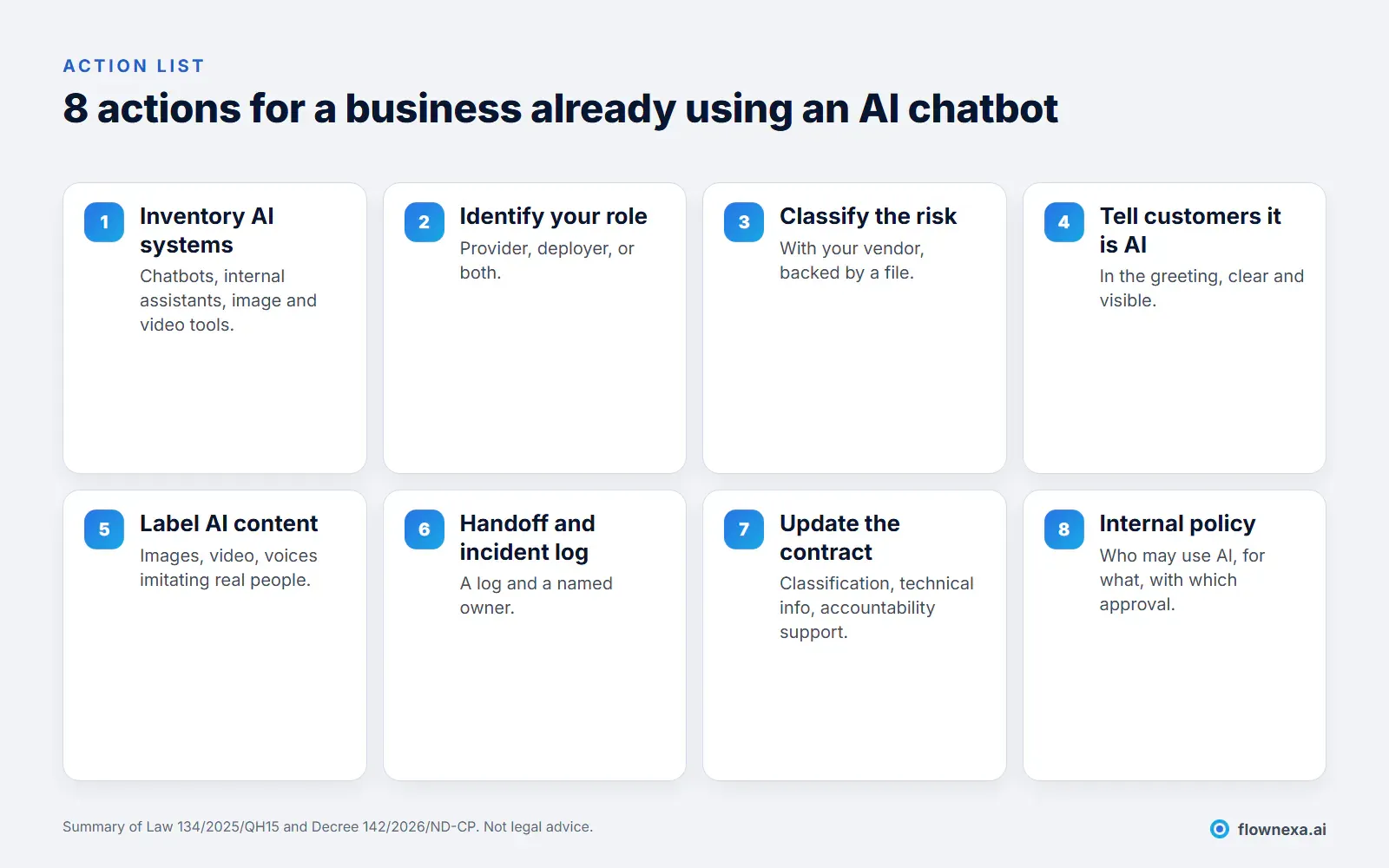
- Inventory your AI systems. List customer-facing chatbots, internal assistants, and image, video, or voice tools used in marketing. Record when each went live (to know whether the transition applies). Tools staff adopt on their own count too; see governing shadow AI without banning it.
- Identify your role for each system: provider, deployer, or both, using the Article 3 definitions.
- Classify the risk with your vendor and request a copy of the classification file to keep (Decree Article 12, clause 6).
- Tell customers they are talking to an AI in the greeting and the interface, on every channel (website, Zalo OA, Messenger, phone).
- Label AI content you publish: AI product images that could pass as real photos, videos with virtual presenters, voices imitating real people.
- Handoff and an incident log. Define clear triggers for passing to staff (see designing a handoff that never makes customers repeat) and keep an error log: wrong prices, wrong policies, disclosed information. Controlling wrong prices and policies is the place to start.
- Update the vendor contract: who classifies and notifies, who keeps the file, a commitment to supply technical information when an authority asks for an explanation, and how incidents are handled together.
- Issue an internal policy: who may use AI to create published content, what must be labelled, and who approves it.
When evaluating a chatbot provider, add "Have you classified this system under Law 134/2025/QH15, and how will you support us if we must explain it?" to the 12 questions before choosing an AI chatbot provider.
Q&A
Frequently asked questions
Does a chatbot that only answers FAQs fall under the AI Law?
If it uses AI to understand questions and generate answers, it is an AI system under Article 3, clause 2. A fixed-script chatbot with no inference or adaptation may fall outside that definition; check the actual technology with your vendor.
Are small businesses exempt?
The law has no size exemption. Duties depend on your role and the system’s risk level. Article 25 gives small and mid-sized businesses specific support: help with conformity assessment costs and free template files, self-assessment tools, training, and advice. That is support, not a waiver of transparency duties.
Does an internal staff assistant need to be notified to the Ministry of Science and Technology?
An internal assistant that does not provide services or content to the public usually falls under the case not classified as medium risk (Decree 142, Article 9, clause 3, point c), so the medium-risk notification procedure does not arise. The business must still explain it on request if there are signs of a violation.
Do articles or emails written with AI need a label?
Text that AI helped spell-check, summarise, paraphrase, or translate without distorting the original is exempt from visible labelling (Decree 142, Article 18, clause 4). The disclosure duty arises when AI-generated content could mislead about the authenticity of events, people, or origin. FlowNexa states its use of AI-assisted drafting in its editorial policy as a voluntary transparency measure.
Does the 1 March 2027 deadline apply to a chatbot launched in 2026?
No. The Article 35 transition covers only systems operating before 1 March 2026. A chatbot put into use from 1 March 2026 must comply from the start.
What if our chatbot vendor is based abroad?
The law applies to Vietnamese and foreign organisations and individuals engaged in AI activities in Vietnam (Article 2). If you run the chatbot under your own brand, you may count as the provider in Vietnam; agree responsibilities with your vendor, write them into the contract, and ask the Ministry of Science and Technology for guidance if unsure.
Sources
- Law on Artificial Intelligence No. 134/2025/QH15 (Vietnamese), passed by the National Assembly on 10 December 2025, in force 1 March 2026 (original text: Articles 2, 3, 7, 9, 10, 11, 12, 15, 25, 29, 34, 35)
- Decree 142/2026/ND-CP (Vietnamese), detailing and guiding the AI Law, issued 30 April 2026, in force 1 May 2026 (Articles 9, 12, 14, 16, 17, 18, 46)
- Related: chatbot customer data collection and personal data protection
- Checked at the time of writing (24 November 2026). The texts may be amended; check that they are current before relying on them.
FlowNexa
Review your chatbot before 1 March 2027
FlowNexa works with you to inventory AI systems, identify roles, prepare a transparent greeting, set up an incident log, and gather technical information for the classification file. This article is a reference and does not replace legal advice.
An AI chatbot for websites, Zalo OA, and Messenger, with staff handoff.
Roles, subprocessors, and how FlowNexa processes data.
Talk through your current chatbot.
